
In short
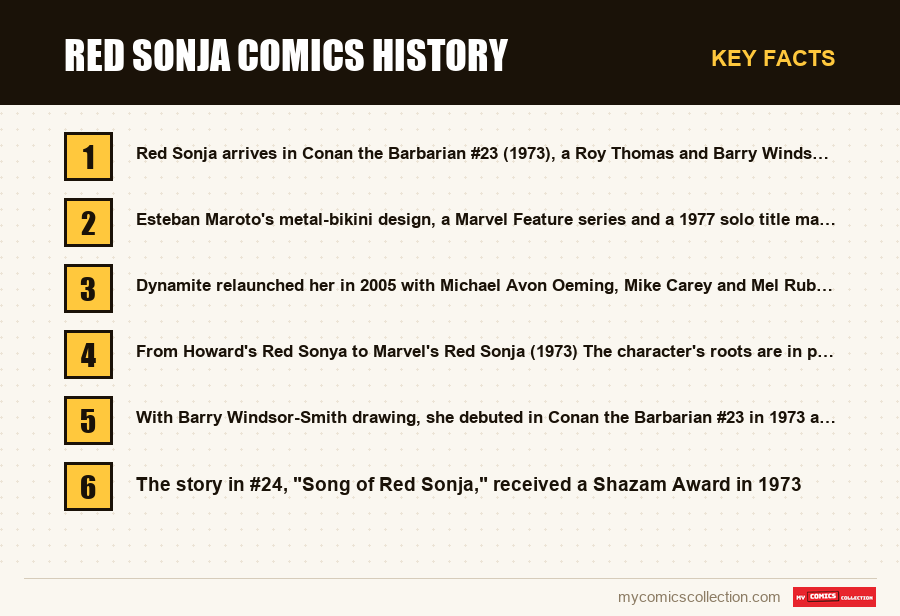
Red Sonja arrives in Conan the Barbarian #23 (1973), a Roy Thomas and Barry Windsor-Smith creation drawn from Howard's Red Sonya of Rogatino, a mercenary of the 1500s. Esteban Maroto's metal-bikini design, a Marvel Feature series and a 1977 solo title made her a headliner; Dynamite relaunched her in 2005 with Michael Avon Oeming, Mike Carey and Mel Rubi, and Gail Simone's 2013 series reset her origin. Marvel's run and Dynamite's volumes are separate sequences.
Few comics characters have been rebuilt as often as Red Sonja. She began as a supporting figure in a Conan story, became the lead of Marvel books through the 1970s and 1980s, spent years in the hands of small publishers, and then returned as the anchor of a Dynamite line that has restarted its numbering again and again.
Every credit, volume number and run length here was checked before writing; the remarks on how each era differs from the next are interpretation. Months are given only where they could be confirmed, and otherwise the year stands alone.
From Howard's Red Sonya to Marvel's Red Sonja (1973)
The character's roots are in prose. Howard's "The Shadow of the Vulture" features Red Sonya of Rogatino, a swashbuckler placed in the 16th century. Roy Thomas, who was writing Conan the Barbarian for Marvel, moved that figure into the Hyborian Age and respelled the name. With Barry Windsor-Smith drawing, she debuted in Conan the Barbarian #23 in 1973 and returned in #24. The story in #24, "Song of Red Sonja," received a Shazam Award in 1973.
That origin has a consequence for collectors: Red Sonja is a Howard-derived adaptation rather than a Howard creation, and the version Marvel published in 1973 is the one most later series descend from. Windsor-Smith's original costume for her was a long-sleeved mail shirt with red silk shorts, a design very different from the one that later defined her.
The two Conan issues are therefore a shared key point for Conan and Red Sonja collectors. A reader who wants her debut needs a copy of the Conan series, not of any Red Sonja title, because she had no book of her own for another couple of years.
The metal bikini: Esteban Maroto changes the look
The costume that became shorthand for the character did not come from Marvel's staff. Esteban Maroto submitted an uncommissioned silver "metal bikini" design to Thomas. It was first printed in black and white in Comixscene #5, Maroto then drew her in it for Savage Tales #3 and The Savage Sword of Conan #1, and it became Sonja's standard look. John Buscema and Dick Giordano also drew her in it, which helped the design settle into a house style.
This is a useful detail for dating pages. If a Marvel-era image shows the mail shirt and shorts, it belongs to the Windsor-Smith moment around #23 and #24; if it shows the metal bikini, it was drawn after Maroto's design circulated. The costume question is also the main thread in the character's critical reception, one that every later creative team has had to answer one way or another.
Marvel Feature and the origin story (1975)
Red Sonja received a headline slot in Marvel Feature volume 2, a seven-issue series (#1 to #7) written by Thomas and Bruce Jones. Dick Giordano drew #1, dated November 1975, and Frank Thorne took over from #2, dated January 1976. Thorne's pencils became the look many readers associate with the early solo years.
Her origin came from a different book. Kull and the Barbarians #3 (1975) ran "The Day of the Sword," written by Thomas and Doug Moench with art by Howard Chaykin, which told how she acquired her skills and introduced the Red Goddess. The story was redrawn by Giordano and Terry Austin in The Savage Sword of Conan #78 (July 1982), so two versions of the same origin exist in print. Distinguishing them is a collecting detail: the artwork differs, and the later version sits in a magazine, not a color comic.
Her own series and the 1978 and 1979 appearances
Red Sonja volume 1 ran 15 issues from 1977, written by Clair Noto and Thomas. Thorne drew #1 to #11, with John and Sal Buscema on the later issues. It gave the character a title of her own.
Two other appearances from the same years extend the picture. A Marvel Super Special #9 (1978) was written by Thomas and Christy Marx with art by Howard Chaykin, and featured the Red Goddess a second time. Then, in Marvel Team-Up #79, titled "Sword of the She-Devil" and dated 1979, Chris Claremont wrote and John Byrne drew a story in which Mary Jane Watson finds Sonja's sword and becomes her reincarnation. The story brings the character into the Marvel superhero universe and ties her to the Spider-Man family of books.
Marvel's later series and the film years (1983 to 1995)
The 1980s brought two more attempts. Red Sonja volume 2 (1983) ran only two issues, written by Christy Marx and Thomas with art by Tony DeZúñiga and Ernie Colón. A volume 3, also dated 1983, ran 13 issues and drew writers Tom DeFalco, Bill Mantlo and Louise Simonson, with artists including Mary Wilshire, Pat Broderick and Rudy Nebres. The volume numbering is a trap: Marvel's "volume 2" and "volume 3" came out in the same year, so the numbers are not a sequence of seasons.
The 1985 film Red Sonja, starring Brigitte Nielsen, brought a two-issue comic adaptation, Red Sonja: The Movie, written by Louise Simonson and Mary Wilshire. In 1987, Fred Blosser, with input from Thomas, organized the Marvel material into a unified chronology. A one-shot, Red Sonja: Scavenger Hunt by Glenn Herdling and Ken Lashley, appeared in 1995. For readers, the stretch is a reminder that licensed adaptations sit beside the main run and are easy to miss.
Do you collect this series?
Track what you own, what you are missing and what your collection is worth. 7-day trial.
Start my trial →
The years outside Marvel and Dynamite's 2005 relaunch
Between the Marvel books and Dynamite's arrival, the character moved through small publishers. Red Sonja 3-D came from Blackthorne in 1998, and Red Sonja: Death in Scarlet from Cross Plains in 1999, written by Thomas with art by Steve Lightle. These are short entries, but they fill the gap between the two eras.
In 2005 Dynamite launched Red Sonja: She-Devil with a Sword, a series that ran from #0 to #80. The #0 script came from Michael Avon Oeming and Mike Carey, and Mel Rubi drew it. The original Sonja dies in #34, and a reincarnation takes over from #35 through the finale at #80. A reader who stops at #34 reads one character's story; a reader who continues reads her successor's. Around it Dynamite built a family of titles: Red Sonja/Claw (2006) by John Layman and Andy Smith, and Spider-Man/Red Sonja (2007), a five-issue series co-published with Dynamite, written by Oeming with art by Rubi. Queen Sonja (#1 to #35) began in 2009 under Joshua Ortega, Arvid Nelson and Luke Lieberman. The publisher's wider strategy is described in the Dynamite history.
Gail Simone and the volume-numbering era (2013 to 2022)
Dynamite's second Red Sonja volume launched in 2013, written by Gail Simone with art by Walter Geovani, running #0 to #18. Simone's series rebooted the character's beginnings, which is why it is a common starting point for readers who want a modern entry.
After it, Dynamite restarted the numbering repeatedly. Marguerite Bennett wrote volume 3 in 2016 (#1 to #6). Amy Chu wrote volume 4 with Carlos Gomez on art, running #0 to #25. Mark Russell wrote volume 5 from 2019 (#1 to #28), with Mirko Colak on art, and left after #24, when Luke Lieberman took over. A spin-off, Killing Red Sonja, followed in 2020. In 2021 Mirka Andolfo's volume 6 began, drawn by Giuseppe Cafaro, and ran #1 to #12. In 2022 Dan Abnett wrote Immortal Red Sonja.
Volume numbers and issue numbers move together in this period but are not the same thing. A listing for "Red Sonja #1" can mean any of several different series from different years, so the volume and the creative team have to be read alongside the number.
The 50th anniversary and the recent era (2023 onward)
In July 2023, for the character's 50th anniversary, Dynamite launched Red Sonja volume 7 by Torunn Grønbekk and Walter Geovani, running #1 to #18. Savage Red Sonja by Dan Panosian and Alessio Petillo followed that November. In 2024 came Red Sonja: Empire of the Damned by Steve Niles and Alessandro Amoruso, and Red Sonja: Death and the Devil. In 2025, Christopher Priest wrote Sonja Reborn, and a new Red Sonja film directed by M.J. Bassett reached the US and UK.
Set against 1973, the recent era shows how far the character has traveled. She has a long list of limited series and one-shots, a film release, and a publisher whose catalog leans on her. For a collector, that breadth is a reason to pick a lane: the original Marvel material, the Dynamite continuity, or a favorite creative team.
The key issues across Red Sonja's history
- Conan the Barbarian #23 (1973): Thomas and Windsor-Smith introduce Red Sonja.
- Conan the Barbarian #24 (1973): the follow-up story "Song of Red Sonja," which won a Shazam Award.
- Marvel Feature #1 (1975): the headline series, with Giordano art and Thomas and Bruce Jones writing.
- Kull and the Barbarians #3 (1975): her origin and the Red Goddess, art by Howard Chaykin.
- Red Sonja #1 (Marvel, 1977): her own series, with Frank Thorne art.
- Marvel Team-Up #79 (1979): Mary Jane Watson becomes her reincarnation.
- Red Sonja #0 (Dynamite, 2005): Oeming, Carey and Rubi relaunch the character.
- Red Sonja volume 2 #0 (Dynamite, 2013): Gail Simone and Walter Geovani reset the origin.
How to follow Red Sonja in a collection
Start with the numbering map. The character appears in the Conan monthly (#23 and #24), in a short Marvel Feature run, and in several Marvel solo volumes, and then in Dynamite's volumes 1 to 7. Every volume restarts at #1 or #0, which means a copy is pinned down by volume, publisher and cover date together, never by the issue number alone.
Decide whether you want chronology or a single creative team. A chronological shelf runs from the Conan issues through Marvel Feature and the 1977 series to Dynamite's 2005 launch. A team shelf follows names: Frank Thorne for the early solo years, Michael Avon Oeming and Mel Rubi for the 2005 launch, Gail Simone for 2013. Many early Marvel stories are also in reprint collections, so check before hunting a single issue.
Finally, watch for the film-related and crossover books, such as the 1985 adaptation and Spider-Man/Red Sonja. They are easy to miss and are numbered separately from the main series.

Frequently asked questions
Look in Conan the Barbarian #23 (1973), where Roy Thomas and Barry Windsor-Smith introduce her; she comes back in #24. She is adapted from Howard's Red Sonya of Rogatino, whom Thomas moved into the Hyborian Age. Her own series came later, so the Conan issues are the place to look.
Esteban Maroto submitted an uncommissioned silver metal bikini design to Roy Thomas. It first appeared in Comixscene #5, and Maroto then drew her in it for The Savage Sword of Conan #1, so it became her standard look. Barry Windsor-Smith's original costume was a long-sleeved mail shirt with red silk shorts.
The 2005 launch, Red Sonja: She-Devil with a Sword, opens with a #0 whose script is credited to Oeming and Carey and whose art is by Rubi. That series ran to #80. The original Sonja dies in #34, and a reincarnation carries the book from #35.
Gail Simone wrote Dynamite's second Red Sonja volume, launched in 2013 with art by Walter Geovani, running #0 to #18. Her series rebooted the character's beginnings, which is why many readers treat it as a modern starting point separate from the Marvel era and the 2005 continuity.
Marvel and Dynamite each restarted the numbering many times. Marvel published volume 1 in 1977, and volumes 2 and 3 in 1983. Dynamite has issued volumes since 2005, including volume 7 in 2023. To identify a copy, read the volume, the publisher, the creative team and the cover date together.
Own a Red Sonja key from the Conan issues, the Marvel Feature run or Dynamite's 2005 launch? Start with an estimate of that copy.
Estimate my comic