You don't need thousands of dollars to invest in comics. Some of the best-performing books of the past five years started under $100 and delivered returns that put the stock market to shame. This guide identifies 10 specific comics currently priced under $100 that combine strong fundamentals, upcoming media catalysts, and genuine long-term collector demand.
Disclaimer: This information is provided for informational purposes only. My Comics Collection is not an investment advisor. Values vary based on condition, rarity, and market trends.
The biggest barrier to comic investing isn't knowledge -- it's the assumption that you need deep pockets. While the headlines focus on million-dollar Action Comics and six-figure Spider-Man keys, the real action for most investors happens in the sub-$100 range. This is where you find asymmetric risk-reward opportunities: books where the downside is limited to your purchase price, but the upside -- driven by an MCU announcement, a viral social media moment, or a slow-burn collector consensus -- can be 3x, 5x, or even 10x your investment.
Every book on this list meets three criteria: it is currently available for under $100 in a respectable grade, it has a clear and specific catalyst for future price appreciation, and it has fundamental collector demand beyond short-term speculation.
1. Ultimate Fallout #4 (2011) -- 1st Miles Morales Spider-Man
Current price: $50-$90 (CGC 9.2-9.4) | Why it's undervalued:
Miles Morales is arguably the most important new Marvel character of the 21st century. The Spider-Verse animated films have turned him into a global icon, and his presence in video games (PlayStation's Marvel's Spider-Man series) reaches an audience that dwarfs traditional comics readership. At under $100 for a near-mint graded copy of his first appearance, this book offers extraordinary value relative to its cultural significance.
Catalyst: Continued Spider-Verse franchise development, potential MCU live-action debut, and ongoing PlayStation game releases featuring Miles as a lead character.
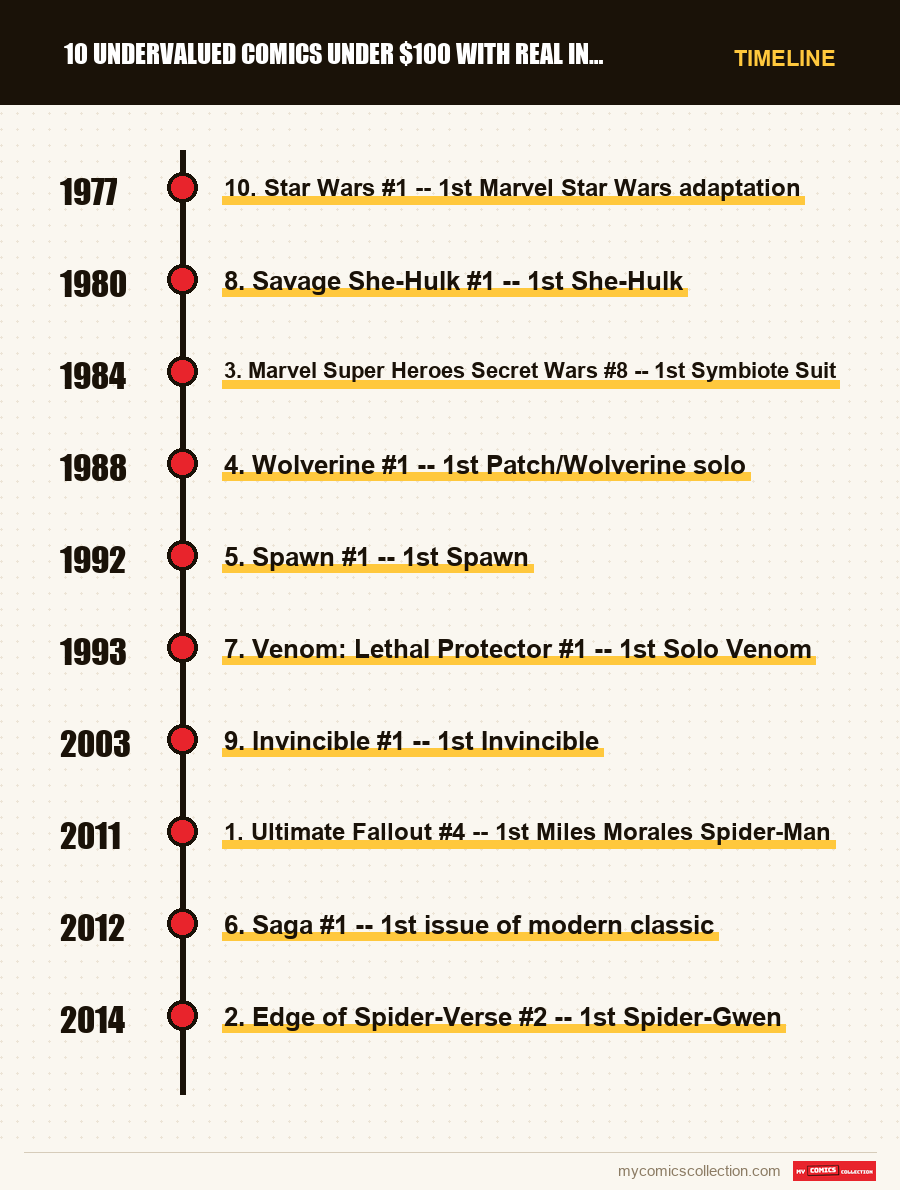
2. Edge of Spider-Verse #2 (2014) -- 1st Spider-Gwen
Current price: $40-$70 (CGC 9.6) | Why it's undervalued:
Spider-Gwen became a breakout star of the Spider-Verse franchise and maintains strong merchandise sales and cosplay popularity. A CGC 9.6 copy of her first appearance under $70 is remarkable for a character with her cultural footprint. The book's iconic Robbi Rodriguez cover is instantly recognizable.
Catalyst: Spider-Verse sequel potential, possible live-action MCU integration, and the character's strong resonance with younger demographics who are the collectors of tomorrow.
3. Marvel Super Heroes Secret Wars #8 (1984) -- 1st Symbiote Suit
Current price: $55-$95 (CGC 9.4) | Why it's undervalued:
This is where Spider-Man first bonds with the alien symbiote that eventually becomes Venom. It's a Bronze Age key from a major crossover event, and it bridges two of the most valuable comic franchises: Spider-Man and Venom. The book is 40+ years old, meaning supply is fixed and slowly declining.
Catalyst: Sony's continued Venom/symbiote franchise development and the inevitable MCU integration of the symbiote storyline.
4. Wolverine #1 (1988, ongoing series) -- 1st Patch/Wolverine solo
Current price: $40-$75 (CGC 9.6) | Why it's undervalued:
Wolverine's first ongoing solo series, launched at the peak of his popularity. The book features a classic Chris Claremont story with gorgeous John Buscema art. As Marvel Studios prepares Wolverine's MCU future, demand for all Wolverine key issues is increasing.
Catalyst: MCU Wolverine casting and solo film/series development. Every major Wolverine key benefits when the character makes headlines.
5. Spawn #1 (1992) -- 1st Spawn
Current price: $50-$90 (CGC 9.8) | Why it's undervalued:
Todd McFarlane's creation launched Image Comics and sold 1.7 million copies -- the best-selling independent comic of all time. Despite the high print run, CGC 9.8 copies are proportionally scarce (the black cover chips easily), and a new Spawn film has been in development for years. The book is also a piece of comic history as the flagship title of the Image Comics revolution.
Catalyst: Spawn film development, Todd McFarlane's ongoing media push, and the character's 30+ year legacy ensuring baseline collector demand.
6. Saga #1 (2012) -- 1st issue of modern classic
Current price: $40-$70 (CGC 9.6) | Why it's undervalued:
Brian K. Vaughan and Fiona Staples created what many consider the greatest comic series of the 2010s. Saga has a passionate, dedicated fanbase, critical acclaim, and inevitable adaptation potential. Unlike superhero keys, this book appeals to literary comic fans -- a growing demographic with purchasing power.
Catalyst: Film or streaming adaptation announcements, continued critical legacy, and crossover appeal to readers who don't typically collect superhero comics.
7. Venom: Lethal Protector #1 (1993) -- 1st Solo Venom
Current price: $40-$65 (CGC 9.6) | Why it's undervalued:
Venom's first solo title marked the character's transition from villain to anti-hero protagonist. The book directly inspired the tone and structure of Sony's Venom films. In CGC 9.6, it's a clean, attractive slab at a price that leaves significant room for appreciation.
Catalyst: Sony's ongoing Venom/symbiote franchise and potential MCU crossover events involving the symbiote.
8. Savage She-Hulk #1 (1980) -- 1st She-Hulk
Current price: $40-$75 (CGC 8.0-9.0) | Why it's undervalued:
She-Hulk's MCU debut has established the character in live-action, and her role in Marvel Comics remains prominent. This is a genuine Bronze Age first appearance of a major Marvel character, available for the price of a dinner out. That's historically anomalous -- most Bronze Age first appearances of characters with MCU presence trade at multiples of this price.
Catalyst: Continued MCU appearances, potential Avengers team integration, and growing recognition of She-Hulk as a top-tier Marvel character.
9. Invincible #1 (2003) -- 1st Invincible
Current price: $60-$95 (CGC 9.4-9.6) | Why it's undervalued:
The Invincible animated series on Amazon Prime was a massive hit, introducing Robert Kirkman's creation to millions of new fans. The show's second season continued the momentum, and a live-action film is in development. Kirkman's track record (The Walking Dead) proves that his properties have long-term media legs.
Catalyst: Season 3 of the animated series, live-action film development, and the proven "Kirkman effect" that keeps his properties culturally relevant for decades.
10. Star Wars #1 (1977, Marvel) -- 1st Marvel Star Wars adaptation
Current price: $50-$80 (CGC 7.0-8.0) | Why it's undervalued:
This crossover collectible appeals to both comic collectors and Star Wars fans -- two of the largest collector communities in the world. The 1977 original series holds nostalgic significance for Gen X collectors, and Disney's ongoing Star Wars content pipeline ensures continued mainstream interest. A high-grade copy of an almost 50-year-old comic for under $100 is a compelling proposition.
Catalyst: New Star Wars films and Disney+ content, upcoming 50th anniversary of the original series in 2027, and dual-fandom demand.
Why Sub-$100 Comics Are the Smart Money Play
The mathematics of sub-$100 investing are compelling when you think in terms of risk-reward asymmetry. Here's why small bets can yield outsized returns:
- Limited downside: The most you can lose on a $75 comic is $75. Even if the book drops 50%, you've lost $37.50 -- the cost of a nice lunch. Compare that to buying a $5,000 Silver Age key that drops 20% -- a $1,000 loss that stings.
- Unlimited upside: A $50 book that catches a media announcement can jump to $200-500+ in days. That's a 4-10x return on a tiny initial investment.
- Multiple shots on goal: With $500, you can buy 7-10 different sub-$100 books. You only need one or two to hit for the portfolio to be profitable overall. With the same $500 in one mid-range book, you have exactly one chance.
- Learning without bleeding: Mistakes at this price point are affordable. Learning which books hold value and which don't is much cheaper with $50-$100 positions than with $500-$1,000 ones.
Building a Sub-$100 Portfolio
The beauty of sub-$100 investing is accessibility. You don't need to be wealthy to start building a comic investment portfolio that could produce meaningful returns over a 3-5 year horizon.
With $500-$1,000, you can acquire 7-10 of these books and build a diversified micro-portfolio spanning different publishers (Marvel, DC, Image), eras (Bronze, Modern), and catalysts (MCU, Sony, streaming). Track your purchases and current values with a collection tracker to monitor performance over time.
Sample $500 portfolio allocation
Here's how you might allocate $500 across five picks for balanced exposure:
- $90 -- Ultimate Fallout #4 (CGC 9.2) -- Miles Morales growth play
- $85 -- Marvel Super Heroes Secret Wars #8 (CGC 9.4) -- Bronze Age symbiote key
- $90 -- Spawn #1 (CGC 9.8) -- Independent publisher, film catalyst
- $95 -- Invincible #1 (CGC 9.4) -- Streaming success, live-action film potential
- $70 -- Savage She-Hulk #1 (CGC 9.0) -- Undervalued Bronze Age, MCU character
- Remaining $70 -- Hold as cash for dip-buying opportunities when one of your watchlist books drops below target price
Portfolio construction tips
- Buy the best grade you can afford -- A CGC 9.8 of a modern key is almost always a better investment than a CGC 9.4 of the same book.
- Diversify catalysts -- Don't put all your money on MCU speculation. Mix in books with multiple demand drivers.
- Be patient -- Sub-$100 books may take 2-5 years to deliver meaningful returns. This is a long game, not a quick flip.
- Set price alerts -- Use eBay saved searches to alert you when these books appear below your target price.
- Reinvest profits -- When a book hits your price target, sell it and reinvest the profits into the next undervalued opportunity. Compounding works for comics just like it works for stocks.
When to sell your sub-$100 picks
The exit strategy is just as important as the entry. For budget-tier investments, consider selling when:
- A book reaches 2-3x your purchase price -- Lock in the gain and redeploy capital
- The primary catalyst materializes (film releases, show premieres) -- Prices typically peak in the 2-4 weeks surrounding the media event, then settle back
- A book breaks above $200 -- At this point, the "cheap comic" thesis has played out and the risk/reward ratio changes
- The fundamental thesis breaks -- If a planned film is cancelled or a character is removed from a franchise, exit before other holders react
Honorable Mentions: Books on the Watchlist
These books currently sit just above or at the edge of the $100 threshold but could dip below on market softness, making them worth monitoring:
- Amazing Spider-Man #194 (1979) -- 1st Black Cat: Currently $80-$120 in CGC 8.0-9.0. The character's enduring popularity and potential MCU appearance make this worth watching for dips.
- Daredevil #168 (1981) -- 1st Elektra: Frank Miller's creation remains iconic. Currently $70-$110 in CGC 8.0-9.0. Any MCU Daredevil development involving Elektra sends this higher.
- Thor #337 (1983) -- 1st Beta Ray Bill: A fan-favorite character with vocal supporters pushing for MCU inclusion. Currently $60-$100 in CGC 9.0-9.4.
Frequently Asked Questions
Absolutely. Many of today's $500-$1,000 keys were $50-$100 books just 5-7 years ago. The key is selecting books with genuine collector demand and upcoming catalysts, not random cheap comics. Every book on this list has specific reasons to expect future appreciation beyond hope and hype.
For books under $100, raw copies offer better value because grading fees ($25-75) represent a large percentage of the book's value. However, if you plan to hold long-term (3+ years), grading now locks in the condition and makes the book easier to sell later. For immediate resale, stay raw to keep costs down.
Plan for a minimum 2-3 year hold. Many of the catalysts listed (MCU developments, film releases, franchise expansions) are on 2-4 year timelines. The best returns in the sub-$100 market come from patience -- buying before the hype and selling into the peak, not chasing momentum.
Short-term price fluctuations are normal. The maximum downside on a $50-$100 book is limited to your purchase price, making these low-risk positions. If the fundamental thesis (character importance, media catalyst, collector demand) remains intact, a price dip is a buying opportunity, not a reason to panic sell.
eBay auctions (not Buy It Now) consistently offer the best prices for sub-$100 books because you can often win below market value. MyComicShop.com and local comic conventions are also excellent sources. Avoid inflated prices at major retailer websites or convention booths that target tourists. Always verify the price with our free estimation tool before purchasing.