Spawn #1 (May 1992): Screenplay & drawing: Todd McFarlane: Publisher: Image Comics: Print run: 1.7 million copies: Estimated CGC 9.8 value: $250-$400.
The launch of Spawn #1 in May 1992 is a historic event in the comics industry. Todd McFarlane, drawing superstar at Marvel (Amazing Spider-Man, Spider-Man #1), leaves the Big Two with six other artists to found Image Comics. The circulation of 1.7 million copies, a record for an independent title, proves that a creator-owned can compete commercially with Marvel and DC.
For collectors, Spawn #1 embodies a paradox: a historically important issue but whose massive circulation limits its rarity. The key is grade: only mint condition 9.8 examples command a significant premium, and rare variants turn a common issue into a premium collector's item.
Publication context
1992 marked the birth of Image Comics, founded by seven disgruntled Marvel artists (McFarlane, Lee, Liefeld, Larsen, Valentino, Silvestri, Portacio). Spawn is the first title to appear under the Image banner and the best-selling. McFarlane bets everything on his concept: Al Simmons, a murdered former CIA agent, returns from hell in the form of Hellspawn, bound by a Faustian pact with the demon Malebolgia.
The Story Inside
The first issue lays the foundation without revealing everything. Al Simmons wakes up in a New York alley, disfigured, amnesiac, wearing a living symbiotic suit. He gradually discovers that he has been dead for five years, that his wife Wanda has remarried his best friend, and that he has limited demonic powers. McFarlane establishes a dark, urban, violent atmosphere: a complete break with the luminous superheroes of the time.
The cover
McFarlane signs a cover that has become iconic: Spawn crouching on a roof, oversized red cape waving in the night, luminescent green eyes. The intense black background and the absence of promotional text (apart from the logo) create maximum visual impact. This image has become the very symbol of Image Comics and the creator-owned revolution of the 90s.
Edition and variants
With 1.7 million copies sold, Spawn #1 is one of the most printed independent comics in history. The standard first print run (black cover, no UPC code) is the most common. Notable variations include: Newsstand Edition (with UPC, rarer), the version Black & White (print limited to a few thousand), and various promotional prints. The most popular variant remains the edition signed by McFarlane with certificate of authenticity.
CGC census data
The CGC census exceeds 15,000 graded copies: a huge figure reflecting the popularity of the title among collectors. About 5,000 reach 9.8, which may seem plentiful but represents less than 0.3% of the total circulation. Newsstand copies in 9.8 are much rarer (less than 200 in the census) and benefit from a premium of 100 to 200%.
Value by grade
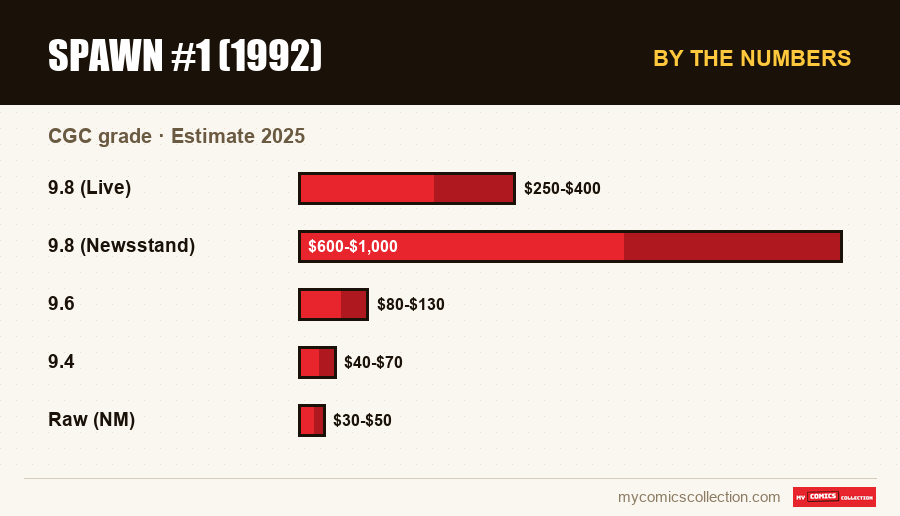
| CGC grade | Estimate 2025 |
|---|---|
| 9.8 (Live) | $250-$400 |
| 9.8 (Newsstand) | $600-$1,000 |
| 9.6 | $80-$130 |
| 9.4 | $40-$70 |
| Raw (NM) | $30-$50 |
Price history
Long considered an issue "too printed" to have value, Spawn #1 has seen a marked resurgence of interest since 2020. The world record for the Spawn series (exceeding 350 issues), persistent rumors of a reboot film, and 90s nostalgia have propelled 9.8s from $100 in 2018 to over $300 today. The Newsstand version followed an even more aggressive curve.
Collecting this series?
Track what you own, what you are missing and what your collection is worth. 7 day trial.
Start my trial →Points of vigilance when purchasing
Spawn #1's glossy paper is prone to spine ticks and to color-breaking creases on the black cover: inspect the edge under raking light. Beware of apparently “mint” copies which present binder's creases internal. Make a distinction between Direct Edition (no barcode) and Newsstand (with UPC): the difference in value in 9.8 is considerable. Be wary of pressed copies which temporarily hide defects.
To delve deeper into the collection of Image Comics titles, check out our guide Collection of independent comics and the article on the 90s collection.
Track your complete Spawn run and identify your missing numbers with My Comics Collection: management number by number, all series combined.
Discover the applicationBeyond issue 1: landmarks of the Spawn series
Spawn #1 grabs the attention, but a coherent collection is also built on the issues and spin-offs that followed. Here are verifiable landmarks to go further.
Issue 9: Angela and Cogliostro
Spawn #9 presents the first appearances of Angela and Cogliostro, two characters created by Neil Gaiman. This issue is tied to a rights dispute: collections published after the litigation excluded issues 9 and 10 (the latter, by Dave Sim, features Cerebus), which were only reprinted later in the Spawn Origins editions. Anyone who wants these two issues must therefore often hunt for the original single issues.
The 1990s spin-offs
- Violator (1994): three-issue miniseries written by Alan Moore, drawn by Bart Sears.
- Angela (1994-1995): three-issue miniseries by Neil Gaiman and Greg Capullo.
- Spawn/Batman (1994): crossover written by Frank Miller and drawn by Todd McFarlane.
- Violator vs Badrock and Spawn: Blood Feud (1995): two four-issue miniseries by Alan Moore.
- Curse of the Spawn (1996-1999): the first long-running monthly spin-off series.
These miniseries have the advantage of being short: you can complete them faster than the main series, and they link the collection to big names of the era.
A few milestones of the main series
Sales slumped around issue 25, then the series regained a steady level around issue 45. The 1997 film made Spawn the top-selling comic of May 1997. Later, issue 185 (October 2008) marks Todd McFarlane's return to the title and a new creative direction: it sold out at the distribution level. These landmarks help place an issue in the life of the series when you browse a long box of singles.
How to organize yourself
For an affordable collection, start from #1, add #9, then choose one or two miniseries from the list above rather than attempting the complete series, which exceeds 350 issues. If you prefer to read, collected editions are enough, but check that they actually contain issues 9 and 10. In every case, note the printing and edition of each issue at purchase: on a series this heavily printed, that detail makes the difference.
Frequently asked questions
In May 1992, from Image Comics, by Todd McFarlane, who both wrote and drew it. He left Marvel with six other artists to found Image, and Spawn was the first title to appear under that banner.
Its print run of 1.7 million copies is one of the highest in history for an independent comic, and the census exceeds 15,000 graded copies. Only perfect 9.8 copies command a significant premium.
The Direct edition has no barcode, whereas the Newsstand carries one (UPC). The Newsstand is much scarcer, and the value gap in 9.8 is considerable.
The glossy paper is prone to spine ticks and color-breaking creases on the black cover, to be inspected under raking light. Beware also of internal binder's creases on copies that look perfect, and of pressed copies that temporarily hide defects.
Al Simmons, an assassinated former CIA agent, wakes up disfigured and amnesiac in a New York alley, wearing a living symbiotic costume. He discovers he has been dead for five years, that his wife Wanda has remarried his best friend and that he has limited demonic powers.