
Lex Luthor has no powers. He faces the most powerful hero in his catalog with money, intelligence, and patience, and that's exactly why he lasts. An opponent of equivalent power forces each episode to strike harder than the previous one, and the one-upmanship reaches its ceiling in a few years. A physically disarmed opponent can never win by force: each confrontation must therefore be invented differently. Inventiveness replaces escalation, and a resource that is renewed does not become exhausted. The only breaking point of the system is not wear and tear, it is the inflation of the means given to this man to keep him credible.
There is, in the mechanisms of antagonism that American comics have produced, a model which has survived all the others without needing to be reconstructed. It's not the monster. It's not the evil double. It is not the cosmic force. He's a man in a suit, with a fortune, an address book and a brain, pitted against a creature who could silence him in a split second and never does. The imbalance is absurd on paper. It is precisely what makes the formula indestructible.
Lex Luthor's longevity is often explained by his charisma, or by the fact that he embodies a critique of economic power. These are fair but secondary readings. The structural reason is more straightforward: an adversary who cannot win by force imposes a permanent writing constraint, and a permanent constraint produces variety. Antagonists who can win by force impose a power constraint, and a power constraint only produces one-upmanship. The first is renewed. The second is running out. This article dismantles this mechanism, then examines its sole weakness: a weakness that comes from the top, not from wear and tear.
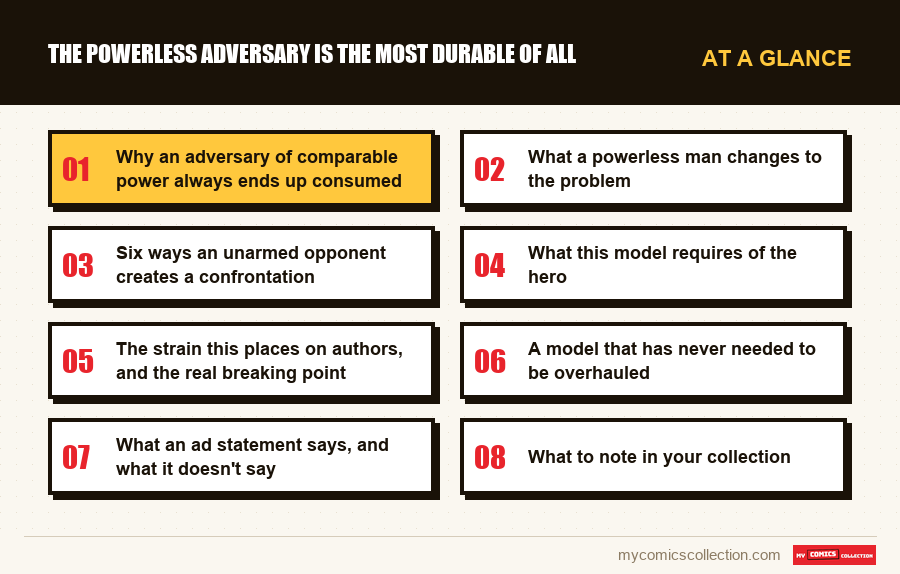
Why an adversary of comparable power always ends up consumed
Take an antagonist whose strength is of the same order as that of the hero. The first encounter works admirably: the stakes are understandable, the outcome is uncertain, the reader needs no explanation. The problem starts at the second meeting. The hero has won once; if nothing has changed, he will win in the same way, and the reader knows this before opening the booklet. To restore uncertainty, the balance of power must be changed. We therefore increase the power of the adversary. He comes back stronger, better equipped, with a new capacity. And the third time, you have to start again.
This mechanic has a formidable property: it is monotonous. It can only go one way. Each episode consumes a portion of the available power reservoir and does not replenish it. After a relatively short number of confrontations, the opponent has become so overwhelming that his defeat can no longer be credibly explained, or else so predictable in his rise that uncertainty has disappeared on the other side. The reader no longer wonders who wins, he wonders how much the bar has been raised this time. This is the moment when the formula died.
The exits available to authors at this stage are all costly. We can make the opponent disappear, which solves the problem by removing the asset. We can reinvent him from top to bottom, which amounts to admitting that the previous character had become unusable and requires regaining the reader's support. We can demote it, bring it back to a lower level by an explanation, but this demotion contradicts what previous episodes have established and damages the memory of the series. None of these outputs are free, and all signal the same thing: the system has reached its ceiling.
We must measure how quickly this ceiling arrives. Power is an implicit numerical scale, and a numerical scale is taken in a few notches. Three or four clashes are enough to go from close combat to combat that threatens a city, then a continent, then more. What remains beyond that is no longer relatable at character level. An antagonist built on power therefore has a predictable editorial lifespan, and this lifespan is measured in years, not decades.
What a powerless man changes to the problem
The exit by force is closed in advance
He cannot defeat the hero in hand-to-hand combat, and no one in the story believes him for a moment. This impossibility, far from being a narrative handicap, is a writing instruction: it prohibits the lazy solution and forces one to look elsewhere. An obstacle that cannot be overcome by the usual means is an obstacle that produces matter.
There's no ladder to climb
An antagonist of equal strength is measured on a single axis. A powerless antagonist is measured on as many axes as there are ways to harm: law, money, reputation, the manipulation of a third party, the creation of a precedent. These axes do not add up to a single value, so there is no requirement for the next story to surpass the previous one.
Defeat does not destroy him
When a threat of power is defeated, it is emptied: it has been shown that it allows itself to be beaten. When a man is defeated, he remains exactly what he was: a man with means and time. Its recirculation costs the story nothing, because it never claimed to be invincible.
It forces the hero to exist differently
Against him, force solves nothing: it would even be the fault. The hero must investigate, prove, convince, sometimes abstain. These are registers that his power made useless elsewhere, and which, here, become his only territory. The opponent doesn't test the muscles, he tests the person.
These four effects combine into one simple property: the device recharges itself. Each story consumes an idea, not a reserve. An idea used does not prohibit the following ones, whereas a power level reached prohibits all lower levels. This is the difference between a resource that is spent and a resource that is renewed, and it is this that explains longevity without needing to invoke public taste.
Constraint is the driving force. An antagonist who could resolve the conflict by force only needs one thing: more force. An antagonist who can't, needs a different plan each time, and a different plan is, by definition, a different story.
This is why this model has survived the ages without a redesign. What ages in a character are its dated attributes: technology, vocabulary, aesthetics. What does not age is a structural position in a balance of power. The position of the unarmed man facing the colossus is intact whatever the decade.
Six ways an unarmed opponent creates a confrontation
The problem is not identifiable
He doesn't come across as a threat. It is first necessary to establish that there is an adversary, which shifts the story from the fight to the demonstration. The hero spends part of the story searching for what he faces, and this search is itself the content.
Time works for him
A powerful being strikes and leaves. A patient man prepares, waits, lets it ripen. This long time frame allows intrigues that take place over several episodes without requiring confrontation at each issue, which alleviates the pressure on one-upmanship.
He occupies a legitimate position
He acts from a recognized place, with instruments that society accepts. Hitting the square would mean hitting the institution that protects it. The hero therefore finds himself prevented not by the power of the adversary, but by his own principles.
He always acts through
He orders, finances, mandates. Between him and the act, there are people, contracts, decision chains. Each of these links is an available secondary character, and therefore a potential story that does not need him to hold.
He transforms the hero's power into an argument
His best weapon is the very existence of his adversary: an individual who can do anything, and who is unconstrained by anything. This argument does not need to be true to work. It turns the hero's central asset on its head and makes him suspect, something no brute force can do.
He makes the victory partial
We can foil his plan without incapacitating him. The end of an episode is therefore never an end point, but a suspension. This form of outcome is what allows a long series to conclude without closing, and to reopen without contradicting itself.
What this model requires of the hero
A character defined by his power has a permanent writing problem: as soon as an obstacle can be overcome by force, there is no more story, only a demonstration. Authors have always known this, and that's why the best sequences of this type of hero are those where his strength is useless. A powerless opponent guarantees this condition every time it appears, without having to invent it.
The movement is clear. Against a physical threat, the hero is judged on his resistance. Against a man, he is judged on his judgment: how far does he go, what does he refrain from, how does he prove what he puts forward, what does he do when the law protects the one he knows to be guilty. These questions only arise for a character who could overlook it and chooses not to. In other words, the disarmed adversary is the only device that transforms the hero's restraint into a dramatic issue rather than a simple displayed moral quality.
This requirement also produces rare readability. The reader does not need to follow a power accounting to understand the issue; it is enough for him to understand an intention. A plan is told, guessed, discussed. A level of force is experienced. This is one of the reasons why these stories remain accessible to a reader who discovers the series late: they do not presuppose knowledge of everything that has been climbed before.
Finally, this model protects the hero from his own inflation. When the antagonists rise in power, the hero must rise with them, and he ends up becoming a character who no longer concerns anything earthly. The human adversary periodically brings him back to human height, not by diminishing him, but by posing a problem that his power does not know how to deal with. It's a scale brake built into the casting.
Collecting this series?
Track what you own, what you are missing and what your collection is worth. 7 day trial.
Start my trial →The strain this places on authors, and the real breaking point
There is a price. For a man without power to remain a credible threat in the face of a being capable of anything, he must be given the means. Money, influence, laboratories, political relays, technologies. But these means cannot remain constant: each time it is defeated, the question “why would it work next time?” » is resting, and the easiest answer is to increase what he has. It's the same slope as power escalation, disguised as something else.
The result, in the long term, is a shift in nature. The businessman becomes an empire. The empire becomes an industrial center capable of competing with states. Personal technology ends up matching, on certain points, the capabilities of the adversary it is supposed to compensate for. At this stage, the character is no longer a man without power: he is a power of another order, simply of another nature. And the mechanism that made it indestructible, the impossibility of winning by force, has quietly ceased to apply.
We must name precisely what is breaking here, because it is not wear and tear. A powerful antagonist dies at the bottom: he has been used too much, his defeats have emptied him, he no longer impresses. The powerless antagonist, for his part, is disrupted from above: we have given him too much for him to remain plausible, and this generosity has taken him out of the category which was his strength. The first goes out, the second becomes denatured. These are two opposing pathologies, and they do not call for the same remedy.
The remedy, when applied, is almost always to remove rather than add. We take back his empire, we send him back to his own means, we put him back in a situation of manifest inferiority. These stripping sequences are often among the character's strongest, and this is no coincidence: they restore the original constraint. They also remind us that the narrative capital of this figure is not what she possesses, but what she lacks.
There is a practical consequence for those who read or collect. The interesting sequences of this type of adversary are not necessarily those where he is at the peak of his powers; these are often those where he has the least. A reader who looks for the moments when the formula works at full capacity has an interest in identifying the phases of reduction rather than the phases of expansion: this is where the constraint becomes visible again, and the writing once again becomes obliged to be inventive.
A model that has never needed to be overhauled
Many antagonist figures had to be reconstructed over the decades, because what defined them was dated: a period fear, a geopolitical conflict, a science fiction technology overtaken by reality. The reconstruction is an admission: it means that the content of the character was based on a context that has disappeared. Nothing of the sort here, because this character does not hold to a content: he holds to a position.
The position is independent of the era. A man who refuses to accept the existence of a being stronger than himself, and who only has what a man can muster to oppose him, is a situation understandable in all decades. His instruments change, the nature of his fortune changes, the vocabulary of his influence changes. The report does not move. This is why this character was able to absorb considerable changes in appearance and function without ever needing a reset of its premise.
It should be added that this stability makes the character reusable by very different authors without the result being inconsistent. An antagonist defined by an ability imposes its ability on anyone who writes it. An antagonist defined by a lack leaves it up to each author to choose how this lack is compensated, and this choice is precisely where individual sensibilities can be expressed. The figure is a framework, not an instruction.
This is also what explains its portability outside the original support. Superhuman power must be shown, so is expensive and goes out of style. A man with means and an obsession transposes himself into any format, including those that have no capacity to represent the spectacular. The model survives changes in medium as it survives changes in times, and for the same reason.
What an ad statement says, and what it doesn't say
A word on the market, in illustration only. A survey carried out on August 29, 2026 on the booklets linked to the character gives, for unverified copies, 52 advertisements ranging from $3.20 to $499.99, with a median of $17.32. For the segment of copies passed by a verification body, there are 18 advertisements ranging from $24.99 to $93,500.00, median at $65.00. These amounts are sums that sellers demanded that day; no completed transactions are measured here, and the two segments are counted separately because they do not describe the same business object.
The verified maximum of $93,500.00 is incommensurable with the median of $65.00 for the same segment, which is enough to rule it out from any overall reading. Furthermore, eighteen advertisements constitute a small number: it does not allow us to establish a price level for this segment, only to note that it exists. Finally, a measurement taken on a single date contains no trend information: nothing in these numbers says whether anything is going up or down, and it would be wrong to imply that.
What we can take away from this can be summed up in one sentence: the vast majority of the issues concerned circulate at modest amounts, and the depth of the unverified offer is significantly greater than that of the verified segment. This is a comment about availability, not value.
What to note in your collection
Note the nature of the conflict, not just the number. For this character, a booklet where the confrontation involves law, finance or manipulation has nothing to do with a booklet where he has combat equipment. A free field indicating which of the two registers dominates transforms a list of numbers into a proofreading tool, because it is exactly this criterion that we are looking for when we want to go back to the formula.
Mark the counting phases. The sequences where the character loses his means are those where the original constraint is restored, and these are often the strongest. They are scattered and bear no distinctive sign in a numbering. Without an explicit note at the time of reading, they become impossible to find two years later.
Distinguish what is verified from what is not, copy by copy. The survey cited above shows two segments whose scales have nothing in common. Mixing the two in the same sheet makes any subsequent estimate unusable. A simple binary indicator per copy, entered at the time of purchase, is enough to avoid the problem permanently.
Date any price observations. An amount without a date is not data, it is a memory. Since an isolated measurement says nothing about a movement, the only way to make these readings usable is to accumulate several of them, spaced apart, each time-stamped. The date matters as much as the number, and it is the field that is most often forgotten.
Spot the intermediaries rather than just the character's appearances. This type of antagonist acts through proxies; part of his arcs take place in fascicles where he appears little or not at all. An indexing which only retains its direct appearances lets entire sections of its intrigues escape. Note the thread, not the thumbnail.
Because it consumes ideas and not power. An antagonist of equal strength must come back stronger each time to remain uncertain, and this rise has a ceiling achievable within a few confrontations. An unarmed antagonist cannot win by force, so each story must invent another means, and one idea used does not prohibit subsequent ones.
Yes, but not through wear and tear. To remain credible in the face of an overpowering being, man must have increasing means at his disposal: fortune, influence, technology. By increasing, these means end up constituting a power of another order, and the character leaves the category which was his strength. The breakdown comes from the top, not fatigue.
Force becomes ineffective, and sometimes at fault. The hero must investigate, establish evidence, convince, and agree not to act when nothing authorizes him to do so. These are registers that its power makes useless in the face of a physical threat. The human adversary is therefore the device which forces him to exist other than through what he can lift.
They describe amounts claimed by sellers that day, not sales made. On the unverified side, 52 listings from $3.20 to $499.99 and a median of $17.32. On the verified side, only 18 advertisements, too small a number to deduce a price level, with a median of $65.00 and a maximum of $93,500.00 which is out of proportion, which must be discarded. A measurement on a single date shows no evolution.
Rather the opposite. The formula works fully when the constraint is visible, that is to say when it has the minimum. The phases where his means are reduced restore the inferiority which forces the writing to be inventive, while the phases of expansion tend to bring him closer to an antagonist of ordinary power.
Follow your booklets without losing track
Register by register, copy by copy, with the verification status and your dated observations: My Comics Collection keeps track of what a list of issues never retains.