The most famous story from this period of Cyclops' career ended with a conclusion that was not as intended: the editorial board rejected the original ending and had it replaced before printing. A few years later, the publisher published this discarded ending in a single issue, sold explicitly as the version that didn't happen. As of the August 29, 2026 eBay listing count, this issue was asking $5.75 and $6.00 on the two copies offered, when the median of unverified listings for the canonical story stood at $52.50 on 56 bids, between $3.00 and $409.00. These amounts are claimed by sellers, never recorded sales.
There are a handful of objects in publishers' catalogs that do not fit into any box. These are not reissues, since they publish content that has never been published. These are not ordinary releases, since they take material produced years earlier for another place. These are not special editions, since they claim to occupy a specific position in a story already told. The issue which contains the refused end of the great story of this period belongs to this tiny family: an official booklet, printed, distributed, numbered, which tells something which did not happen.
This is a rarer situation than it seems. The comics industry constantly produces discarded material (recomposed panels, rewritten dialogue, endings changed along the way) and this material almost always remains invisible. It ends up in drawers, in interviews, in convention anecdotes. The particularity of the case before us is that the publisher ended up taking the rejected version out of its drawer and putting it on sale, without disguising it, selling it precisely for what it is. This gesture transforms a working document into an editorial object, and it produces a category that most collection inventories cannot name.
Why does a publisher publish what he had refused?
The first reflex is to find the gesture contradictory. An editorial department refuses an ending, imposes another version, goes so far as to have the work redone before printing, then, a few years later, the same house prints the version it had blocked. However, this is not a contradiction, because the two decisions do not answer the same question. Refusing an ending means deciding what the series should say to its readers at that precise moment. Publishing that same ending later means arbitrating on what a readership is willing to buy once the question is no longer open.
Between the two moments, something has changed, and that something is the controversy itself. As long as the debate is lively, publishing the rejected version would amount to disavowing one's own decision and confusing the official story at the worst possible moment. Once the dust settles, the debate ceases to be a problem and becomes an active one. The curiosity accumulated around “what we should have read” constitutes an identified, measurable demand, addressable by a unique product. The publisher no longer takes a narrative risk: he sells a supplement to a story whose outcome is already stabilized in people's minds.
Added to this is a much more prosaic, and probably decisive, consideration. The rejected material has been paid for. The pages were ordered, produced, paid for, then put aside. Economically, a stock of finished boards that earns nothing is a fixed asset. Publishing it requires neither a major new creative order nor the construction of a new readership: all it requires is a design, a cover, and distribution. The marginal cost is low, the demand is prequalified, and the item sells on its own because its argument is contained in a sentence that everyone immediately understands.
We must also see what the publisher gains symbolically. To publish a rejected version is to display a form of transparency without conceding anything in substance: the official ending remains the official ending, nothing is retracted, no continuity is modified. The house shows its behind the scenes while keeping control of the story. It is a low-risk operation with real image benefits, in a sector where the public is very attached to manufacturing stories.
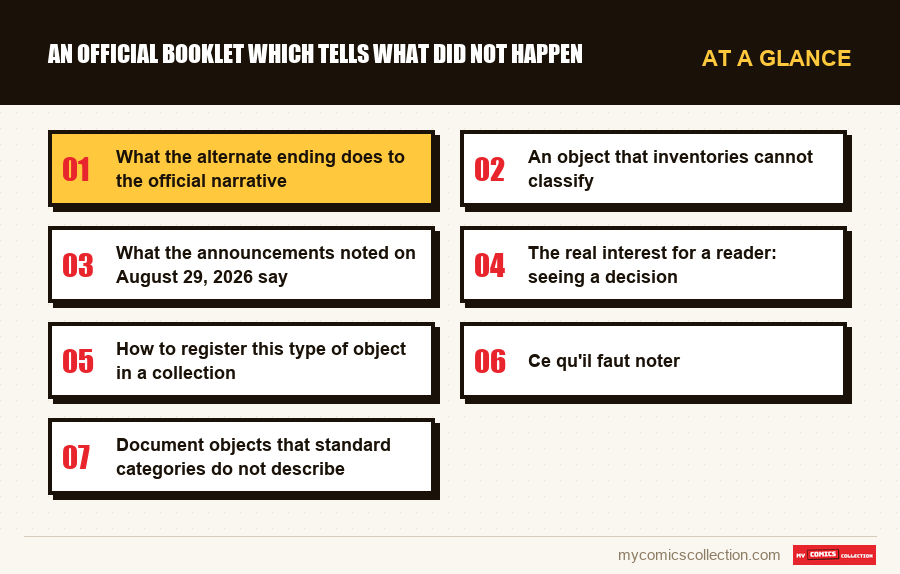
What the alternate ending does to the official narrative
It doesn't cancel anything
The publication of the rejected version does not remove any authority from the conclusion published at the time. This remains what the series actually told, what readers read at the time of publication, and what the sequels relied on. The alternative booklet does not replace: it is added, in the margins, without the right to vote on continuity.
She definitely accompanies
On the other hand, once this version is available, it will not be released again. The canonical story can now be read with, in the permanent background, the awareness that another outcome existed and that it was ruled out by decision. This is an irreversible addition: we cannot unlearn that a fork has been closed.
It shifts the attention to the decision
A reader who knows both versions no longer only judges the story, he also judges the arbitration. The question becomes « pourquoi celle-ci plutôt que celle-là », which shifts the center of gravity from fiction to process. Few published objects produce this shift in attention.
It creates a duplicate reading
The story acquires an unusual depth: it now has a published version and a possible version, both printed by the same company. This duplication almost never exists in the medium, where abandonment usually remains oral information, never an object that can be placed on a table.
This coexistence has a practical consequence for those who arrange a collection: the story is no longer limited to a series of consecutive numbers. It includes a satellite, published much later, which belongs to the file without belonging to the series in the strict sense. Classifying it with the other issues of the story distorts the publication chronology; classifying it on its release date separates it from the only set to which it is connected by meaning. Neither solution is perfect, and that is precisely what makes the object worth documenting.
All amounts cited in this article come from a count of eBay listings carried out on August 29, 2026. These are prices requested by sellers as of this date, no transactions concluded. An ad can stay online for months without finding a buyer.
The search for this story turned up 56 unverified listings, from $3.00 to $409.00, with a median of $52.50, and only 4 verified listings, from $69.99 to $210.00, median $112.50. Four observations are too small a number to conclude on a price level, and the isolated maximum reflects the hope of a seller, not a market observation.
An object that inventories cannot classify
Ni continuité, ni hors-continuité
The issue recounts events that were supposed to happen in continuity and didn't make it. Putting it in “continuity” is false; storing it in a “parallel universe” is just as important, since it was never intended as a variation but as the original version.
Deux dates, aucune évidente
The object has a creation date, contemporary with the story, and a publication date, much later. Both are correct and contradict each other. Most collection sheets only offer one field, which means you have to choose arbitrarily and lose the most significant information.
No reissue status
A reissue republishes content that has already been published. Here, the content was never released. Marking it "reprint" is a factual error that then propagates throughout all of a collector's automatic sorts and searches.
Un rattachement ambigu
The booklet belongs to the story file but not to its numbering. It forms an appendix with no natural place: neither before, nor after, nor between two numbers. A strictly sequential inventory cannot represent it correctly.
An identity easy to confuse
Because it covers the same story, it appears in the same searches as the original issues and collections. Without an explicit note, a copy purchased for a few dollars can be recorded as if it were an issue of the story itself.
Uncaptured documentary value
What makes the object interesting, showing an editorial decision, does not fall into any standard field. Neither the grade, nor the publisher, nor the date say so. Only a free comment, written by the collector, preserves the information.
What the announcements noted on August 29, 2026 say
The statement deserves to be read line by line, because its differences are more telling than its levels. On the unverified side, 56 listings covered a considerable range: from $3.00 to $409.00, with a median of $52.50. A gap of this magnitude does not describe a price but a heterogeneous set of objects classified under the same research: original fascicles, collections, copies in very different states. Verified side, only 4 ads, between $69.99 and $210.00, median $112.50. Four points do not make a distribution: this figure is indicative, nothing more, and it would be imprudent to deduce a reference level from it.
These are the titles actually observed which carry the clearest information. There was a paperback volume containing the story at $3.00, and two copies of the single issue containing the discarded ending, at $5.75 and $6.00. These last two ads explicitly stated in their title that this was the original ending: in other words, the sellers knew exactly what they were offering and put it forward as their main argument.
The relationship between these two series of figures is the usable fact of this statement. The issue that contains the rejected version was asking, that day, about ten times less than the median of unverified announcements of the canonical account. The editorial argument is however maximal: it is the object whose very existence is an event. We must therefore draw a careful formulation, and only one: what did not happen cannot be collected like what did happen. The request is for pages that readers actually read at the time, not for those that could have been read.
We must resist the temptation to go further. A listing count on a given date describes what sellers hope to get, not what a buyer paid. It says nothing about a trajectory, nothing about a rarity, nothing about a dynamic. Two listings under six dollars are two observations, not a deal. The only thing that this survey firmly establishes is that on that date, the object was accessible for a derisory sum in view of its documentary singularity.
Collecting this series?
Track what you own, what you are missing and what your collection is worth. 7 day trial.
Start my trial →The real interest for a reader: seeing a decision
A comic book reader is constantly faced with editorial decisions, and he almost never sees any of them. A series changes tone, a character disappears from one panel to another, a plot ends abruptly: the reader notices a result and guesses a cause. The arbitrations which produce these effects remain off-screen, dispersed in meetings of which nothing remains printed. This is the ordinary condition of reading.
The booklet which contains the refused ending breaks this condition for once. It does not just tell an alternative story: it makes a decision visible, material, comparable. The reader has both terms of the arbitration at his disposal and can, to his extent, reconstruct what weighed. He doesn't get the deliberation itself, but he gets what it was about, which is already exceptional. Few media outlets offer their audiences the opportunity to hold in their hands the unsuccessful branch of an editorial choice.
This interest does not depend on any judgment on the respective quality of the two versions. Whether the discarded ending is better or worse than the one published is a matter of taste and of little importance here. What matters is the very existence of the comparison. It teaches the reader that the stories they consume are products of decisions, and that these decisions could have happened differently. It's a lasting lesson, transposable to all the other series he will read next.
This special status also explains why the object deserves careful documentary treatment in a collection. Its value is neither due to its condition, nor to its supposed rarity, nor to the amount that anyone would ask for it. She wants him to testify. A misidentified copy, stored without a note, loses exactly what made it interesting: the fact that it documents a refusal.
How to register this type of object in a collection
The first decision is that of attachment. The most robust approach consists of considering the story as a file rather than as a sequence: the original issues, the collections which include them, and this late issue form the same thematic whole, even if their publication dates extend over years. Sequential classification remains useful for reading, but it should not control the organization of the file.
The second decision concerns the declared nature. We must reject the two easy labels. This is not a reprint, since the content was previously unpublished. It is not a non-continuity story in the usual sense, since it was never intended as a variation. In the absence of a category available in most tools, the feasible solution is to use the most neutral category and to include the exact information in a free note, written once and for all.
The third decision concerns the dates. Keeping the actual publication date is essential for any reliable chronology, but it says nothing about what the object is. The note must therefore remind that the material is contemporary with the story and that only its publication is late. Without this clarification, the sheet will suggest, in a few years, that it is an addition written after the fact, which would completely reverse the meaning of the thing.
The fourth decision is financial, and it is simple: do not confuse the asking price with a value. The amounts recorded on August 29, 2026 are used to establish an order of magnitude at the time of purchase, not to provide an estimate of assets. An object purchased for a few dollars remains an object purchased for a few dollars, and its real interest lies elsewhere. The catalog allows you to verify the exact identification of the number, which is much more useful than an estimate.
The fifth decision, finally, is to write the note right away. The particularity of this booklet is invisible on the cover for those who do not know the history of its manufacture. In two years, the buyer's memory will be less precise; in ten, the file may be consulted by someone else. A line written at the time of purchase fully preserves what the object is worth documenting.
Ce qu'il faut noter
Refusal is prior to publication, never the other way around. The original ending was discarded before the story was printed, then replaced, and the series was released with its replacement conclusion. The subsequent release of the booklet does not reverse this decision: it simply publishes the other term. Confusing the order of the two moments leads to reading the object as a late correction, which it is not.
Coexistence is definitive and asymmetrical. The ending that appears retains all of its narrative authority, the ending that is discarded acquires none. But the second no longer disappears from the landscape: it permanently accompanies the first, and modifies the way in which we read it. It is a permanent addition to the story record, not an optional substitution or variation.
The category is missing in almost all inventories. Neither continuity, nor special issue, nor reissue: the object occupies a space that collection tools do not offer. The practical consequence is that it will be misplaced by default, and only a handwritten note will preserve its exact status. This is where a collector has the most to gain by being methodical.
The figures for August 29, 2026 are requests, not sales. The 56 unverified listings ranged from $3.00 to $409.00 for a median of $52.50; the 4 verified listings ranged from $69.99 to $210.00 for a median of $112.50; the two copies of the issue containing the discarded ending were listed at $5.75 and $6.00. Four verified observations do not allow any conclusion on a level, and an isolated maximum reflects the hope of a seller.
The relationship between the two series of amounts is the most solid fact in the statement. The booklet containing the rejected version asked about ten times less than the median of the canonical account, even though its editorial argument is unique. The careful formulation that results from this can be summed up in one line: what has not happened cannot be collected like what has happened. This is a dated observation, not a forecast.
No. The conclusion published at the time remains that of the story and that on which the sequels were based. The late fascicle publishes the version which had been discarded before printing, without granting it the slightest authority over continuity. Both coexist, but only one matters narratively.
Two interests converge. The curiosity of the readership, once the controversy has settled and the debate has cooled, becomes an identifiable demand that a unique product can serve without narrative risk. And the material has already been paid for: publishing it mobilizes a fixed asset at a low marginal cost.
Both options have a flaw. Classifying it with the story distorts the publication chronology; classifying it on its real date cuts it off from the only set to which it is attached. The feasible solution is to keep its exact release date and attach it to the story file with an explicit note.
These are prices posted by sellers that day, not completed deals. They place an order of magnitude at the time of the survey and nothing more. With only 4 verified listings, the number is too small to establish a level, and the difference between $3.00 and $409.00 on unverified listings reflects very different items placed under the same search.
Because what makes it interesting doesn't appear in any standard field: neither the grade, nor the date, nor the publisher say that it documents an editorial refusal. Without a comment written at the time of purchase, the file will lose essential information and the object will end up recorded as a banal number in the story.
Document objects that standard categories do not describe
A booklet that publishes a rejected ending does not fit into any ready-made box. My Comics Collection allows you to note what each copy attests, to attach a late satellite to the story to which it belongs, and to find this information years later, intact.