Let's be direct: there is no such thing as a Spawn "Bronze Age" key issue. The Bronze Age of comics ends in the mid-1980s, while Spawn debuted in May 1992 (Image Comics, Todd McFarlane): squarely in the Modern age. If you're hunting Spawn "Bronze Age" keys, you're chasing a ghost. The genuine key issues are all 1990s comics, and the most iconic is Spawn #1, which sold roughly 1.7 million copies: the all-time record for a creator-owned comic. Here's where to actually look.
Comic "ages" are chronological markers: Golden Age (late 1930s-1956), Silver Age (1956-1970), Bronze Age (1970-mid-1980s), then the Modern/Copper era. Spawn arrived in 1992: nearly a decade after the Bronze Age ended. Looking for a Bronze Age Spawn is like looking for a 1980s smartphone.
Rather than inventing issues that don't exist, this guide redirects you to the real Spawn keys, all 1990s and 2000s comics, with live eBay values, medians across all editions, measured in June 2026 via our estimator.
Why "Spawn Bronze Age" makes no sense
The Bronze Age is the era running roughly from 1970 to the mid-1980s. Image Comics didn't even exist yet: the publisher was founded in 1992 by a group of star artists leaving Marvel, and Spawn #1 hit shelves in May 1992. Every Spawn issue therefore belongs to the Modern age: by definition, there is no Golden, Silver, or Bronze Age Spawn.
If you landed here via a "Spawn Bronze Age" search, it's most likely a terminology mix-up. The good news: Spawn's real grails are easy to identify, accessible, and well documented. Let's run through them.
The real Spawn key issues (live values, June 2026)
Values = median of active eBay listings, all editions and grades combined (our estimator, eBay.fr + eBay.com). A modest "all grades" median is normal: it's pulled down by raw copies and lots, while high-grade CGC slabs sell for considerably more.
| Issue | Significance | eBay median |
|---|---|---|
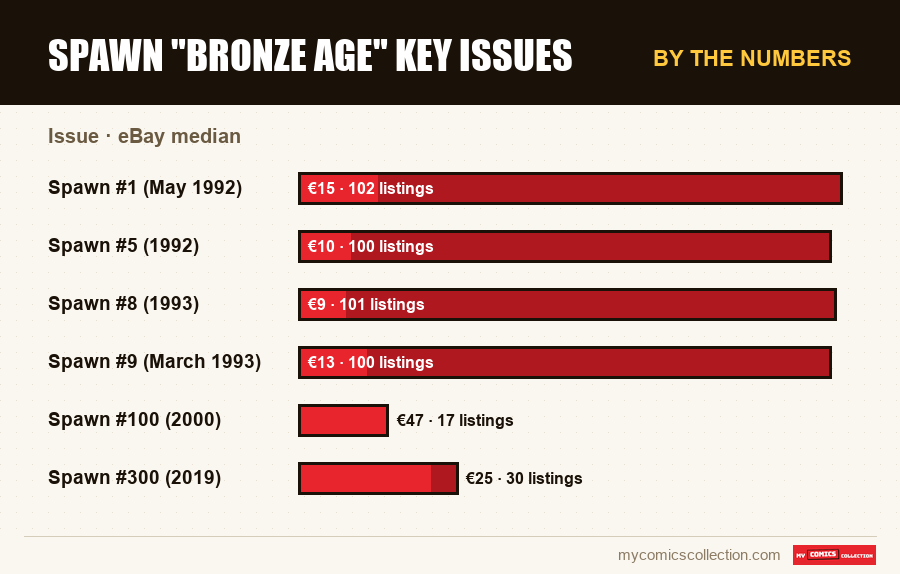
| Spawn #1 (May 1992) | 1st appearance of Al Simmons / Spawn; ~1.7M copies | €15 · 102 listings |
| Spawn #5 (1992) | Continuation of the first McFarlane arc, widely collected | €10 · 100 listings |
| Spawn #8 (1993) | Issue immediately preceding the Angela key | €9 · 101 listings |
| Spawn #9 (March 1993) | 1st appearance of Angela (written by Neil Gaiman) | €13 · 100 listings |
| Spawn #100 (2000) | Death of Angela and Malebolgia; anniversary issue | €47 · 17 listings |
| Spawn #300 (2019) | Record issue (longest-running creator-owned superhero series) | €25 · 30 listings |
#1 and #9: the two keys to know
- Spawn #1 (May 1992). The first appearance of Al Simmons and the cornerstone of any Spawn collection. Its print record is what makes it exceptional: roughly 1.7 million copies (≈1.25M direct market, 200,000 newsstand, 250,000 via Anco), making it the best-selling creator-owned comic in history (sources: Comichron, Image Comics). The upshot: it stays very affordable raw (€15 median) because copies are everywhere: value concentrates in high-grade CGC slabs and the scarcer newsstand edition.
- Spawn #9 (March 1993). The first appearance of Angela, written by Neil Gaiman (original cover price: $1.95). It's the series' "character" key: the Gaiman/McFarlane rights dispute, settled in Gaiman's favor in 2013, ultimately led to Angela being sold to Marvel. Despite that status, the median sits at €13: a remarkable entry point for a significant first appearance.
Collector strategy (grounded in real data)
- Forget the "Bronze Age." Focus your hunt on 1992-1993: #1 and #9 are the two foundational keys.
- Grade drives value. On both #1 and #9, the gap between a raw copy and a high-grade CGC slab is large. On #1, the newsstand edition stands clearly apart from the direct-market edition.
- Check live values. The medians above are from June 2026 and they move. For #100, the low listing count (17) makes its median less reliable than #1 or #9: treat it as a ballpark, not a fixed price.
Own a Spawn comic? Get a free valuation with our tool based on real eBay sales to find its low, median and high value.
Frequently asked questions
No. The Bronze Age runs from about 1970 to the mid-1980s, while Spawn debuts in May 1992 at Image Comics, squarely in the modern age. Every Spawn issue therefore belongs to the modern age.
Spawn #1 (May 1992), the first appearance of Al Simmons, which sold around 1.7 million copies: a record for a creator-owned comic. Scarcity therefore plays out in condition and in the newsstand edition.
The March 1993 issue contains the first appearance of Angela, scripted by Neil Gaiman. The rights dispute between Gaiman and McFarlane, settled in Gaiman's favor in 2013, ended with Angela being sold to Marvel.
Spawn #100 (2000) marks the death of Angela and Malebolgia in the anniversary issue, and Spawn #300 (2019) is a record issue for the longest-running creator-owned superhero series. Spawn #5 and #8 round out the first arc.
Because it clearly differs from the direct market edition and exists in far smaller numbers: about 200,000 copies at newsstands against about 1.25 million in the direct market. On such an abundant issue, that is where the scarcity lies.