There is no Silver Age Sandman key issue. Neil Gaiman's Sandman (Dream / Morpheus of the Endless) debuted in January 1989: a Copper/Modern-age character, not Silver Age (1956-1970). Older "Sandman" characters do exist, but they are different people: Wesley Dodds (Golden Age, Adventure Comics #40, July 1939) and the Simon & Kirby Sandman (Bronze Age, 1974). None is Silver Age. Here's how to avoid buying the wrong book, and where the real grails are.
"Sandman Silver Age key issue" is a trap search: it blends three unrelated characters under one name. The Silver Age (≈1956-1970) simply produced no major Sandman series that collectors still chase.
This guide stays strictly verifiable: real-time eBay medians (via our estimator) when listing volume is sufficient, documented publication facts, and, when a precise figure isn't reliable, a qualitative read rather than an invented one.
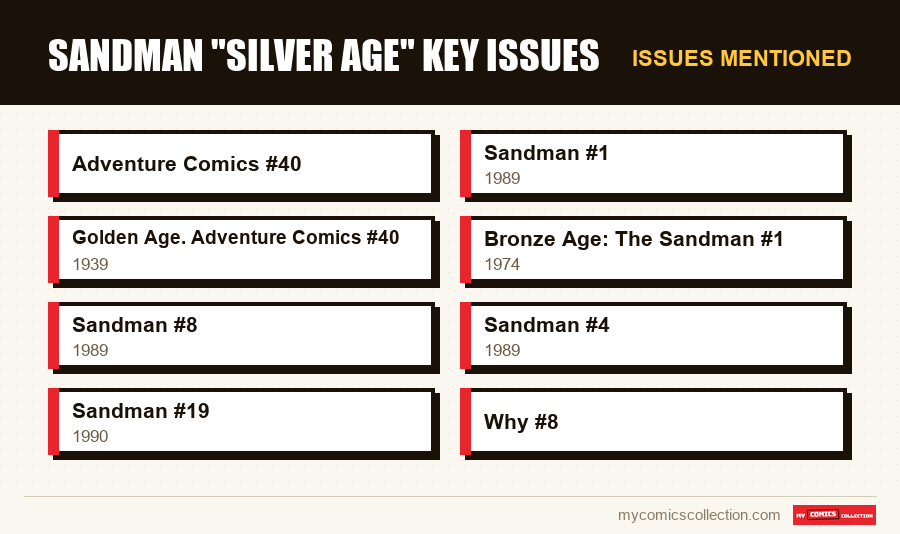
Three "Sandmen," three eras: don't confuse them
The name "Sandman" has been worn by several DC characters with no direct narrative link. To buy the right comic, you first need to know which one you're after:
| Character | First appearance | Era | Creators |
|---|---|---|---|
| Wesley Dodds (the gas-mask Sandman) | Adventure Comics #40 (July 1939) | Golden Age | Gardner Fox & Bert Christman |
| Sandman (Dr. Garrett Sanford) | The Sandman #1 (1974, DC) | Bronze Age | Joe Simon & Jack Kirby |
| Dream / Morpheus (the Endless) | The Sandman #1 (January 1989) | Copper/Modern Age | Neil Gaiman, Sam Kieth, Mike Dringenberg, Dave McKean |
Notice the gap: no Silver Age row. Between the 1939 Sandman and the 1974 one, DC published no landmark Sandman series across 1956-1970. The hunt for a Silver Age Sandman "grail" rests on a mix-up.
The real "vintage" treasure: Wesley Dodds (Golden, not Silver, Age)
If you want a high-value vintage Sandman, the target isn't the Silver Age but the Golden Age. Adventure Comics #40 (July 1939) marks the first appearance of Wesley Dodds, the gas-mask, sleeping-gun Sandman, by Gardner Fox and Bert Christman. It's an exceedingly rare 1939 book: its Near Mint value is referenced around $102,000 (source: Key Collector Comics). At that level you're talking museum-grade: nothing to do with Gaiman's series.
The 1974 Sandman (Simon & Kirby) belongs to the Bronze Age: The Sandman #1 (1974) introduces Dr. Garrett Sanford and was one of the last Simon/Kirby collaborations. A sought-after comic, but from a wholly separate universe to the Endless.
The real key issues: Gaiman's series (1989+)
If you landed here via "Sandman," you almost certainly mean Neil Gaiman's series: 75 issues (1989-1996), which moved from DC to Vertigo and was adapted by Netflix in 2022. Here are its real key issues.
| Issue | Significance | eBay value (all editions/grades) |
|---|---|---|
| The Sandman #1 (Jan. 1989) | "Sleep of the Just," 1st appearance of Dream/Morpheus | median ≈ €8 · 76 listings |
| The Sandman #8 (1989) | 1st appearance of Death of the Endless | eBay volume too thin for a reliable figure: see below |
| The Sandman #4 (1989) | Appearance of Lucifer (in Hell) | median ≈ €6 · 16 listings |
| The Sandman #19 (1990) | "A Midsummer Night's Dream," World Fantasy Award | eBay volume too thin for a reliable figure |
Values = median of active eBay listings (eBay.fr + eBay.com), all editions and grades combined, via our estimator (June 2026).
Why #8 and #19 are the real grails (beyond raw value)
- #8: the first Death. It's the most coveted issue of the run: the first appearance of Death of the Endless, Morpheus's cheerful sister, under a Dave McKean cover with Mike Dringenberg interiors. The eBay listing volume is too low (fewer than 10) to publish a reliable median, but it's by far the issue where high-grade CGC slabs and Neil Gaiman-signed copies trade highest: well above the other issues, as Heritage Auctions sales confirm (source: Heritage Auctions).
- #19: literary legitimacy. "A Midsummer Night's Dream" is the only comic ever to win a World Fantasy Award (Best Short Story, 1991): to the point that the rules were later changed to make comics ineligible in that category (source: sfadb, World Fantasy Awards 1991). A unique distinction that makes it a piece of history.
- #1 and #4: the affordable entry. #1 remains very accessible (median ≈ €8 across 76 listings); even Lucifer's appearance (#4) sits around €6 in standard edition. The gap widens mainly in high-grade CGC.
Bottom line: don't hunt for a Silver Age Sandman: it doesn't exist. Aim for the Golden Age (Dodds, 1939) for ultra-premium vintage, or Gaiman's series (1989+) with #8 and #19 leading for collectible modernity. And always check condition and live value: the medians above are from June 2026 and they move.
Own a Sandman and unsure of the edition or era? Get a free valuation with our tool based on real eBay sales to find its low, median and high value.
Frequently asked questions
No: the Silver Age (roughly 1956-1970) produced no major Sandman series. The search actually mixes three unrelated characters under one name.
Wesley Dodds (Adventure Comics #40, July 1939, Golden Age), Dr. Garrett Sanford (The Sandman #1, 1974, Bronze Age, by Joe Simon and Jack Kirby) and Dream/Morpheus (The Sandman #1, January 1989, by Neil Gaiman). None is from the Silver Age.
Adventure Comics #40 (July 1939), the first appearance of Wesley Dodds, the gas-mask Sandman, by Gardner Fox and Bert Christman. It is a museum-level piece, unrelated to Gaiman's series.
The Sandman #1 (January 1989, first appearance of Dream), #4 (Lucifer), #8 (first appearance of Death) and #19 ("A Midsummer Night's Dream"). The series runs 75 issues (1989-1996) and was adapted as a series in 2022.
It is the only comic to have won a World Fantasy Award (Best Short Story, 1991). The rules were later changed to exclude comics from that category.