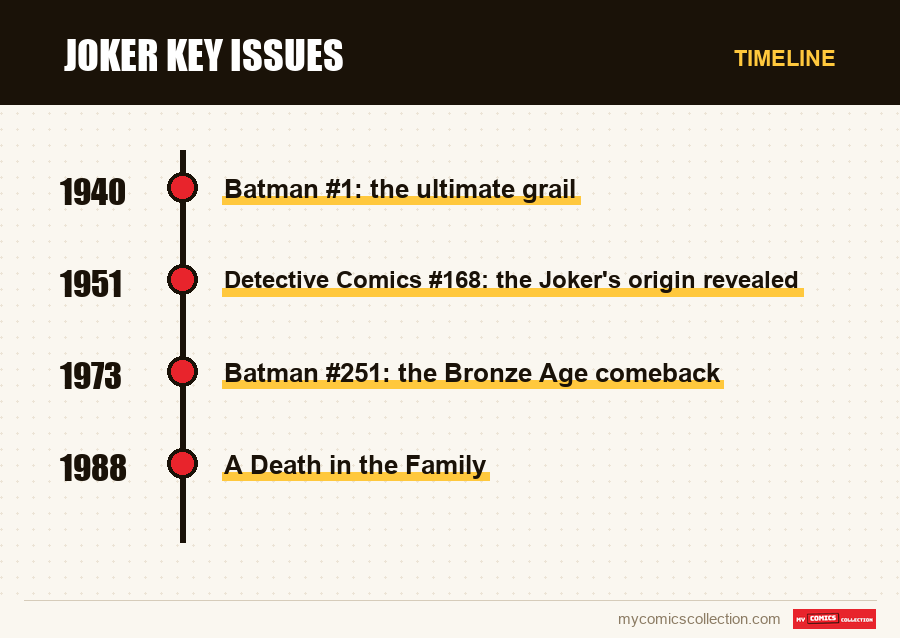
The ultimate Joker grail is Batman #1 (Spring 1940), the character's first appearance: a CGC 9.4 copy sold for $2,220,000 at Heritage Auctions in 2021, and a CGC 7.0 realised $794,449 at Goldin in 2025. Detective Comics #168 (1951), which reveals the Joker's origin as the Red Hood, fetched $324,000 in CGC 9.4 (Heritage, November 2022). The most sought-after Bronze Age key remains Batman #251 (1973), whose CGC 9.8 copy set a record at $38,000 at ComicLink in June 2024.
This article's title mentions the Silver Age, but honesty demands a clarification: the Joker debuted in the Golden Age (Batman #1, 1940) and his most important keys are Golden Age books or early Bronze Age milestones. During the Silver Age proper (1956-1969), the Joker appeared regularly in the Batman series, but as a harmless prankster: no issue from that period qualifies as a major collecting key. His comeback as a genuinely dangerous killer dates to 1973 and Batman #251. This guide covers the real keys honestly: Golden Age origins, Bronze Age return, and modern classics.
This guide sticks to the verifiable: eBay medians from our estimator (eBay.fr + eBay.com, June 2026) and records documented by Heritage Auctions, ComicLink, and the specialist press. The eBay median for Batman #1 (€7, 100 listings) is overwhelmingly dominated by modern reprints and facsimile editions: it does not reflect the value of the 1940 original, which is a six-figure grail. For Detective Comics #168 (4 listings), our tool's reliability threshold is not met: only auction records are cited.
Joker key issue ranking (real market values, June 2026)
The two Golden Age grails (Batman #1 and Detective Comics #168) cannot be valued through our eBay estimator in any meaningful way: the Batman #1 median is skewed by facsimiles, and Detective Comics #168 has only 4 listings. The figures cited for those issues come exclusively from documented auction records.
| Issue | Significance | eBay data (all grades) | Documented record |
|---|---|---|---|
| Batman #1 (Spring 1940) | 1st Joker and Catwoman (Golden Age) | Median €7 · 100 listings: dominated by reprints, not representative | $2,220,000 (CGC 9.4, Heritage 2021); $794,449 (CGC 7.0, Goldin 2025) |
| Detective Comics #168 (Feb. 1951) | First Joker origin / Red Hood (late Golden Age) | 4 listings: below reliable threshold | $324,000 (CGC 9.4, Heritage Nov. 2022) |
| Batman #251 (Sep. 1973) | Joker restored as killer; iconic Neal Adams cover (Bronze Age) | Median €9 · 65 listings | $38,000 (CGC 9.8, ComicLink Jun. 2024) |
| Batman #427 (Dec. 1988) | A Death in the Family: reader vote on Robin's fate | Median €21 · 16 listings | Not publicly documented |
| Batman #429 (Jan. 1989) | Jason Todd's death confirmed | Median €28 · 32 listings | Not publicly documented |
Record sources: Heritage Auctions, Goldin Auctions, ComicLink, bleedingcool.com, cgccomics.com.
Batman #1 (1940): the ultimate grail
Published in Spring 1940, Batman #1 is one of the most important comics ever printed. It is the first appearance of the Joker and, in the same issue, of Catwoman. The script is by Bill Finger, with art by Bob Kane and a key creative contribution from Jerry Robinson: whose precise role in designing the Joker has long been debated, with all three figures giving different accounts. The character's look, a grinning, chalk-faced criminal inspired by the 1928 silent film The Man Who Laughs, made him the perfect foil for Batman. The issue is extraordinarily scarce: the CGC Census records only a handful of copies in high grade. A CGC 9.4 copy sold for $2,220,000 at Heritage Auctions in January 2021: the absolute record for the issue. More recently, a CGC 7.0 realised $794,449 at Goldin's Summer Goldin 100 auction in September 2025, setting the record for that grade. Our eBay estimator returns a median of €7 across 100 listings for Batman #1, but this figure is entirely distorted by modern facsimile editions and reprints selling for a few euros: never cite it as the value of the 1940 original.
Detective Comics #168 (1951): the Joker's origin revealed
Published in February 1951, Detective Comics #168 tells the origin of the Joker for the first time. The story "The Man Behind the Red Hood" presents a nameless laboratory worker who dons the Red Hood mask to commit a robbery, dives into a chemical vat to escape Batman, and emerges disfigured: chalk-white skin, green hair, a permanent rictus grin. The Joker is born. The issue is ranked among Overstreet's top 100 Golden Age comics. Our estimator returns only 4 listings: well below our reliability threshold of 15, so only auction records can be cited. A CGC 9.4 copy sold for $324,000 at Heritage Auctions in November 2022, setting the record for the issue. A CGC 6.0 had realised $23,345 at Heritage in March 2022, illustrating how steep the grade curve is for this book.
Batman #251 (1973): the Bronze Age comeback
Where the Silver Age had reduced the Joker to a quirky nuisance, Batman #251 reinstated him as a cold-blooded killer. Written by Denny O'Neil and drawn by Neal Adams, "The Joker's Five-Way Revenge!" (September 1973) sees the Joker escape from a psychiatric hospital and methodically hunt down former gang members who had betrayed him to the police. The cover, Batman scanning the horizon as the Joker leers in the background, is one of the most reproduced images in DC Comics history. The issue is ranked among Overstreet's top 25 Bronze Age comics. Our estimator returns a median of €9 across 65 listings (all grades combined): solid entry-level pricing. In high grade, a CGC 9.8 set a record at $38,000 at ComicLink in June 2024; only 30 copies graded CGC 9.8 existed in the census at that time.
A Death in the Family (Batman #427-429, 1988-1989)
The A Death in the Family arc (written by Jim Starlin, drawn by Jim Aparo) is one of the most shocking moments in DC history: the Joker beats Jason Todd, the second Robin, with a crowbar, then detonates the warehouse where Batman finds his partner barely alive. Batman #427 (December 1988) is the infamous phone-vote issue in which readers decided Jason Todd's fate: they chose death by 5,343 votes to 5,271. Batman #429 (January 1989) confirms his death. Our estimator returns a median of €21 across 16 listings for #427 and a median of €28 across 32 listings for #429 (all grades, all printings). No high-grade auction record has been publicly documented for either issue, which remain accessible at the entry level.
A note on the Silver Age: an honest assessment
Between 1956 and 1969, the Joker appeared regularly in the Batman series, but Comics Code Authority restrictions stripped him of all genuine menace. He became an eccentric schemer rather than a killer, and no issue from this period constitutes a major Joker key. Any collector searching for "Joker Silver Age keys" should know upfront that this segment simply does not produce collecting milestones: the character's real keys sit in the Golden Age (1940-1951) and the Bronze Age (1973 onwards). The Silver Age is a chapter to know rather than a chapter to hunt.
Own a Batman or Joker comic? Get a free valuation with our tool based on real eBay sales to find its low, median, and high value.
Frequently asked questions
No. The Joker first appeared in the Golden Age (Batman #1, 1940). Between 1956 and 1969, he appears in the Batman series but as a toned-down prankster, since the Comics Code Authority banned serious violence: no issue from that period is a major key. The real turning point dates from 1973.
Published in spring 1940, it holds the first appearance of the Joker and, in the same issue, of Catwoman. The script is by Bill Finger, the art by Bob Kane, with a contribution from Jerry Robinson, whose role in creating the Joker was long debated. Beware: modern reprints and facsimiles muddy the listings.
Dated February 1951, it tells the Joker's origin for the first time in "The Man Behind the Red Hood": a nameless lab worker puts on the Red Hood mask, dives into a vat of chemicals to escape Batman and comes out disfigured.
Written by Denny O'Neil and drawn by Neal Adams, "The Joker's Five-Way Revenge!" (September 1973) puts the Joker back in his role as an unpredictable murderer, after years as a harmless prankster. Its Neal Adams cover is iconic.
The arc (Batman #427 to #429, 1988-1989), written by Jim Starlin and drawn by Jim Aparo, sees the Joker murder Jason Todd, the second Robin. #427 (December 1988) is the issue of the readers' phone vote on the character's fate, and #429 (January 1989) confirms his death.