There are no Silver Age Harley Quinn comics: the character was created in 1992 by Paul Dini and Bruce Timm. Her true collectible key is The Batman Adventures #12 (September 1993), her first comic appearance, with CGC 9.8 copies trading at around $3,250 (direct edition) to $5,280 (newsstand variant) based on 2024 market data.
Harley Quinn is one of DC's most popular characters of the past thirty years, but her publishing history holds a surprise for collectors hunting Silver Age issues: there are none. The Silver Age of American comics runs roughly from 1956 (the reintroduction of the Flash in Showcase #4) to around 1970. Harley Quinn made her debut on 11 September 1992 in the episode "Joker's Favor" of Batman: The Animated Series, created from scratch by writer Paul Dini and art director Bruce Timm. She is therefore a thoroughly modern character, Contemporary era by any standard guide, with no issues from the Golden, Silver, or Bronze Ages.
This guide is honest about that fact, then redirects to the keys that actually exist and trade actively. Important note on our estimator: the eBay tool does not index the Batman Adventures , Harley Quinn , or Suicide Squad series: they fall outside the tool's whitelist. All figures cited here come from documented specialist sources (sellmycomicbooks.com, pricecharting.com, Heritage Auctions) rather than the internal estimator.
Harley Quinn: a character born in 1992, with no Silver Age history
The Silver Age represents the era of DC and Marvel editorial innovation that ran from roughly 1956 to 1970. Throughout that entire period, Harley Quinn did not exist: not in comics, not in animation, not even as a concept. Collectors searching for "Silver Age Harley Quinn keys" encounter a straightforward paradox: they do not exist. Any listing claiming otherwise is selling a reprint, a facsimile, or a mislabeled issue.
The only honest way to approach collecting Harley Quinn keys is to work with the issues that genuinely exist: her animated debut (1992), her comic first appearance (1993), her origin story (1994), and the landmark solo launches. These are all modern-era issues, and they are the ones that attract documented auction activity and real collector demand.
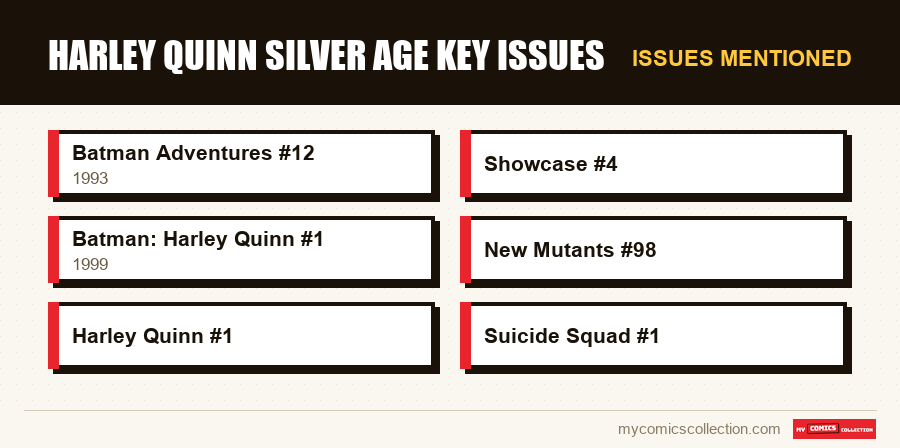
Harley Quinn's real key issues: reference table
| Issue | Significance | High-grade value (documented sources, 2024) |
|---|---|---|
| The Batman Adventures #12 (Sep. 1993) | 1st comic book appearance | CGC 9.8 direct: ~$3,250 · newsstand: ~$5,280 |
| Batman Adventures: Mad Love (Feb. 1994) | Full origin story (Dr. Harleen Quinzel) | Actively traded; CGC 9.8 prices not precisely documented publicly |
| Batman: Harley Quinn #1 (Oct. 1999) | 1st in-continuity DC Universe appearance, Alex Ross cover | Entry-level accessible; CGC 9.8 circulating on eBay and ComicConnect |
| Harley Quinn vol. 1 #1 (Oct. 2000) | First solo ongoing series | Accessible ungraded; high grade moderately valued |
| Suicide Squad vol. 4 #1 (Sep. 2011) | New 52 redesign, new red-and-blue look | Accessible; demand sustained by film adaptations |
The Batman Adventures #12 (1993): the essential key
Published in September 1993 with script by Kelley Puckett and art by Mike Parobeck, The Batman Adventures #12 is the first printed appearance of Harley Quinn: released just under a year after her television debut in September 1992. The character had originally been conceived as a one-scene walk-on in the animated series; her unexpected popularity with audiences led to her development as a recurring villain and, eventually, to her full integration into the DC Universe proper.
On the market, this issue is the undisputed Harley Quinn grail. Approximately 9,000 copies have been certified by CGC: a modest census compared to high-volume modern keys like New Mutants #98 (Deadpool's first appearance, over 25,000 graded copies). CGC 9.8 direct-edition copies trade at around $3,250, while the rarer newsstand variant commands around $5,280 at the same grade, according to 2024 market data compiled by sellmycomicbooks.com. Mid-grade entry points: CGC 9.6 ($1,300-$1,430) and CGC 9.4 ($840-$1,075): remain active for collectors who do not require a 9.8.
Batman Adventures: Mad Love (1994): the official Harley Quinn origin
Published in February 1994, Batman Adventures: Mad Love is a prestige-format one-shot written by Paul Dini and drawn by Bruce Timm: Harley Quinn's original creators. It tells the complete story of Dr. Harleen Quinzel, a psychiatrist at Arkham Asylum who falls under the Joker's influence and crosses into crime. The book is the definitive statement on the character's psychology and won both the Eisner Award and the Harvey Award in its year of publication, two of the medium's highest distinctions.
In collection terms, Mad Love is an actively sought key in high grade. Precise CGC 9.8 records are not publicly documented to the same degree as Batman Adventures #12, but the prestige format remains active on Heritage Auctions and ComicConnect. Copies signed by Dini in CGC Signature Series command a notable premium over unsigned equivalents.
Later keys: DC Universe, solo series, and New 52
Batman: Harley Quinn #1 (October 1999, written by Paul Dini, cover by Alex Ross) marks Harley Quinn's official transfer from the animated universe into DC's main continuity: the Batman Adventures issues having been published under a tie-in imprint rather than the core DC line. The Alex Ross cover makes it a particularly desirable display piece. In October 2000, Harley Quinn gained her first true solo ongoing with Harley Quinn #1, written by Karl Kesel and drawn by Terry Dodson. September 2011 brought the New 52 relaunch in Suicide Squad #1 (Adam Glass), which gave the character a radical redesign (bleached skin, bicolored red-and-blue hair) that directly inspired Margot Robbie's portrayal in Suicide Squad (2016, $746.8 million worldwide gross). Harley Quinn vol. 2 #1 (November 2013, Jimmy Palmiotti and Amanda Conner) is the most acclaimed solo launch in her catalogue, a run that significantly expanded her readership. The Suicide Squad (2021, directed by James Gunn) grossed $168.7 million worldwide, and Lady Gaga subsequently played the character in Joker: Folie à Deux (2024), extending the character's cultural reach into a new decade.
Frequently asked questions
No: the Silver Age covers roughly 1956-1970, and Harley Quinn was created in 1992 by Paul Dini and Bruce Timm, debuting on television on September 11, 1992 in the "Joker's Favor" episode of Batman: The Animated Series. Any listing claiming otherwise is selling a reprint, a facsimile or a misdescribed issue.
The Batman Adventures #12 (September 1993), by Kelley Puckett and Mike Parobeck, the character's first appearance in print. The rarer newsstand variant is valued above the direct edition.
Batman Adventures: Mad Love (February 1994), by Paul Dini and Bruce Timm, tells the full story of Harleen Quinzel, an Arkham psychiatrist who falls under the Joker's influence. This prestige one-shot won the Eisner and Harvey awards the year it was published.
Batman: Harley Quinn #1 (October 1999), written by Paul Dini with a cover by Alex Ross. The Batman Adventures issues belonged to a tie-in label for the animated series; Harley Quinn vol. 1 #1 (2000) is then her first ongoing solo series.
Suicide Squad vol. 4 #1 (September 2011) introduces her new red and blue look. It remains accessible, with demand supported by the film adaptations.
Own a Harley Quinn comic? Get a free valuation with our tool based on real eBay sales to find its low, median, and high value.