There are no Harley Quinn Bronze Age key issues: the character was created in 1992, long after that era ended. The true collector grail is The Batman Adventures #12 (September 1993), her first printed comic appearance: a CGC 9.8 direct edition sold for around $3,250 in 2024, with the newsstand variant reaching $5,280 at the same grade (source: sellmycomicbooks.com / Goldin Auctions).
Harley Quinn was created in 1992 by writer Paul Dini and artist Bruce Timm for Batman: The Animated Series. Her debut episode, "Joker's Favor", aired on September 11, 1992: decades after the Golden, Silver, and Bronze Ages of American comics. There are therefore no Harley Quinn issues from those earlier eras: any article, list, or listing claiming otherwise is simply mistaken.
This guide sticks to the verifiable: documented records from specialist platforms (sellmycomicbooks.com, GoCollect, Goldin Auctions) and established historical facts. Our eBay estimator does not index the Batman Adventures , Harley Quinn , or Suicide Squad series: no eBay medians are cited for these titles. All figures quoted come exclusively from documented third-party sources.
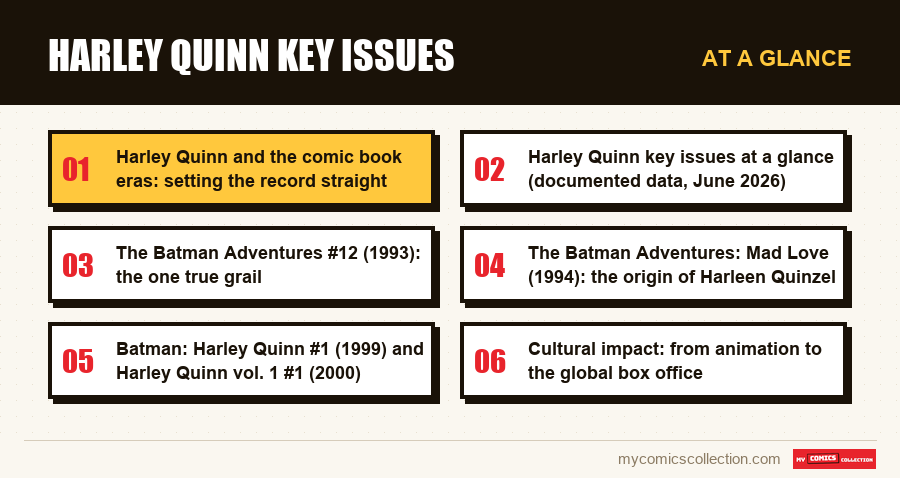
Harley Quinn and the comic book eras: setting the record straight
The Bronze Age of American comics runs roughly from 1970 to 1985. The Silver Age spans the late 1950s to the early 1970s. Harley Quinn made her first appearance, on screen and on paper, in 1992, firmly placing her in the Modern Age (sometimes called the Copper Age for the 1984-1992 window, depending on which periodisation you follow). She has no issues from any earlier era. A collector searching for a "Bronze Age Harley Quinn key" is searching for something that was never published.
Harley Quinn key issues at a glance (documented data, June 2026)
| Issue | Significance | High-grade value (documented source) |
|---|---|---|
| The Batman Adventures #12 (Sep. 1993) | 1st printed appearance of Harley Quinn | CGC 9.8 direct: ~$3,250 · CGC 9.8 newsstand: ~$5,280 (Goldin Auctions, 2024) |
| The Batman Adventures: Mad Love (1994) | Origin of Harleen Quinzel: Dini & Timm | Active CGC market; high-grade record not publicly documented |
| Batman: Harley Quinn #1 (1999) | 1st mainstream DC Universe appearance; Alex Ross cover | Qualitative: accessible in low grade, premium in CGC 9.8 |
| Harley Quinn vol. 1 #1 (Dec. 2000) | First Harley Quinn solo ongoing series | Accessible ungraded; high-grade value depends on CGC grade |
| Suicide Squad #1 (New 52, 2011) | Iconic new look, popularised by the 2016 film | Entry-level accessible; variants and CGC 9.8 command a premium |
The Batman Adventures #12 (1993): the one true grail
Published on August 3, 1993 with a September 1993 cover date, The Batman Adventures #12 is the Harley Quinn key for any serious collector. The story "Batgirl: Day One" (script by Kelley Puckett, art by Mike Parobeck and Rick Burchett) introduces Harley Quinn in print for the first time: a few months after her creation by Paul Dini and Bruce Timm for the animated series. She appears in her original red-and-black costume alongside the Joker.
The market is well supplied (approximately 9,000 CGC-certified copies exist) but demand remains consistent. In 2024, sales documented via Goldin Auctions place the CGC 9.8 direct edition around $3,250 , versus $5,280 for the scarcer newsstand variant at the same grade. The lower-grade market stays active: a CGC 8.0 has traded around $550, a CGC 7.0 around $450. At the 2021 post-pandemic peak, a CGC 9.8 direct reached $2,640 and a newsstand $3,800: meaning 2024 levels have surpassed those earlier highs. Expert consensus is consistent: only high grade (9.6 minimum) justifies a long-term investment on a title that is too common in the mid-grade range.
The Batman Adventures: Mad Love (1994): the origin of Harleen Quinzel
Published in 1994 in prestige format (squarebound, 64 pages), Mad Love was co-written and illustrated by Paul Dini and Bruce Timm: the characters's original creators. It is the founding story that explains how psychiatrist Harleen Quinzel, working at Arkham Asylum, fell under the Joker's influence and became Harley Quinn. The album won both the Eisner Award and the Harvey Award in 1995, cementing its narrative standing. It is an essential companion piece to Batman Adventures #12 for any Harley Quinn collection. First printings are identifiable by a black cover with a playing card in the lower right corner reading "Mad Love" in red lettering. The CGC market for Mad Love is active, but high-grade auction records have not been publicly documented to date.
Batman: Harley Quinn #1 (1999) and Harley Quinn vol. 1 #1 (2000)
Batman: Harley Quinn #1, published September 30, 1999, is another notable key: it marks Harley Quinn's first appearance in the mainstream DC Universe continuity, outside the animated universe. The cover by Alex Ross, one of the medium's most celebrated painters, makes it a visually distinctive piece. Harley Quinn vol. 1 #1 (December 2000, script by Karl Kesel, art by Terry Dodson) then opened her first solo ongoing series: an editorial milestone every Harley collector will recognise. Both issues remain accessible in low grade and represent a reasonable entry point into the collection without requiring a large budget.
Cultural impact: from animation to the global box office
Harley Quinn's film success directly fuelled demand for her key comics. Suicide Squad (2016, directed by David Ayer, with Margot Robbie in the role) grossed $749 million worldwide. Birds of Prey (2020) totalled $205.5 million , and James Gunn's The Suicide Squad (2021) brought in $168.7 million . The animated Harley Quinn series voiced by Kaley Cuoco launched in November 2019 on DC Universe and has run for multiple seasons. Each major release has generated demand spikes for The Batman Adventures #12 and the surrounding keys.
Own a Harley Quinn comic? Get a free valuation with our tool based on real eBay sales to find its low, median, and high value.
Frequently asked questions
No: Harley Quinn was created in 1992 by Paul Dini and Bruce Timm for Batman: The Animated Series, well after the Bronze Age ended. Any list or sale claiming otherwise is inaccurate.
On screen, in the episode "Joker's Favor", aired on 11 September 1992. In print, in The Batman Adventures #12 (cover-dated September 1993), with the story "Batgirl: Day One" by Kelley Puckett, Mike Parobeck and Rick Burchett.
The Batman Adventures #12, Harley Quinn's first printed appearance, where she wears her original red and black costume alongside the Joker. In high grade, the newsstand variant trades higher than the direct edition.
The Batman Adventures: Mad Love (1994), which tells the origin of Harleen Quinzel, Batman: Harley Quinn #1 (1999), her first appearance in the main DC universe with a cover by Alex Ross, and Harley Quinn vol. 1 #1 (December 2000), her first solo ongoing. Suicide Squad #1 (New 52, 2011) introduces her new look, popularised by the 2016 film.
The Modern Age, which begins after the Bronze Age (roughly 1970-1985). She therefore has no issue in the Golden, Silver or Bronze Ages.