
The ultimate Doctor Strange key is Strange Tales #110 (July 1963, Silver Age): a CGC 9.6 copy sold for $150,000 at Heritage Auctions in April 2024. For the Bronze Age, the revival begins with Marvel Premiere #3 (July 1972), followed by the celebrated Englehart/Brunner run and Doctor Strange vol.2 #1 (1974): issues with documented records that are far more accessible than their Silver Age predecessor.
Doctor Strange was created by Stan Lee and Steve Ditko in Strange Tales #110 in July 1963: a Silver Age issue where the character appeared as a backup feature alongside the Human Torch. The series became Doctor Strange with issue #169 (1968), the first title to carry his name, continuing the Strange Tales numbering. After cancellation with #183 (1969), the Bronze Age brought a genuine revival: Marvel Premiere #3 (1972) launched a new solo run, and the Steve Englehart/Frank Brunner collaboration (1973-1974) is now considered among the finest Marvel comics of the decade. Benedict Cumberbatch later introduced the character to a new generation: Doctor Strange (2016) grossed $677.8 million worldwide, Doctor Strange in the Multiverse of Madness (2022) $955.8 million, and the character played a pivotal role in Spider-Man: No Way Home (2021, $1.9 billion worldwide).
This guide focuses on documented keys from the Bronze Age (1970-1979) and the unmissable Silver Age first appearance. Note: our eBay estimator does not index the Strange Tales , Doctor Strange (any series), or Marvel Premiere titles: all figures cited come exclusively from documented specialist sources (Heritage Auctions, sellmycomicbooks.com, GoCollect). No number is invented; where no public record exists, we remain qualitative.
Doctor Strange key issue ranking (real documented data)
All records below come from Heritage Auctions and sellmycomicbooks.com. Our eBay estimator does not cover these series: no eBay median is cited.
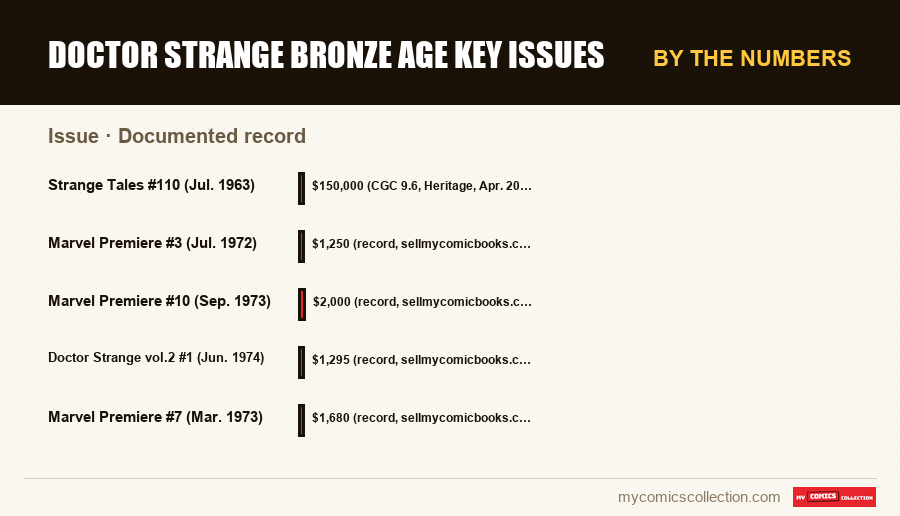
| Issue | Significance | Documented record |
|---|---|---|
| Strange Tales #110 (Jul. 1963) | 1st appearance: Stan Lee/Steve Ditko (Silver Age) | $150,000 (CGC 9.6, Heritage, Apr. 2024) |
| Marvel Premiere #3 (Jul. 1972) | 1st Bronze Age solo: Stan Lee/Barry Windsor-Smith | $1,250 (record, sellmycomicbooks.com) |
| Marvel Premiere #10 (Sep. 1973) | Shuma-Gorath climax: Englehart/Brunner | $2,000 (record, sellmycomicbooks.com) |
| Doctor Strange vol.2 #1 (Jun. 1974) | First-ever #1 issue: Englehart/Brunner (Silver Dagger) | $1,295 (record, sellmycomicbooks.com) |
| Marvel Premiere #7 (Mar. 1973) | Englehart/Brunner arc key | $1,680 (record, sellmycomicbooks.com) |
Sources: Heritage Auctions (Strange Tales #110 record), sellmycomicbooks.com (Marvel Premiere and Doctor Strange vol.2 records).
Strange Tales #110 (1963): the Silver Age key you cannot ignore
Even in a Bronze Age guide, the starting point demands attention. Strange Tales #110 (July 1963) contains the first appearances of Doctor Strange, the Ancient One, Nightmare, and Wong: four founding characters in a single issue. The seven-page story is written by Stan Lee and drawn by Steve Ditko, the duo who defined the character's psychedelic visual identity. This issue is notoriously scarce in high grade : a CGC 9.6 copy sold for $150,000 at Heritage Auctions in April 2024. A CGC 9.2 brought approximately $42,500, and a CGC 9.4 reached around $55,200 at earlier market peaks. Entry-level copies (CGC 4.0) trade around $4,000. This is a genuine investment, not an impulse buy.
Marvel Premiere #3 (1972): the Bronze Age revival
Marvel Premiere #3 (July 1972) launches the Bronze Age renaissance of the Sorcerer Supreme. The anthology title, Marvel's vehicle for testing solo characters, carries a script by Stan Lee over a visual plot by Barry Windsor-Smith, who also handles the interior pencils. The story, titled "While the World Spins Mad!", pits Doctor Strange against Nightmare and marks the character's return to dedicated solo format after the post-#183 hiatus. This issue opens a run covering Marvel Premiere #3 through #14 (July 1972: March 1974).
The documented record sale for this issue is $1,250 according to sellmycomicbooks.com: far below the Silver Age ceiling but a solid Bronze Age market signal. Ungraded copies in presentable condition circulate at considerably more accessible price points, making this an attainable key for a collector wanting to anchor the beginning of the character's greatest creative period.
Marvel Premiere #9-14 and the Englehart/Brunner run
Starting with Marvel Premiere #9 (1973), Steve Englehart (writer) and Frank Brunner (artist) took charge of the character for what is now regarded as one of the great Bronze Age Marvel runs. Their collaboration, conceived over regular dinners where the two plotted stories together, extended from Marvel Premiere #9 through #14 and then into Doctor Strange vol.2 #1 through #5, producing psychedelic, cosmically ambitious stories that stood apart from mainstream superhero fare. The Shuma-Gorath arc, which sees the death of the Ancient One and Doctor Strange's ascension to Sorcerer Supreme, peaks in Marvel Premiere #10 (September 1973), whose documented record stands at $2,000 . Marvel Premiere #7 (March 1973) carries a record of $1,680 from the same source. These issues remain accessible in mid grade but command significantly higher values in high-grade CGC.
Doctor Strange vol.2 #1 (1974): the first real number one
Published in June 1974, Doctor Strange vol.2 #1 is the very first issue of the character's history to carry the number "1": the 1968 series had continued the Strange Tales numbering from #169. Written by Steve Englehart and drawn by Frank Brunner (inks by Dick Giordano), the issue introduces Silver Dagger, a new villain who breaks into the Sanctum Sanctorum. Englehart and Brunner co-plotted the series together, defining a shared vision that made the opening arc a cohesive artistic statement. Brunner's cover for this issue remains a reference point for the character five decades later. The documented record sale is $1,295. CGC 9.8 copies with white pages represent the top of the market; no single public record exists for that grade, so no figure can honestly be cited.
Own a Doctor Strange comic? Get a free valuation with our tool based on real eBay sales to find its low, median, and high value.
Frequently Asked Questions
Marvel Premiere #3 (July 1972) launches the Sorcerer Supreme's renaissance in an anthology that tests characters as solos. The script is by Stan Lee over a visual plot by Barry Windsor-Smith, who also draws the interior pages. It is far more accessible than the Silver Age issues.
Steve Englehart and Frank Brunner, whose run (1973-1974) is considered among the most beautiful pages of the decade. Marvel Premiere #7 (March 1973) is an arc key, Marvel Premiere #10 (September 1973) delivers the Shuma-Gorath climax, and Doctor Strange vol.2 #1 (June 1974) introduces Silver Dagger.
Because it is the unavoidable starting point: the first appearance of Doctor Strange, the Ancient One, Nightmare and Wong, four founding characters in one issue. The seven-page story is by Stan Lee and Steve Ditko, who defined the character's psychedelic aesthetic. The character appeared there as a backup feature alongside the Human Torch.
From issue #169 (1968), the first title in his own name, which continues Strange Tales numbering. After an interruption with #183 (1969), it is the Bronze Age that sees the Sorcerer Supreme truly reborn, with Marvel Premiere #3 in 1972.
Benedict Cumberbatch popularized the character with a new generation through Doctor Strange (2016). The Bronze Age keys benefit, while remaining far more accessible than Strange Tales #110. Where no public record exists, it is better to stay cautious than to extrapolate.