Catwoman is not a hero, nor is she an adversary. She has never been one for long, and that is precisely what her readers like about her. From the point of view of a catalog, this indetermination is costly: it prevents it from carrying the antagonism of a major event, from serving as a rallying figure, from holding its place in a team without the question of its loyalty ending up occupying the entire story, and from being entrusted to a franchise which needs a stable promise. In exchange, she offers him what almost no one else has: the ability to cross alignments without denying oneself, to remain readable in opposing registers, and to last more than eighty years without recasting. His longevity is exactly what keeps him from occupying the most profitable roles.
There is a category of characters that we never quite know which side they are on, and this category is much narrower than we imagine. Most of the figures that we believe to be ambiguous are only so for a while: they oscillate for a few years, then an author decides, a saga fixes them, an adaptation stabilizes them, and the ambiguity becomes a biographical anecdote. Catwoman is an exception. It was never decided. No saga has definitively put it away, no reference version has imposed its answer, and no generation of readers has inherited a clear verdict from the previous generation. What is striking, when we consider her from a distance, is not that she changes sides, many characters change sides, it is that she never needed to choose to remain credible.
This peculiarity is usually recounted as a writing success, and it is one. But it has a reverse side that is rarely formulated, and this reverse side is industrial before being literary. A publishing house does not create personalities, it creates roles: it needs threats on which to build an event, reliable figures around which to group a team, promises clear enough to carry a franchise and identities stable enough to be declined. Each of these roles requires something that ambiguity denies by construction. Catwoman is therefore a character that publishing loves to publish and struggles to use. The thesis of this article is contained in one sentence: moral ambiguity is a literary quality and an industrial handicap, and there is no way to keep the former without paying for the latter.
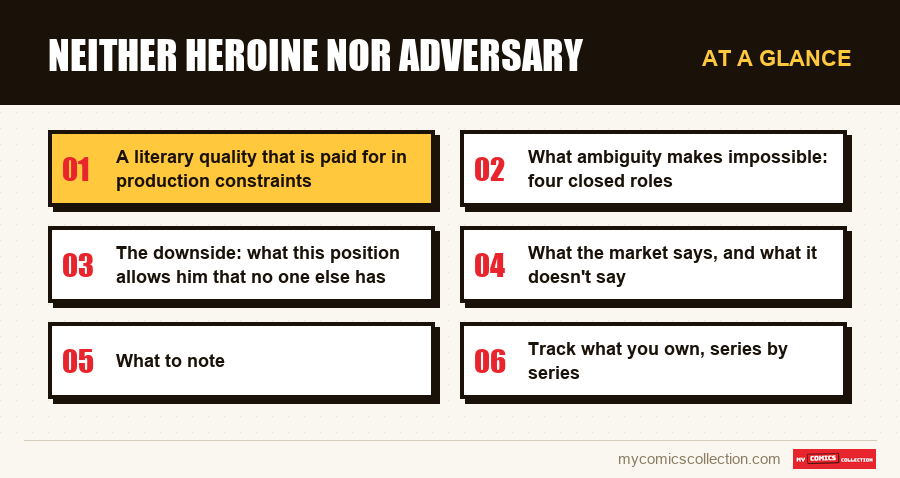
A literary quality that is paid for in production constraints
Moral ambiguity is one of the few traits that a reader recognizes immediately and that an editor cannot plan for. It produces scenes that nothing else produces: conversations where we don't know what is going to be decided, alliances whose end is visible from the start, greetings that look like threats. But it doesn't fit into any programming box, and a publishing house programs. It publishes regular series, prepares events eighteen months in advance, decides which characters will carry which promise and which will be available for other titles. In this order of concerns, a character whose status cannot be written on a card is a complicated asset, whatever its artistic interest.
What ambiguity makes impossible: four closed roles
We must take seriously the idea that an editorial role is a formal constraint, not a preference. When a house launches a big event, it doesn't just need a charismatic villain: it needs a threat that nothing relativizes, because the entire system is based on the idea that everyone must unite against it. When she puts together a team, she doesn't just need a squad: she needs the places to be acquired, otherwise each scene replays the same question. When she entrusts a franchise to a character, she is not buying a character but a promise: the reader must know, before opening, what kind of experience he is buying. Catwoman fails all three of these tests, and a fourth, for the same single reason-her definition lies in not being defined.
She cannot carry the antagonism of an event
A big event works because the threat is unreserved: it cannot be discussed, it cannot be negotiated, it does not include any zone where one could understand its point of view. But the interest of Catwoman lies entirely in this area. Making her the central threat would mean removing what makes her herself, and the reader would immediately feel this as a manufactured betrayal. Conversely, maintaining it as it is would cause the collective urgency to collapse: we do not mobilize an entire community against someone who half the room expects to be right.
She cannot be the rallying figure
The symmetrical role is closed to him for a symmetrical reason. A rallying figure must be reliable: the story delegates the reader's trust to him, and this delegation does not support any reservations. A character who we do not know if he will keep his word cannot occupy the place where we keep our word by definition. Every time a story attempts to promote her to this position, it must first make her prove something, and this demonstration consumes the narrative space that the rallying figure is supposed to free up for others.
She can't settle into a team
A team is based on an economic presupposition: the places are acquired, therefore the story can move on to something else. Introducing a member whose loyalty remains open replaces this presupposition with a question, and this question is structurally inexhaustible. Either the screenwriters pose it, and it ends up occupying the entire device to the detriment of the external intrigues; or they stop asking it, and the character loses what distinguished him. Both outcomes are losses, which explains why his passages in collective training are always sequences, never installations.
She can't support a franchise
A franchise sells a stable and renewable promise: a register, a tone, a type of adventure that we find from one product to another. This is the exact opposite of a character whose interest lies in not knowing in advance what register he is in. Declining Catwoman in range would mean choosing for her, once and for all, the answer she refuses to give. Attempts always come up against the same wall: they succeed artistically as they fail commercially to be reproducible.
These four impossibilities become one, expressed in four different grammars. Each of these roles requires a fixed position, and the character only exists on condition of not fixing it. It is therefore not an operating defect, publisher negligence or a lack of ambition: it is an incompatibility of form. And it must be said clearly, because the usual conclusion, “we never knew what to do with it”, is false and unfair. We knew very well what to do with it. We have simply never been able to give him the jobs that pay the most, because these jobs all require something of which his literary value is the negation.
We must carefully distinguish two notions that we constantly confuse: the ambivalence of a character and their indecision. An indecisive character hesitates, suffers from his hesitation, and the story works to resolve it. Catwoman doesn't hesitate. It has perfectly defined priorities, they simply do not coincide with those of one camp or those of the other.
This difference explains why it does not wear out. A hesitation is resolved and the character falls back; an autonomous scale of values is never resolved, because there is nothing to resolve. This is also what makes his position irreducible to the roles described above: we can make a hesitation evolve into a decision, we cannot convert private coherence into public allegiance.
The downside: what this position allows him that no one else has
An industrial handicap is not a curse. What Catwoman loses in profitable roles, she gains back in circulation, and this gain is considerable: to the point that it probably explains her uninterrupted presence since the beginning. Three benefits are worth detailing, because they are all direct consequences of the same cause.
Crossing alignments without denying yourself
Most characters who change sides pay for each passage of a justification. The conversion must be explained, made credible, its consequences assumed, and the readership keeps track of it. Catwoman doesn't pay anything, because she doesn't change sides: she occupies the same point while the camps move around her. A story can therefore place her on the side of order then on the side of disorder in the space of a few months without having to write the slightest transition.
Remain legible in opposing tones
Some characters do not survive the change of register: transposed into a tonality that is not their own, they become involuntarily comical or frankly illegible. It supports the criminal story and the light story, the fresco and the miniature, the romantic and the dry, because its coherence does not depend on any moral decorum. There is no tone in which it would be out of place, making it available for almost any project.
Last without redesign
Longevity is generally purchased at the price of periodic reconstructions: we redefine motivations, we rewrite origins, we adjust the character to the era. She has gone through more than eighty years without any of these operations being necessary, because indeterminacy never goes out of fashion. There is nothing to modernize in a position of refusing positions.
Serve as a revealer to others
His presence forces the characters around him to articulate what they believe. Faced with a clear threat, a hero acts; in front of her, he must explain why he acts, and this is where the story becomes interesting. This moral test function is a constant use value, which explains the frequency of its appearances even in periods where it does not carry any series.
Enter anywhere without authorization
A clearly ordered character requires justification for appearing outside of his or her domain. She doesn't ask for any: her presence in a plot need never be motivated by alliance or hostility. This lack of entry cost makes it a narrative tool of rare flexibility, which can be used in an isolated episode as well as in a long arc.
Resisting reinterpretations
Each era has proposed its reading of it, and none has canceled the previous ones. A defined figure is replaced by its most recent version; an indeterminate figure accumulates its versions without hierarchy. This is why a reader today can approach any period without feeling like they are reading an outdated variant.
Collecting this series?
Track what you own, what you are missing and what your collection is worth. 7 day trial.
Start my trial →What the market says, and what it doesn't say
An editorial thesis is difficult to verify with figures, and we must be careful not to make them say more than they can. A survey carried out on August 29, 2026 on the advertisements published for a solo series from the 2000s concerning her counted one hundred and seventy-five, with amounts claimed ranging from one dollar to one hundred and eighty dollars and a mid-distribution of seven dollars. These amounts are requested by sellers, not observed during transactions: they describe intentions, not a market.
What this survey allows us to observe is limited but clear. One hundred and seventy-five proposals available at the same time, half of which are below seven dollars, describe a long, abundantly printed and easily accessible series. This is the signature of a continuous career: a character published without interruption produces volume, and volume is not a rarity. The isolated maximum, at the other end of the scale, contradicts nothing: it reflects the hope of a particular seller on a particular copy, and a hope is not an established price. No trend can be inferred from a single reading, and none of these observations constitute predictions.
There is, however, a discreet coherence between this observation and the thesis. Characters employed in the most profitable roles focus attention on a small number of decisive moments, the value of which follows. A character who crosses everything without ever occupying the center produces on the contrary a diffuse presence, spread over decades and hundreds of issues. It’s another form of success, less concentrated, more difficult to grasp, and much more comfortable for those who want to build a collection without chasing exceptional pieces. To locate the moments when attention was really concentrated, reading the key numbers remains the most effective starting point.
What to note
Ambiguity is not a phase, it is its definition. We cannot wait for it to be resolved, and we must not read its variations as stages on a journey that ends somewhere. Each story starts the question from scratch because the question is the character. A reader looking for a coherent moral progression from one decade to the next will be looking a long time, and for the wrong reasons.
The most profitable roles all require a fixed position. Event threat, rallying figure, permanent team member, franchise head: these four jobs only have this requirement in common, and it is exactly the one that it cannot satisfy. Understanding this avoids the usual misunderstanding of seeing editorial negligence where there is a formal inconsistency.
Its longevity and its ceiling have the same cause. This is the most counterintuitive and important point. We would like to believe that we could maintain the duration by removing the ceiling; it's impossible, because what has kept her available for more than eighty years is precisely what keeps her from top jobs. Any attempt to lift the cap involves slicing, and slicing removes the reason for its duration.
The volume is not a failure. A continuous career produces numerous print runs and a lasting abundance in circulation, which the reading of August 29, 2026 soberly illustrates. Confusing abundance with low interest is a common misjudgment: abundance measures the consistency of publication, not the quality of what has been published.
For a collector, the reading order matters more than the internal chronology. Since no version expires the previous ones, entry into the character is chosen by tone rather than by date. It's a rare case where you can start almost anywhere without penalizing yourself, provided you accept that your side's question will never be answered, and know precisely what you already have, which requires orderly tracking rather than approximate memory.
Neither, and it's not a dodge. It pursues its own priorities, which sometimes overlap those of one camp and sometimes those of the other, without ever being confused. Stories that try to put it definitively on one side produce a weakened version, because they remove the tension that makes it interesting. The right question is not which side she stands on, but what she values , and the stories make this quite clear.
Because a large-scale event is based on a threat that nothing can put into perspective. The entire device consists of bringing together characters who usually do not cooperate, and this convergence only makes sense if the adversary leaves no room for discussion. It occupies exactly the place of discussion. Placing it at the center would require hardening it to the point of making it unrecognizable, or maintaining its ambivalence and seeing the collective emergency collapse.
They're not failures, but they don't settle. The reason is mechanical: a team works because places are acquired, which frees the story for other intrigues. A member whose loyalty remains open replaces this assumption with a permanent questioning that ends up consuming all available space. The screenwriters then find themselves faced with a losing choice: ask the question until exhaustion, or abandon it and lose the singularity of the character.
Difficult, because a franchise first sells a renewable promise. The reader or viewer must know in advance what type of experience they are buying, and this predictability is the very condition of the variation. A character whose value rests on the unpredictability of his position cannot provide this guarantee without ceasing to be himself. This is why his best appearances are often isolated proposals, successful but not reproducible.
Very little, and we have to accept it. The statement of August 29, 2026 includes announcements in progress, that is to say amounts claimed by sellers, never completed transactions. One hundred and seventy-five simultaneous propositions with a seven-dollar middle distribution describe abundance, not value. The gap between the minimum and the maximum reflects very dispersed individual expectations. No conclusion about evolution can be drawn from this, and that is not what such counting is intended to do.
Track what you own, series by series
A character published continuously for more than eighty years leaves behind hundreds of booklets scattered between series, one-off appearances and entire periods that are easy to confuse. My Comics Collection lists what you have, reports shortages and prevents you from buying the same issue twice.