In 1986, a mini-series dedicated to Elektra broke the mold of everything published by its publisher at the time: painting and mixed techniques in place of inked lines, an exploded story, a narrator whose gaze cannot be trusted. It is an experimental work produced within a commercial catalog, and it could only exist in a very short editorial window: a character established enough to justify the expense, secondary enough so that a failure would not hurt anyone, and a publisher seeking legitimacy with an adult readership. Forty years later, the graphic influence is everywhere, critical recognition is acquired, and the market remains indifferent: on August 29, 2026, there were 144 online ads, between 0.99 and 249.95 dollars claimed, with a midpoint of distribution at 7.31 dollars.
There are two ways to look at a superhero comic book published by a major company. The first consists of reading it as a link: it arrives after something, it prepares something, it belongs to a continuity which encompasses and goes beyond it. The second consists of reading it as an autonomous object, with its own manufacturing rules, its own internal logic, its own formal challenge. Most series fall under the first reading. Some, very few, impose the second. The 1986 mini-series Elektra belongs to this handful, and this is precisely what makes it fascinating to study, and, as we will see, terribly unrewarding to collect.
What strikes you first is the refusal of the line. At that time, mass production was based on a well-oiled chain: penciling, inking, coloring, separation. Each stage has its job, its deadlines, its cost. The result is instantly recognizable: clear contours, flat areas, readability designed to survive cheap printing. The 1986 mini-series abandons this device. She is painted, and not just painted: she assembles materials, collages, textures that do not come from drawing. The boxes cease to be regular windows. The reader is no longer looking at a reproduced action, he is looking at a worked surface. It's a radical shift, and it occurs in a booklet sold on newsstands, alongside titles which have not changed anything in their method.
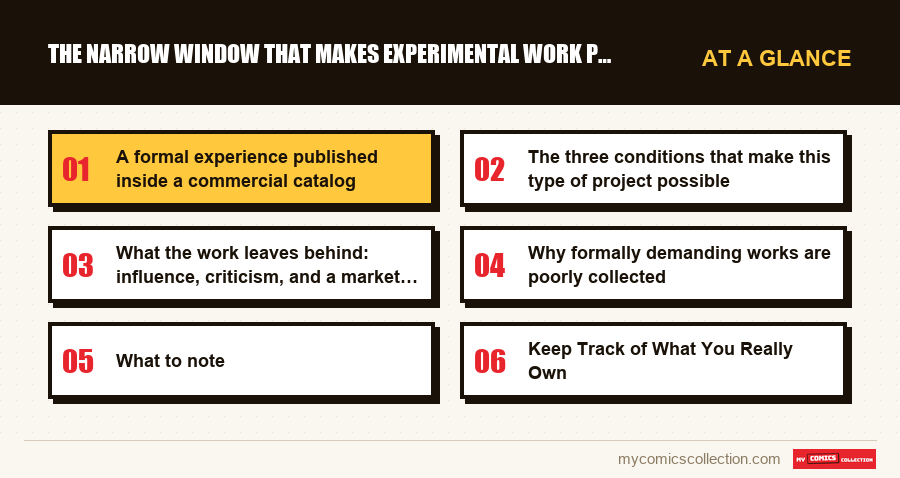
A formal experience published inside a commercial catalog
The anomaly must be measured. A mainstream comic book publisher of this era operates like a cadence factory. The publication schedule is sacred, readability is an industrial imperative, and the slightest deviation costs money before even reporting anything. A painted board takes longer than an inked board. It reproduces less well on economic paper. It often requires a different, and therefore more expensive, printing treatment. It is not easy to correct if the result disappoints, because there is no inker to correct it behind. In short, everything in the logic of production pushes us to refuse this type of project. And yet he comes out.
The narration accompanies the graphic gesture. The story does not unfold in a straight line: it returns on itself, interrupts itself, juxtaposes sequences of which we do not immediately know whether they are experienced, remembered or fantasized. The point of view is unstable, and this instability is not an accident of construction, it is the subject. We don't read what the character does, we read the way in which a damaged conscience organizes what she has gone through. The form becomes the argument. In a medium where the vast majority of production conscientiously explains to the reader what they are seeing, this reliance on ambiguity is an almost provocative luxury.
The three conditions that make this type of project possible
The thesis of this article is contained in one sentence: such a work only exists if three conditions are met at the same time, and this conjunction never lasts long. This is neither a stroke of luck nor an individual achievement: it is an editorial window that opens and closes. Here's what it's made of.
A character established enough to justify the expense
Nobody funds an expensive formal experiment around an unknown figure. The name must have already circulated, it must have left a trace in the readers' memory, a sales department must be able to say “we know this one is talking to someone”. Elektra, in 1986, crossed this threshold: she is no longer a passing figure, she is identified, she carries a reputation. It is this accumulated capital of attention that allows an atypical project to get through the door: it does not start from scratch, it builds on an already established interest.
Secondary enough that failure costs nothing
This is the condition that we always forget, and it is the most decisive. We don't do experiments on a locomotive. A title which carries the turnover of a house has no right to formal adventure: the risk of losing the established readership is too great. A second-tier character, on the other hand, offers a comfortable margin for error. If the miniseries goes unnoticed, nothing falls apart. This relative absence of stakes is exactly what buys freedom. The paradox is cruel: audacity is authorized because it doesn't quite count.
A publisher seeking to legitimize itself
The mid-1980s were a time when the major labels wanted to prove that they could produce something other than entertainment for teenagers. The ambient discourse speaks of maturity, of an adult audience, of cultural recognition. In this context, a difficult work is no longer just a commercial bet: it is an argument of prestige. It serves to show that the house knows how to do it. This search for legitimacy opens up a budget that purely accounting logic would never have unlocked.
A window that closes quickly
The three conditions do not hold together for long. A secondary character who meets with success ceases to be secondary, and becomes too valuable to be exposed. A publisher who has obtained legitimacy no longer needs to pay for it. And a character who remains obscure for a long time ends up no longer justifying the investment. The window is narrow by nature: it assumes an unstable balance between sufficient notoriety and limited stakes, at a time when the institution has something to prove.
This reading grid explains the existence of the mini-series much better than the usual heroic story: the one where a visionary creator wrests his project from obtuse leaders. Talent is obviously necessary, but it is not sufficient, and it is certainly not rare: in all eras, authors propose ambitious things. What is rare is the moment when the organization says yes. Look at the experimental production of the big houses over several decades: it is concentrated in clusters, around periods where these conditions coincide. It's not a story of individuals, it's a story of windows.
A practical consequence for the reader: look for experimental works where the commercial stake was moderate. Big, high-flying stocks are, by construction, conservative: they have too much to lose. The margins of the catalog, on the other hand, regularly house formally more daring objects, precisely because no one was watching too closely.
And a consequence for the collector: this same marginal position, which made audacity possible, is also what prevents the work from having influence on the market afterwards. Freedom and market value come, here, from the same cause, and they work in opposite directions.
What the work leaves behind: influence, criticism, and a market that doesn't move
Forty years later, we can make three separate assessments, and they do not tell the same story.
The first assessment is graphic, and it is spectacular. The paint applied to the superhero story, the assumed use of texture, the box treated like a plastic surface rather than a window: all of this has spread. We find this grammar in numerous covers, complete stories, and prestigious projects subsequently published. An entire generation of designers understood, by seeing this type of object, that the medium tolerated something other than the inked line. The influence is diffuse, difficult to quantify, but impossible to deny when we look at what comes next.
The second assessment is critical, and it is solid. The work figures into serious discussions about what mainstream comics has produced that is most ambitious. It is cited, analyzed, taught. It serves as an example when it comes to demonstrating that a commercial catalog can house formal research. This recognition has never been denied; it even consolidated over time, as distance allowed the gesture to be seen for what it was.
The third balance sheet is marketable, and it is flat. As of August 29, 2026, the list of online advertisements devoted to this mini-series gave 144 active proposals. The displayed floor went down below the dollar: 0.99 exactly, and the high went up to 249.95 dollars. The middle of the distribution was at $7.31. In other words: half of the sellers were asking less than eight dollars for an object unanimously presented as the pinnacle of the medium.
Collecting this series?
Track what you own, what you are missing and what your collection is worth. 7 day trial.
Start my trial →Why formally demanding works are poorly collected
We must take this gap seriously rather than being outraged by it. It is not accidental, and it does not only concern this title. Works that require reading effort share characteristics that systematically put them at a disadvantage in circulation between collectors. Here are the main ones.
No first appearance inside
A miniseries that explores the psyche of an already existing character introduces nothing. No new face, no new costume, no element that the rest of the production will take over. However, this is largely what buyers are looking for when they are looking for a specific booklet. A work without an entry point to point out literally goes under the radar of the most widespread research methods.
Difficult to recommend without preparation
An accessible story is conveyed in one sentence: “start there”. A story with a fragmented narration and unstable point of view cannot be transmitted like that. It is necessary to explain the context, warn about the form, accompany the reading. This friction greatly reduces the number of spontaneous recommendations, and the spontaneous recommendation is the main driver of circulation of a title.
Recognition that comes through criticism
The notoriety of this mini-series was built in the analytical texts, the retrospectives, the courses. It’s a slow, cultivated circuit that produces respect but very little purchasing urgency. Nothing to do with the rumor that circulates among readers and which triggers rapid movements on a given issue.
An abundant supply without scarcity
The August 29, 2026 statement showed 144 listings available at the same time. A buyer who wants these booklets has no reason to hurry or pay dearly: he immediately finds several sellers. The absence of tension on availability is enough to crush the asking prices, regardless of any consideration of the quality of the work.
An isolated summit that proves nothing
The maximum recorded, $249.95, stands out violently from the rest. It should not be read as a reference price: it is an amount hoped for by a seller, displayed in an ad, without any transaction to validate it. A solitary high point measures an ambition, not a market. The median at $7.31 is infinitely more informative about what actual demand is willing to consider.
A value that moves towards reissue
Formally careful works often end up being republished in formats that serve them better: better paper, restitution of textures, full presentation. This format becomes the object that readers really want to own, and the original fascicles find themselves relegated to the rank of historical curiosity: sought after by few people, therefore cheap.
None of these mechanisms say anything about the quality of the work. They describe circulation frictions: what is transmitted quickly, what is easily sought, what creates urgency. A demanding comic strip systematically ticks the wrong boxes in this grid, and the result is what we observe. We simply have to stop expecting the market to validate an aesthetic judgment: that's not its job.
What to note
The editorial window is the real subject. It's not the talent that's lacking when a big house doesn't publish anything experimental: it's the conjunction. You need an established but not central character, a moment when the institution wants to give itself cultural stature, and a temporary tolerance for risk. Take away just one of these three ingredients and the project doesn't come out. In 1986, around Elektra, the three were united, and it did not last.
The marginal position is both the cause of audacity and the cause of commercial indifference. This is the most interesting crux of this story. If the character had been a locomotive, we would never have let anyone abandon the inked line for painting and collage. But it is this same marginality which today deprives the booklets of the status of coveted object. You can't have both: creative freedom is paid for in commercial visibility, both in production and resale.
The 144 announcements noted on August 29, 2026 tell of an abundance, not a rejection. When more than one hundred and forty copies are offered simultaneously, no buyer has any reason to outbid. The floor under a dollar and the median at $7.31 reflect quiet availability, not a disavowal of the content. Remember that these are amounts requested by sellers, never recorded transactions: the distinction is essential before drawing any conclusion.
The maximum at $249.95 is noise, not a signal. An isolated point at the top of a distribution centered at $7.31 does not define any reference level. It expresses a person's hope, possibly supported by a particular state of conservation or a careful presentation. Building an estimate on this announcement would amount to confusing the exception displayed with the rule observed.
This stock is a great reader's buy and a bad investor's buy, and there is no contradiction. For a few dollars, you have access to an object that has changed the way the medium views color, material and narrative voice. This is a rare content/price ratio. On the other hand, nothing in what we observe suggests that we should buy it hoping for anything other than the pleasure of reading it and storing it correctly. Separating these two motivations already means avoiding half of the collection disappointments.
On three simultaneous levels. The graphic plan first: it is painted and worked in mixed techniques, where the standard production chain was based on sketching then inking then coloring. Then the narrative plan: the story does not progress linearly, it folds in on itself and juxtaposes sequences whose status remains ambiguous. Finally, the plan of the point of view: the consciousness which tells the story is not reliable, and this instability is the heart of the subject rather than a decorative artifice. Each of these choices, taken in isolation, was already unusual in the context; the three together constitute a real break.
Because three conditions were met at the same time. The character had accumulated enough notoriety for the expense to be justified to a sales department. It occupied a fairly secondary place in the catalog so that failure would not threaten any essential income. And the publisher was going through a period where he was actively seeking to demonstrate that he could address an adult readership, which transformed a difficult work into a prestige argument. Remove one of the three and the project remains in a drawer.
The survey carried out on August 29, 2026 on online advertisements identified 144 proposals, with amounts requested ranging from 0.99 to 249.95 dollars and a median at 7.31 dollars. These are amounts claimed by sellers, not closed sales: they indicate the level at which the offer appears, not the level at which it is concluded. The prudent reading is that an ordinary copy commonly sells for under eight dollars, in a context of abundant supply.
The two systems do not measure the same thing. Critical recognition assesses formal ambition, inventiveness and influence exerted. Circulation between collectors reacts to the rarity available, the ease of recommendation and the presence of identifiable sought-after elements: of which this mini-series is devoid since it does not introduce anything new. A work can therefore be cited everywhere and found everywhere, which is exactly the case here.
This probably isn't the best entry point. The fragmented construction and the uncertain narrator assume that we already have an idea of who the character is and what he has been through, otherwise a good part of the effects are lost. It is better to first approach stories with more direct narration, then return to this work knowing what it deconstructs. Read in this order, it takes on a whole new depth.
Keep Track of What You Really Own
Experimental works are exactly the ones we forget to inventory: they are neither expensive nor sought after, so they slip off the lists. My Comics Collection allows you to inventory your issues, track the status of each copy and instantly find what you already have, even on titles that no one talks about on the marketplaces.