The must-have key issue for any Thanos collector is Iron Man #55 (February 1973), the first appearance of the Mad Titan written and drawn by Jim Starlin: our eBay estimator returns a median of €9 across 73 listings, but that figure reflects a blend of all printings and all grades. In high grade, CGC copies trade at an entirely different level: a CGC 9.8 copy sold for $9,600 in 2022 according to sellmycomicbooks.com, against an all-time record of $13,025 set at ComicLink in 2013.
Thanos is a Bronze Age creation: there are no Silver Age or Golden Age issues featuring him. Jim Starlin invented the character for Iron Man #55 (February 1973), a single issue that also introduces Drax the Destroyer. That same Starlin then developed Thanos through an ambitious multi-title saga in the 1970s, before resurrecting him to orchestrate The Infinity Gauntlet in 1991: one of the most widely read cosmic events in the history of the medium.
This guide is editorial rather than exhaustive: it identifies the essential Thanos story arcs in publication order, weighing their literary significance against their interest to collectors. All prices come from our eBay estimator (eBay.fr + eBay.com, June 2026) or from auction records documented in specialist press.
Key issue overview by arc
| Issue | Arc / significance | eBay data (all grades) | Documented record |
|---|---|---|---|
| Iron Man #55 (Feb. 1973) | 1st appearance of Thanos and Drax the Destroyer | Median €9 · 73 listings | $13,025 (CGC 9.8, ComicLink 2013) |
| Captain Marvel #25-33 (1973-74) | The Thanos War: Starlin's original saga | Series not in tool | Not publicly documented |
| Avengers #125 (Jul. 1974) | Avengers crossover in the Thanos War | Median €9 · 54 listings | Not publicly documented |
| Silver Surfer #34 (1990) | Thanos returns: Infinity Gauntlet prelude | Median €19 · 55 listings | Not publicly documented |
| The Infinity Gauntlet #1-6 (1991) | Starlin/Pérez/Lim: the cosmic masterpiece | Series not in tool | Not publicly documented |
| Infinity #1-6 (2013) | Hickman: introduces the Black Order and Thane | Series not in tool | Not publicly documented |
| Thanos vol.2 #13-18 (2017-18) | Cates/Shaw: "Thanos Wins", Cosmic Ghost Rider | Series not in tool | Not publicly documented |
Price sources: mycomicscollection.com eBay estimator (June 2026), sellmycomicbooks.com, Bleeding Cool.
The Thanos War (1973-1974): Starlin's founding arc
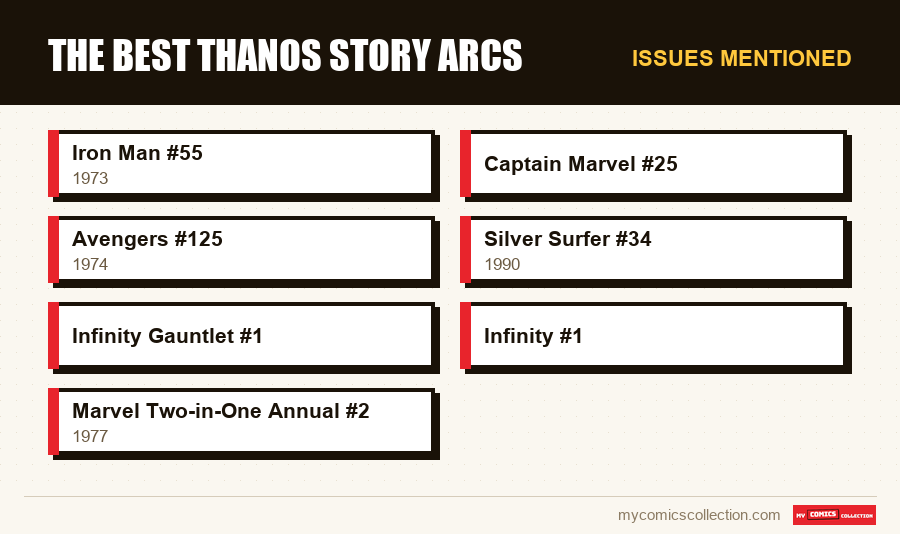
Everything begins with Iron Man #55 (February 1973), plotted and drawn by Jim Starlin with a co-script by Mike Friedrich. This Bronze Age issue introduces Thanos, the Mad Titan, alongside Drax the Destroyer, Mentor, Starfox, and the Blood Brothers: an extraordinary concentration of first appearances in a single issue. Starlin then took over Captain Marvel from issue #25 and built an ambitious saga running through #33 (March 1973: January 1974, published bi-monthly). The central thread: Thanos seeks the Cosmic Cube to conquer the universe, with Mar-Vell and Rick Jones standing in his way. The arc spilled into Avengers #125 (July 1974), where Earth's Mightiest Heroes are drawn into the conflict. It concluded in Marvel Two-in-One Annual #2 (1977) with Thanos's death: turned to stone by Adam Warlock.
For collectors, Captain Marvel and Marvel Two-in-One Annual are not covered by our eBay tool: no reliable median is available. Avengers #125 returns a median of €9 across 54 listings: a solid volume for the entry-level market. In high-grade CGC, these Bronze Age issues are sought after but no public auction record has been widely documented for them.
Thanos Returns and The Infinity Gauntlet (1990-1991): the absolute peak
After thirteen years of absence, Thanos was resurrected by Jim Starlin in Silver Surfer #34 (1990, art by Ron Lim). The mission assigned to him by Death eclipses anything he attempted in the 1970s: kill half of all living beings in the universe. This run of issues (#34-38), collected as "Rebirth of Thanos," serves as the direct prelude to The Infinity Gauntlet. Our eBay estimator returns a median of €19 across 55 listings for Silver Surfer #34: the highest of any Thanos key covered by the tool, reflecting its status as the key return issue.
The Infinity Gauntlet #1-6 (1991) is the arc that made Thanos a universal villain. Starlin on script, George Pérez on pencils (replaced by Ron Lim from #4 onward): Thanos assembles the six Infinity Gems, snaps his fingers, and erases half of all life in the universe. The miniseries has been continuously in print for over thirty years and directly inspired the structure of Avengers: Infinity War (2018, $2.048 billion worldwide box office) and Avengers: Endgame (2019, $2.799 billion: the second highest-grossing film of all time). Our eBay tool does not cover The Infinity Gauntlet as a separate series, so no reliable median can be cited here.
Infinity (2013) by Jonathan Hickman: Thanos as conqueror
After Starlin's arcs, the next major Thanos moment in comics is Infinity (2013) by Jonathan Hickman, with art by Jim Cheung, Jerome Opeña, and Dustin Weaver. Across six issues, Hickman runs two parallel threads: the Avengers in space fighting the Builders, and Thanos seizing the opportunity to invade Earth with his Black Order: Corvus Glaive, Proxima Midnight, and their lieutenants. The arc introduces Thane, Thanos's secret son, whose power traps the Mad Titan in a state of living death. It is Hickman who conceptualizes the Black Order and lays the groundwork for the MCU's Phase 3 adaptations. The political and cosmological depth of the arc sets it apart from most Marvel events of that era.
"Thanos Wins" (2017-2018) by Donny Cates: the modern reference
The Thanos vol.2 run by Donny Cates and Geoff Shaw (specifically the "Thanos Wins" arc (#13-18, 2017-2018)) redefines the character for a new generation. The premise: present-day Thanos is pulled to the end of time by his future self, "King Thanos," who has achieved absolute destruction and found only emptiness waiting for him. The arc introduces the Cosmic Ghost Rider (Frank Castle as a cosmic peacekeeper in a dead universe) and examines the tragic absurdity of a being for whom total victory is nothing but void. Graphically raw and narratively ambitious, "Thanos Wins" consistently ranks among the five best Thanos stories ever written. Cates uses the Mad Titan as a vehicle for nihilism and solitude: an unexpected register for a supervillain comic.
Own a Thanos comic? Get a free valuation with our tool based on real eBay sales to find its low, median, and high value.
Frequently asked questions
In Iron Man #55 (February 1973), written and drawn by Jim Starlin with Mike Friedrich co-scripting. The issue also introduces Drax the Destroyer, Mentor, Starfox and the Blood Brothers, a density of first appearances that was rare for the time.
It is Jim Starlin's foundational arc (1973-1974), picked up in Captain Marvel from issue 25. Avengers #125 (July 1974) is its crossover with the Avengers.
The 1991 miniseries (Starlin, Pérez, then Ron Lim from #4) sees Thanos gather the six Infinity Gems and wipe out half of all life in the universe. It directly inspired the structure of Avengers: Infinity War, and Silver Surfer #34 (1990) is its prelude.
Over six issues, with Jim Cheung, Jerome Opeña and Dustin Weaver on art, two threads cross: the Avengers leave to fight the Builders in space while Thanos invades Earth with his Black Order.
"Thanos Wins" (Thanos vol.2 #13-18, 2017-2018) by Donny Cates and Geoff Shaw, in which the present-day Thanos is thrown to the end of time by his future self, "King Thanos". The arc introduces the Cosmic Ghost Rider, Frank Castle turned Guardian.