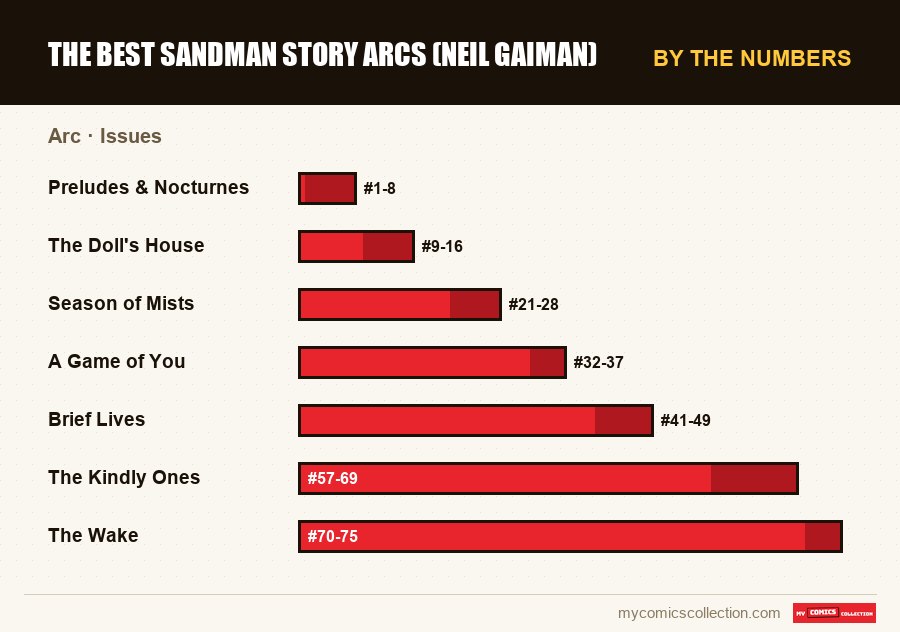
The narrative high points of Sandman (Neil Gaiman, DC/Vertigo, 1989) cluster in seven major arcs, from Preludes & Nocturnes (#1-8) to The Wake (#70-75). For collectors, the opening arc holds the key issues: Sandman #1 ("Sleep of the Just," Jan. 1989) shows an €8 eBay median across 76 active listings (June 2026), while #8, the first appearance of Death of the Endless, is the series' most sought-after issue.
This guide is editorial: it ranks the arcs by narrative weight and importance to a collection, not by budget. The saga runs 75 issues (1989-1996), broken into largely self-contained stories: the best way to decide where to start and which issues to chase.
One era note worth getting right: Gaiman's Sandman (Dream / Morpheus) is a Copper/Modern-age character, born in 1989. There are no Silver- or Bronze-Age issues of HIS series: the earlier "Sandman" characters (Wesley Dodds, 1939; the Kirby/Simon Sandman, 1974) are entirely different. The figures below come from our eBay estimator; where listing volume is too thin to be reliable, we stay qualitative rather than invent a value.
The seven major arcs, ranked
The breakdown follows the official collected editions (DC/Vertigo). The arcs read roughly in order, but each has its own flavor.
| Arc | Issues | What sets it apart |
|---|---|---|
| Preludes & Nocturnes | #1-8 | The founding arc. Holds #1 (origin) and #8 (first Death). |
| The Doll's House | #9-16 | First true epic: the dollhouse, the Corinthian. |
| Season of Mists | #21-28 | Dream is given Hell; Lucifer abdicates. Often cited as the peak. |
| A Game of You | #32-37 | The most intimate and divisive; centered on Barbie. |
| Brief Lives | #41-49 | A road trip with Delirium; the saga's emotional pivot. |
| The Kindly Ones | #57-69 | The longest arc; the tragedy converges. |
| The Wake | #70-75 | The epilogue and the wake; closes the series. |
Between Doll's House and Season of Mists sits Dream Country (#17-20), a short-story collection: including #19.
Why Preludes & Nocturnes matters most to collectors
It's the arc that concentrates the key issues, and so the value:
- #1 "Sleep of the Just" (January 1989): the origin, written by Neil Gaiman, art by Sam Kieth, cover/design by Dave McKean. An €8 eBay median across 76 listings (June 2026): affordable, and very liquid for a 1989 issue.
- #8 "The Sound of Her Wings" (August 1989): the first appearance of Death of the Endless, Dream's sister and an instant icon. This is the most in-demand issue of the run. Our estimator places it well above #1, but on a listing count too thin to publish a reliable median: always check the live value before buying.
The most awarded arc: Dream Country and issue #19
The Dream Country collection holds the most decorated single issue in the series: Sandman #19, "A Midsummer Night's Dream" (art by Charles Vess), the only comic ever to win the World Fantasy Award (1991, Best Short Fiction). The rules were in fact changed afterward to make comics ineligible in that category. As for value, the issue stays accessible and lightly speculative: its appeal is primarily literary and historical.
Where to start, and what to chase
- To read: begin with Preludes & Nocturnes, then go in order: the escalation is real from The Doll's House and Season of Mists onward.
- To collect single issues: prioritize #1 (origin, very liquid), #8 (first Death, the grail), then #19 (the award-winner). The rest of the run fills in easily at low prices.
- Beyond the 75 issues: Sandman: Overture (2013-2015) and the Netflix series (2022) renewed interest: one more reason to secure the key issues in good condition.
Own some Sandman issues? Get a free valuation with our tool based on real eBay sales to find their low, median and high value.
Reading order and pitfalls to avoid when collecting Sandman
The series runs 75 issues (1989-1996). The seven major arcs cover 58 of them: Preludes & Nocturnes (8 issues), The Doll's House (8), Season of Mists (8), A Game of You (6), Brief Lives (9), The Kindly Ones (13) and The Wake (6). The remaining 17 issues are interludes, including the Dream Country collection (#17 to #20). If you collect single issues, don't stop at the arcs alone: a quarter of the series sits between them.
Here is a progressive reading order, following publication order:
- Preludes & Nocturnes (#1 to #8): the founding arc, setting the scene.
- The Doll's House (#9 to #16): the first true major story.
- Dream Country (#17 to #20): four short stories, including the award-winning #19.
- Season of Mists (#21 to #28): often cited as the saga's peak.
- A Game of You (#32 to #37): the most intimate and divisive, centered on Barbie.
- Brief Lives (#41 to #49): the emotional pivot, a road trip with Delirium.
- The Kindly Ones (#57 to #69): the longest arc, where the tragedy converges.
- The Wake (#70 to #75): the epilogue that closes the series.
The first pitfall is a namesake. Neil Gaiman's Sandman (Dream, or Morpheus) was born in 1989; earlier Sandmen, Wesley Dodds' (1939) and Kirby and Simon's (1974), are completely different characters. Before buying a Golden, Silver or Bronze Age issue under the Sandman name, check it is not another character: no issue of Gaiman's series exists before 1989.
The second pitfall concerns sequels. Sandman: Overture (2013-2015) is a prequel published long after the series and is not part of the 75 issues. It is collected separately, and should not be confused with the original series when filling gaps.
To build a coherent base without buying everything at once, first aim at the three issues that matter most: #1 (the origin), #8 (first appearance of Death) and #19 (the award-winning issue). Then complete arc by arc. Each arc almost stands alone, so you can stop after any of them without a narratively incomplete collection. For readers first and foremost, the collected editions follow the same split as the arcs above.
Frequently asked questions
The series has 75 issues (1989-1996), split into seven major arcs: Preludes & Nocturnes (#1 to #8), The Doll's House (#9 to #16), Season of Mists (#21 to #28), A Game of You (#32 to #37), Brief Lives (#41 to #49), The Kindly Ones (#57 to #69) and The Wake (#70 to #75). The Dream Country collection (#17 to #20) sits between two of them.
In Sandman #8, "The Sound of Her Wings" (August 1989), the first appearance of Death of the Endless, Dream's sister. It is the most sought-after issue of the series. It sits well above #1 in value, but the small number of listings means you should check the live market value before buying.
Sandman #19, "A Midsummer Night's Dream" (art by Charles Vess), is the only comic to have won the World Fantasy Award (1991, best short story). The rules were then changed to make comics ineligible in that category. It remains accessible and not very speculative: its appeal is above all literary and historical.
No: Dream (Morpheus) was born in 1989, in the Copper and Modern Age, and no issue of his series exists in the Silver or Bronze Age. Earlier Sandmen, Wesley Dodds' (1939) and Kirby and Simon's (1974), are completely different characters.
To read, start with Preludes & Nocturnes then follow the order: the build-up is real from The Doll's House and Season of Mists. To collect, prioritize #1 (origin, very liquid), #8 (the grail) then #19 (the award-winning issue). The rest of the series is easy to complete on a small budget.