Saga by Brian K. Vaughan and Fiona Staples is an ongoing science-fantasy series from Image Comics, launched in March 2012. It has won multiple Eisner Awards, including Best Continuing Series in 2013, 2014, 2015, and 2017. There is no film or television adaptation: Vaughan has consistently declined offers. Single-issue values are driven by critical acclaim, award recognition, and the scarcity of the first-print #1, which was under-ordered at approximately 37,641 copies according to Comichron.
Saga starts from a single, radical premise: a couple from warring species, Alana from the planet Landfall and Marko from its moon Wreath, flees with their newborn daughter Hazel, who narrates the story as an adult. Brian K. Vaughan designed the series to exist only as a comic, repeatedly turning down adaptation offers from film and television. That decision is part of what gives the series its unusual identity, and part of what makes its original single issues worth collecting.
This guide focuses on the series' major story arcs and what they mean for collectors. All price data comes exclusively from our eBay estimator (eBay.fr + eBay.com, June 2026) and documented specialist sources. One ground rule: any eBay median based on fewer than 15 listings is not cited as a price reference. Saga launched in 2012: there are no key issues from the Golden, Silver, or Bronze Age.
Volume 1 (issues #1-6): the founding arc
The first arc builds the entire universe in six issues: Alana and Marko fleeing with newborn Hazel, Prince Robot IV dispatched to pursue them, and the introduction of The Will, a mercenary bounty hunter. Fiona Staples establishes her visual language immediately (saturated colour, hybrid creatures, violence and tenderness in the same panel) setting Saga apart from any other Image title of the period. This arc is the most actively collected of the series, primarily because of issue #1.
Issue #1 (March 2012) is the centrepiece. Our eBay estimator returns a median of €6 across 46 listings: enough volume to cite, but requiring careful reading: that figure blends all five printings, and reprints circulate well below the price of a genuine first print. The first printing is identified by orange title lettering and the absence of any "Second Printing" notation. In CGC 9.8, the Diamond Retailer Summit variant: limited to approximately 500 copies and distributed exclusively to retailers at a trade event: carries a fair market value of $2,500 according to GoCollect. Issues #2 through #6 each return fewer than 15 active listings: no median is cited.
Volume 2 (issues #7-12): rising stakes and a digital controversy
The second arc introduces D. Oswald Heist, a reclusive writer whose novel inspired Alana, and deepens the relationships between the main cast. Marko's father dies protecting the family: the first major emotional blow of the series. This is where Saga makes clear that no character is safe, regardless of their narrative weight.
Issue #12 (2013) has a place in the history of digital comics: Comixology briefly declined to sell it on iOS, citing their own interpretation of Apple's content policy. The platform reversed the decision within days, clarifying that the call was theirs, not Apple's. The episode sparked a national debate about censorship in digital distribution. Our estimator returns only 2 listings for this issue: no median is cited.
Volume 3 (issues #13-18): the series finds its depth
The third arc consolidates what makes Saga distinctive: the family as the last line of resistance against institutional war and bureaucratic indifference. The family hides on Quietus with Heist; journalists investigate their story; Prince Robot IV is routed. Hazel takes her first steps: a moment of visual grace inside an arc marked by violence. Many longtime readers consider this the artistic high point of the series' first half, and the arc that turns casual readers into committed collectors.
Volume 4 (issues #19-24): the cracks within
With the fourth arc, Vaughan moves the danger inside the relationship. Settled on the planet Gardenia, the family fractures: Alana develops a dependency on a psychotropic substance; Marko drifts dangerously close to another woman. The series gains psychological weight and separates itself from classic space opera by refusing any notion of frictionless heroism. Dengo, a supporting character who abducts the family, is one of the most carefully constructed antagonists in the run.
"The War for Phang": Volume 7 (issues #37-42): the major emotional turning point
Published after the series returned from a hiatus in 2016, the seventh arc is consistently cited by long-term readers as the most devastating section of the run. The family lands on war-torn Phang, and Vaughan accumulates losses without pause: the disappearance of Izabel, the ghost who has been Hazel's companion since the first arc, and Alana's miscarriage following the destruction of the planet. No other arc concentrates as much grief across six issues. In single-issue form, "The War for Phang" is among the arcs most sought by collectors who want to own the series' defining emotional moments in their original format.
Summary table: arcs and eBay data (June 2026)
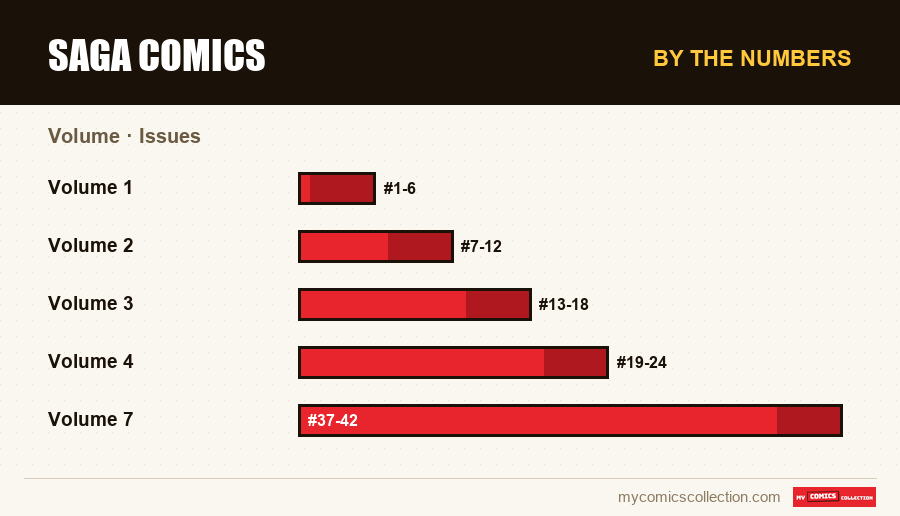
| Volume | Issues | Key moment | eBay data |
|---|---|---|---|
| Volume 1 | #1-6 | 1st appearance of Hazel, Alana, Marko; #1 is the flagship key | #1: median €6 / 46 listings (all printings); #2-6: <15 listings, not cited |
| Volume 2 | #7-12 | Death of Marko's father; #12 pulled by Comixology (2013) | #12: 2 listings: not cited |
| Volume 3 | #13-18 | Hazel's first steps; Prince Robot IV defeated | Insufficient volume across all issues |
| Volume 4 | #19-24 | Alana's addiction; kidnapping by Dengo | Insufficient volume |
| Volume 7 | #37-42 | "The War for Phang": Alana's miscarriage, loss of Izabel | Insufficient volume |
Sources: mycomicscollection.com eBay estimator (June 2026), GoCollect, Comichron, CBR, AIPT Comics, Comic Book Legal Defense Fund, Bleeding Cool.
Why collect Saga in single issues?
The collector case for Saga single issues rests on three pillars distinct from those that support most other modern series. The first is the absence of a screen adaptation. Unlike The Walking Dead or Marvel and DC properties, Saga has never been adapted for film or television: Vaughan has explicitly turned down offers, stating that the series was built for the comics medium and that he sees no reason to compromise it. This makes the original single issues the only available version of the narrative. The second pillar is award recognition: Eisner Awards for Best Continuing Series in 2013, 2014, 2015, and 2017; Vaughan won Best Writer in 2013, 2014, and 2017; Staples took Best Cover Artist and Best Penciller/Inker in 2017. These are documented results that place the series among the most decorated comics of its generation. The third pillar is the documented scarcity of the first-print #1: under-ordered at approximately 37,641 copies according to Comichron, an anomaly for a series that would become one of Image Comics' best-sellers.
Frequently asked questions
With Volume 1 (#1-6), the founding arc: Alana and Marko's flight with newborn Hazel, Prince Robot IV's pursuit and the arrival of The Will, a bounty hunter. It is also the most collected arc, mostly for issue #1.
By the orange title lettering and the absence of any "Second Printing" or later mention. The first printing was reportedly under-ordered at about 37,641 copies according to Comichron, while five printings followed one another.
No, there is no film or television adaptation. Brian K. Vaughan has refused every offer received, considering that the series was designed to remain a comics object, which keeps single issues as the only narrative version.
The Eisner Award for best continuing series in 2013, 2014, 2015 and 2017. Fiona Staples was also honored in 2017 for her art and her covers.
"The War for Phang", Volume 7 (#37-42), published after the series' 2016 hiatus. The family lands on a war-torn planet and suffers one loss after another over six issues.
Own issues of Saga? Get a free valuation with our tool based on real eBay sales to find the low, median, and high value of each copy.