
Moon Knight is a Bronze Age creation: Marc Spector first appeared in August 1975 in Werewolf by Night #32 (Doug Moench & Don Perlin), and he has no Silver Age or Golden Age issues whatsoever . The key issue:WBN #32: reached $42,000 in CGC 9.8 in 2023 according to sellmycomicbooks.com. The foundational Moench/Sienkiewicz run (1980-1984), the six-issue Ellis/Shalvey arc (2014), and the Lemire/Smallwood series (2016-2017) are the three pillars every serious collector needs to know.
Moon Knight holds a singular place in the Marvel pantheon: created by Doug Moench and Don Perlin in 1975, he has no Silver Age ancestry and no Golden Age legacy. He is a Bronze Age character, born in an era when Marvel was experimenting with darker, morally ambiguous heroes. Marc Spector, a mercenary left for dead in Egypt and resurrected before the statue of the moon god Khonshu, carries multiple identities (Steven Grant, Jake Lockley) not as simple disguises but as the genuine fragmentation of a broken psyche. That psychological complexity is the raw material his best writers have worked with ever since.
This guide is editorial and honest about its sources: our eBay estimator does not cover the Werewolf by Night , Moon Knight , or Marvel Spotlight series: it returns invalid parameters for these titles. Every figure cited here comes from documented web sources (sellmycomicbooks.com, CGC, Heritage Auctions). Where no public sale record exists, we stay qualitative.
The Bronze Age keys: what to know before anything else
A critical reminder for every collector: Moon Knight has no Silver Age appearances. Anyone offering you a "1960s key" for Moon Knight is selling fiction. The genuine Bronze Age keys are as follows:
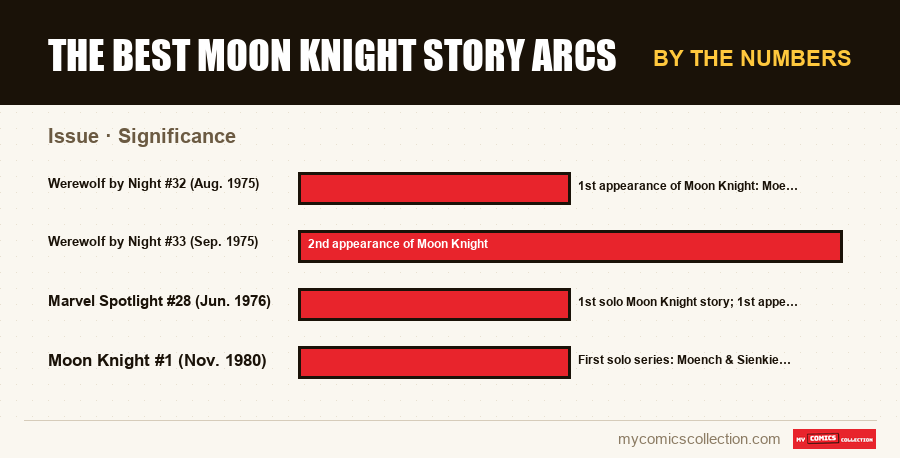
| Issue | Significance | Documented data |
|---|---|---|
| Werewolf by Night #32 (Aug. 1975) | 1st appearance of Moon Knight: Moench & Perlin | $42,000 in CGC 9.8 (2023, sellmycomicbooks.com); $31,200 in CGC 9.8 (Mar. 2020, Heritage Auctions); $25,200 in CGC 9.6 (2022) |
| Werewolf by Night #33 (Sep. 1975) | 2nd appearance of Moon Knight | Not publicly documented in high grade: qualitative only |
| Marvel Spotlight #28 (Jun. 1976) | 1st solo Moon Knight story; 1st appearances of Marlene Fontaine and Crawley | Recent 90-day average ~$1,678 in CGC 9.8 (GoCollect) |
| Moon Knight #1 (Nov. 1980) | First solo series: Moench & Sienkiewicz; 1st app. of Raoul Bushman | $925 in CGC 9.8 (2022, sellmycomicbooks.com): a common book; only the 9.8 grade makes investment sense |
Sources: sellmycomicbooks.com, Heritage Auctions, CGC, GoCollect. Our eBay estimator does not cover these series.
Run 1: Moench & Sienkiewicz (1980-1984): the foundational bedrock
Moon Knight's first solo series (roughly issues #1-38, 1980-1984) is the work of Doug Moench and Bill Sienkiewicz. Moench knew the character better than anyone: he had created him five years earlier in Werewolf by Night. This run established every element later writers would draw from: the four identities (Marc Spector the fighter, Steven Grant the millionaire, Jake Lockley the cab driver, Moon Knight the avatar of Khonshu), the relationship with Marlene Fontaine, the sidekick Frenchie, and the persistent ambiguity around the hero's mental state. Sienkiewicz began in a style close to Neal Adams, precise and realistic, before evolving toward an expressionist, almost painterly approach that foreshadows his revolutionary work on New Mutants. Issue #10 ("Too Many Midnights") is frequently cited for showing Moon Knight in a human, vulnerable light unusual for the era. This is not a standard superhero series: it is a nocturnal New York noir with a mythological figure at its center.
Run 2: Warren Ellis & Declan Shalvey (2014): six issues, one aesthetic shock
Moon Knight vol. 7, #1-6 (2014): collected as From the Dead: is one of the most admired Marvel runs of the 2010s, achieved in only six issues. Warren Ellis strips the character to his essence: Marc Spector has a single mission, to protect travelers of the night, and each issue stands as a self-contained story. Ellis also reformulates the identity concept: rather than one superhero and three civilian covers, Moon Knight becomes three distinct heroic personalities, including a new "Mister Knight" figure in a white suit. Declan Shalvey and colorist Jordie Bellaire deliver page layouts of surgical precision, every panel a deliberate narrative decision. Disorienting, brutal, and strange: this run is the best entry point for an adult reader encountering the character for the first time.
Run 3: Jeff Lemire & Greg Smallwood (2016-2017): the psychological masterwork
Moon Knight vol. 8, #1-14 (2016-2017): collected in three volumes: Lunatic , Reincarnations , and Birth and Death: is widely regarded as the character's high-water mark. Marc Spector wakes up in a psychiatric hospital with no powers and years of medical records proving he was never Moon Knight. Greg Smallwood builds a unique visual architecture: each identity has its own color palette, its own typography, its own graphic language. The narrative confronts head-on the question of what is real and what is delusion. The climax of the third volume, braiding Marc Spector's Jewish heritage with his service to an Egyptian god, is considered by many critics to be the finest story ever told with this character. This run reads as a prestige literary work, not a standard superhero comic.
Moon Knight on Disney+: what it meant for collectors
The Moon Knight miniseries (Disney+, March 30, 2022), starring Oscar Isaac as Marc Spector / Steven Grant and Ethan Hawke as antagonist Arthur Harrow, ran for six episodes and earned an 86% critics' score on Rotten Tomatoes (240 reviews) and a Metacritic score of 69/100. The adaptation reignited collector interest in Bronze Age keys: Werewolf by Night #32 in CGC 9.8 reached its documented high of $42,000 in 2023, building on the earlier peak of $31,200 recorded at Heritage Auctions in March 2020. Mid-grade copies (CGC 9.0, 8.0) remain accessible: that is where the real market sits for most collectors.
Own a Moon Knight comic? Get a free valuation with our tool based on real eBay sales to find its low, median, and high value.
Frequently asked questions
Werewolf by Night #32 (August 1975), by Doug Moench and Don Perlin. Moon Knight is a Bronze Age character: there is no Golden or Silver Age issue, and anyone offering a "1960s key" is selling smoke.
In Marvel Spotlight #28 (June 1976), which also features the first appearances of Marlene Fontaine and Crawley. The first solo series then starts with Moon Knight #1 (November 1980), by Moench and Sienkiewicz, with the first appearance of Raoul Bushman.
The founding run by Moench and Sienkiewicz (1980-1984), the one by Warren Ellis and Declan Shalvey (vol. 7, #1-6, 2014, collected as From the Dead) and the one by Jeff Lemire and Greg Smallwood (vol. 8, #1-14, 2016-2017), unanimously considered the character's peak.
Marc Spector wakes up in a psychiatric hospital, powerless, with years of medical files saying he was never Moon Knight. The story, collected in three volumes (Lunatic, Reincarnations, Birth and Death), is a psychological masterpiece.
The Moon Knight series, released on March 30, 2022 with Oscar Isaac as Marc Spector and Steven Grant, runs six episodes and introduces Ethan Hawke as Arthur Harrow. It renewed interest in the character and his first appearances.