Harley Quinn is a modern creation (1992): she has no Golden Age, Silver Age, or Bronze Age issues. Her absolute key is The Batman Adventures #12 (September 1993), her first comic appearance, with CGC 9.8 copies currently trading around $2,000-$3,250 for regular editions. For readers, her finest arc remains Batman Adventures: Mad Love (1994), the defining one-shot by her creators Paul Dini and Bruce Timm.
Harley Quinn reached the screen before she reached the page. Paul Dini and Bruce Timm created her for Batman: The Animated Series, where she first appeared in the episode "Joker's Favor" in September 1992. Her move to print was almost immediate: The Batman Adventures #12 shipped in September 1993 and remains her first comic book appearance. Originally conceived as a one-note sidekick for the Joker, she quickly became one of DC's most complex and commercially successful characters: a trajectory shaped by thirty years of writers who took her seriously.
This guide is editorial: it maps the essential story arcs for reading the character and identifies the key issues for collectors. Our eBay estimator tool does not index the relevant series ( batman-adventures , harley-quinn , suicide-squad): no internal eBay median is available for these titles. All figures cited here come from documented external sources: sellmycomicbooks.com, PriceCharting, Heritage Auctions, and specialist press.
Key issues every collector should know
Since Harley Quinn was created in 1992, every one of her keys belongs to the modern era. There are no Golden Age, Silver Age, or Bronze Age issues featuring the character: any guide claiming otherwise is fiction. The table below covers the essential entry points.
| Issue | Significance | Indicative value (CGC) |
|---|---|---|
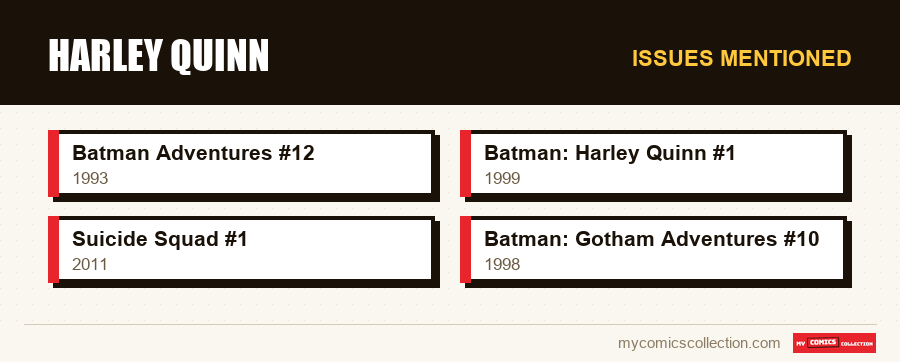
| The Batman Adventures #12 (Sept. 1993) | First comic appearance: the absolute key | CGC 9.8: ~$2,000-$3,250 (regular) / ~$5,280 (newsstand) |
| Batman Adventures: Mad Love (1994) | Origin of Harleen Quinzel: Dini & Timm | Entry-level accessible; high grade: qualitative range |
| Batman: Harley Quinn #1 (Oct. 1999) | First mainline DC Universe appearance: Alex Ross cover | Active market; value driven by the Ross cover |
| Harley Quinn vol. 1 #1 (2000) | First solo ongoing: Karl Kesel & Terry Dodson | Entry-level accessible; high-grade CGC sought |
| Suicide Squad #1 (Sept. 2011, New 52) | Iconic new look: Adam Glass | Solid market; key New 52 issue |
| Harley Quinn vol. 2 #1 (2013) | Conner/Palmiotti run: recurring NYT bestseller | Entry-level accessible |
Value sources: sellmycomicbooks.com (2024), PriceCharting, Heritage Auctions. Our eBay tool does not cover these series: no internal median is available.
Mad Love (1994): the founding arc, by Dini and Timm
Published in 1994 in prestige format (48 pages), Batman Adventures: Mad Love is the essential text on Harley Quinn. Paul Dini wrote it, Bruce Timm drew it: the two creators of the character delivered the complete story of psychiatrist Harleen Quinzel's fall, manipulated and transformed by the Joker: her patient at Arkham Asylum. The book won an Eisner Award in 1994, an unusual distinction for a one-shot, and established the psychological framework that every subsequent interpretation has drawn on. It is the arc to read first and the first album to acquire for a serious collection. Ungraded copies circulate at accessible prices; a CGC 9.8 commands significantly more, though no headline auction record has been publicly documented for this title.
The Conner/Palmiotti run (2013-2016): the bestseller era
In November 2013, Amanda Conner and Jimmy Palmiotti took over Harley Quinn (vol. 2), drawn primarily by Chad Hardin. Their approach was a deliberate departure: the Joker was removed as the gravitational centre, replaced by an independent Harley who moves to Coney Island, inherits a building above a freakshow, and joins a roller derby team. The series mixed situational comedy with action and emotionally resonant sequences: most notably issue #25, in which Harley definitively breaks with the Joker. The run appeared regularly on New York Times bestseller lists throughout its 30-issue span (through 2016), making Harley one of DC's top-selling characters. The opening arc "Hot in the City" (issues #1-7) is the best entry point into their work.
Harleen (2019, DC Black Label): the origin reinvented by Stjepan Sejic
Published as a three-issue prestige miniseries under the DC Black Label imprint, Stjepan Sejic's Harleen has been consistently described by critics as one of the finest takes on the character. Sejic handled script, art, colour, and lettering entirely alone. The story approaches Harleen Quinzel's fall through retrospective narration, her future self recounting her own unravelling, with a mastery of facial expression and body language that sets Sejic's work apart in the medium. The tragic dimension is more pronounced than in Mad Love, and the character's own agency is placed more squarely at the centre. It is essential reading in the modern album format.
Other arcs worth your time
Beyond those three pillars, several series deserve a collector's attention. Gotham City Sirens (2009, Paul Dini and Guillem March) explores the dynamic between Harley, Poison Ivy, and Catwoman across 26 issues, with some of the warmest and most unsettling sequences about the character's idea of family. Harley Quinn & Poison Ivy (2019, Jody Houser and Adriana Melo) deepens that relationship over six issues in the wake of the animated series' first season. The Stephanie Phillips and Riley Rossmo run on Harley Quinn vol. 4 (from 2021) takes a darker approach, anchoring Harley in a sustained attempt at rehabilitation. For a compact character study, Batman: Gotham Adventures #10 (1998, "Mightier Than the Sword") remains one of the sharpest short-format portraits of the character's psychology.
Harley Quinn on screen and the collector market
Screen adaptations have provided sustained support for key issue demand. Suicide Squad (2016, with Margot Robbie as Harley Quinn) grossed $749.2 million worldwide, setting August opening records at the time. Birds of Prey (2020) generated $205.5 million: a commercial disappointment relative to expectations, but one that maintained the character's global visibility. The animated series Harley Quinn, which premiered on November 29, 2019 with Kaley Cuoco voicing the lead, cemented Harley as a headline character in her own right, independent of the Joker. These cultural moments have drawn collectors to The Batman Adventures #12 and Mad Love well beyond the traditional DC long-box audience.
Frequently Asked Questions
Batman Adventures: Mad Love (1994), the founding one-shot by Paul Dini and Bruce Timm. It tells the fall of psychiatrist Harleen Quinzel, manipulated and then transformed by the Joker, and won an Eisner Award in 1994.
On screen, in the "Joker's Favor" episode of Batman: The Animated Series (September 1992), created by Paul Dini and Bruce Timm. Her first comics appearance follows with The Batman Adventures #12 (September 1993).
Amanda Conner and Jimmy Palmiotti's on Harley Quinn vol. 2 (2013-2016, 30 issues). Harley becomes independent there and settles in Coney Island; the series regularly appears on New York Times bestseller lists.
Harleen (2019, DC Black Label), in three prestige issues, entirely by Stjepan Sejic. It approaches Harleen Quinzel's fall through retrospective narration, with a more pronounced tragic dimension than in Mad Love.
Gotham City Sirens (2009, 26 issues) around Harley, Poison Ivy and Catwoman, Harley Quinn & Poison Ivy (2019, six issues) and Stephanie Phillips and Riley Rossmo's run on Harley Quinn vol. 4 (from 2021).
Own a Harley Quinn comic? Get a free valuation with our tool based on real eBay sales to find its low, median, and high value.