The three Doctor Strange arcs most consistently cited by collectors and critics are Ditko's Eternity Saga ( Strange Tales #130-146, 1965-1966), the Sise-Neg cycle by Englehart and Brunner (Marvel Premiere #12-14, 1973-1974), and the Jason Aaron and Chris Bachalo run ( Doctor Strange vol. 5, 2015-2017). This guide covers the key issues for each era, with documented market data, and honesty about when no reliable figure exists.
Doctor Strange is one of Marvel's most singular creations: born from the imagination of Stan Lee and Steve Ditko, launched as a five-page back-up feature in Strange Tales #110 (July 1963) before becoming one of the universe's most important cosmic pillars. An arrogant surgeon transformed into the Sorcerer Supreme after a car accident destroys the use of his hands, Stephen Strange is a Silver Age creation: there are no Doctor Strange keys predating 1963. His editorial history spans three major eras: the Ditko era (1963-1966), the Bronze Age revival (1972-1979), and the modern era. Benedict Cumberbatch brought the character to the MCU in Doctor Strange (2016, $677.8 million worldwide) and Doctor Strange in the Multiverse of Madness (2022, $955.8 million worldwide), as well as in Avengers: Infinity War , Endgame , and Spider-Man: No Way Home.
A note on market data: our eBay estimation tool does not index the Strange Tales , Doctor Strange , or Marvel Premiere series: these titles are outside its covered parameter set and return no medians. All figures cited in this guide come exclusively from documented web sources: sellmycomicbooks.com, Heritage Auctions, GoCollect, and ComicConnect.
Silver Age keys: the Sorcerer Supreme's first steps
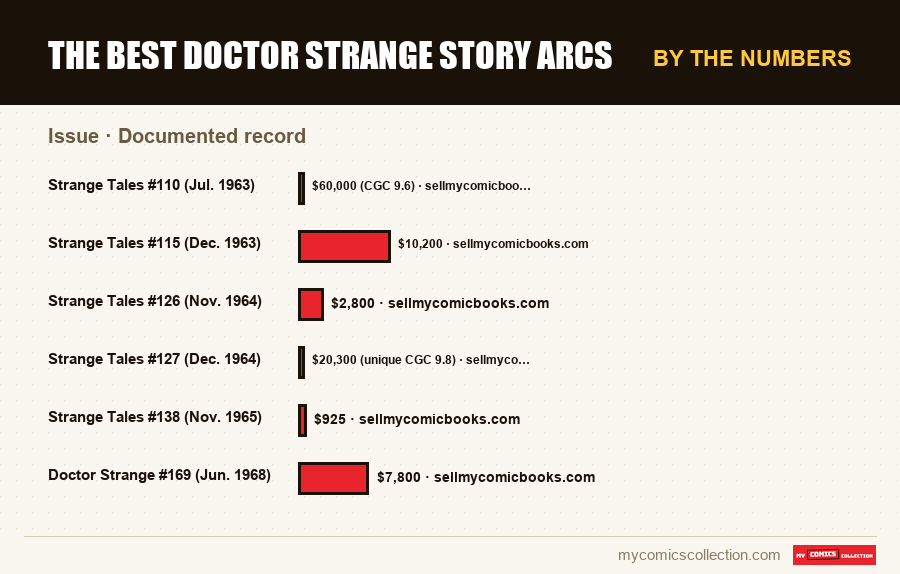
Strange Tales #110 (July 1963) is the cornerstone of any Doctor Strange collection: the first appearance of the character, the Ancient One, Wong (unnamed), and Nightmare, in a five-page story plotted and drawn by Steve Ditko from a Stan Lee script. The documented record sale is $60,000 for a CGC 9.6 copy, reported by sellmycomicbooks.com in connection with the MCU film announcement. Below that ceiling, copies in lower grades remain reachable, but no grade of this key is inexpensive.
Strange Tales #115 (December 1963) delivers the complete origin: the tale of the surgeon ruined by an accident, his pilgrimage to the Ancient One in Asia, and Baron Mordo revealed as the first antagonist. This is where the classic Vishanti incantations (Agamotto, Hoggoth, Oshtur) appear in print for the first time. Documented record: $10,200 . Strange Tales #126 (November 1964) introduces Dormammu and Clea: record $2,800 . Strange Tales #127, the only known CGC 9.8 copy, reached $20,300.
| Issue | Significance | Documented record |
|---|---|---|
| Strange Tales #110 (Jul. 1963) | 1st appearance: Doctor Strange, the Ancient One, Wong, Nightmare | $60,000 (CGC 9.6) · sellmycomicbooks.com |
| Strange Tales #115 (Dec. 1963) | Complete origin: first Vishanti incantations | $10,200 · sellmycomicbooks.com |
| Strange Tales #126 (Nov. 1964) | 1st appearance of Dormammu and Clea | $2,800 · sellmycomicbooks.com |
| Strange Tales #127 (Dec. 1964) | Dormammu arc continuation: only known CGC 9.8 | $20,300 (unique CGC 9.8) · sellmycomicbooks.com |
| Strange Tales #138 (Nov. 1965) | 1st appearance of Eternity | $925 · sellmycomicbooks.com |
| Doctor Strange #169 (Jun. 1968) | First solo title, continuing Strange Tales numbering | $7,800 · sellmycomicbooks.com |
Sources: sellmycomicbooks.com. This site's eBay tool does not cover these series: no eBay median is available for any of these titles.
The Eternity Saga (Strange Tales #130-146, 1965-1966): Ditko at his peak
Co-plotted and fully drawn by Steve Ditko (with Lee scripting), the Eternity Saga spans seventeen consecutive issues of Strange Tales, #130 through #146. The story begins when Dormammu and Baron Mordo form an unprecedented alliance to hunt Doctor Strange across every dimension in existence. Cornered, Strange has only one option: find Eternity, the omniscient personification of the universe itself.
The resolution arrives in issue #138, the first appearance of Eternity, and culminates in #146, Ditko's final issue on the series. That finale delivers one of the most visually audacious confrontations in Silver Age comics: Eternity, a cosmic figure whose body is the star-filled sky, facing down Dormammu, Lord of the Dread Dimension. Ditko's abstract imagery, his ability to render non-Euclidean dimensions and mental spaces on a comics page, makes this arc an aesthetic object far beyond the superhero genre of its time. For collectors, the key issues within the arc are #126-127 (Dormammu/Clea), #130 (the start of the Dormammu-Mordo alliance), and #138 (Eternity). Issue #146 is the last Ditko: an editorial milestone as much as a collectible.
Englehart and Brunner: the Sise-Neg cycle (Marvel Premiere #12-14, 1973-1974)
After Ditko's departure in 1966, Doctor Strange moved to his own title in 1968 (Doctor Strange #169, first series, art by Dan Adkins: record $7,800). The true Bronze Age revival arrived with Steve Englehart writing and Frank Brunner drawing, beginning with Marvel Premiere #9 (1973). The most ambitious arc of their collaboration occupies issues #12 through #14 (November 1973: March 1974).
The story opens with "Time Doom": Doctor Strange and Baron Mordo pursue Sise-Neg, a 31st-century sorcerer traveling back through history to absorb all magical energy. The name is a transparent reversal: Sise-Neg = Genesis. The saga peaks at issue #14 ("Sise-Neg Genesis") when the sorcerer reaches the beginning of the universe, becomes omnipotent, and recreates reality exactly as it was: including protecting an original garden from Shuma-Gorath. The controversy was genuine: Stan Lee found the theological implications too sensitive and reportedly considered publishing a retraction; Englehart, by his own account, circulated a fake fan letter signed by a Catholic priest to prevent one. The arc is universally cited as among the most philosophically ambitious Doctor Strange stories ever published. The success of the Englehart/Brunner run directly triggered the launch of Doctor Strange vol. 2 #1 (June 1974, record $1,295), the character's first dedicated ongoing series since 1969.
Jason Aaron and Chris Bachalo (2015-2017): magic has a price
Jason Aaron and Chris Bachalo's run on Doctor Strange (2015, vol. 5) covers issues #1 through #20, plus the annual and the Last Days of Magic one-shot. The opening arc ("The Way of the Weird," #1-5) establishes a radical premise: every spell Strange casts incurs a concrete physical debt: pain, sickness, injury. Magic is not free. That single idea restructures the character's mechanics and distinguishes this run sharply from every previous approach.
The centerpiece arc, "The Last Days of Magic" (#6-10 and the one-shot), sends a technological army, the Empirikul, to systematically eradicate all magic across the multiverse. Strange must defend the existence of his discipline while stripped of his most spectacular powers, against an antagonist whose logic is extinction. Bachalo's expressionist, fragmented visual style is ideally suited to the character's oneiric register. This run remains the modern reference point for Doctor Strange and reads best in omnibus form (the Doctor Strange by Jason Aaron & Chris Bachalo Omnibus collects the full run).
Do you own a Doctor Strange comic? Get a free valuation using our tool based on real eBay sales to find out its low, median, and high market value.
Frequently asked questions
Ditko's Eternity Saga (Strange Tales #130-146, 1965-1966), the Sise-Neg cycle by Englehart and Brunner (Marvel Premiere #12-14, 1973-1974) and the Jason Aaron and Chris Bachalo run (Doctor Strange vol. 5, 2015-2017).
Over seventeen consecutive episodes, Dormammu and Baron Mordo ally to hunt Doctor Strange across every dimension. Cornered, Strange seeks Eternity, the omniscient personification of the universe, who first appears in #138.
It is Ditko's last episode on the series and the finale of the Eternity Saga: Eternity, whose body is a starry sky, faces Dormammu. Ditko's abstract, surreal imagery makes it an aesthetic object in its own right.
The December 1963 issue brings Stephen Strange's complete origin: the accident that ruins the surgeon, his pilgrimage to the Ancient One in Asia and the reveal of Baron Mordo as antagonist. The incantations to the Vishanti appear there for the first time.
No: there is no Doctor Strange key earlier than 1963. The character was born in Strange Tales #110 (July 1963) from Stan Lee and Steve Ditko, which places him in the Silver Age.