
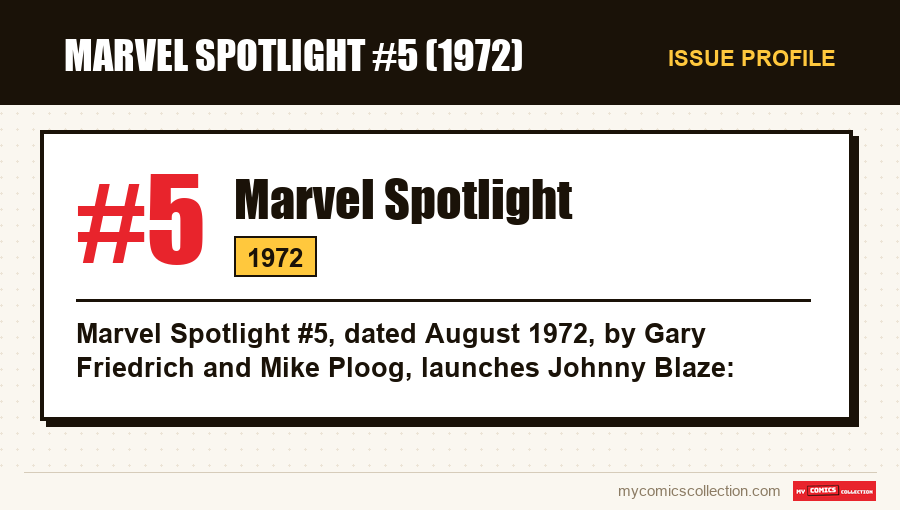
The first appearance of Ghost Rider, the motorcycle rider with the flaming skull, is in Marvel Spotlight #5, dated August 1972. The story is written by Gary Friedrich, drawn by Mike Ploog, and tells how stunt rider Johnny Blaze makes a demonic pact to save his mentor. Collectors go after it because it is the character's starting point, and because it appeared in a tryout series that does not carry the character's name in its title.
Buying Marvel Spotlight #5 calls for particular care, for a reason that has nothing to do with its condition. This issue does not carry the name of the character it launches: Johnny Blaze's first appearance is buried in the fifth issue of a generic series, and the name "Ghost Rider" had already appeared on the cover of an entirely different Marvel series five years earlier. Between a misfiled issue and a misread name clash, some listings sell something other than what the buyer thinks they are buying.
As always on this guide, only verified information (creators, issue numbers, dates) is asserted; the analysis is our own, with no reproduction of protected art or dialogue.
Marvel Spotlight #5: the date, the creators, what happens in it
The issue carries the date August 1972 on its cover, following the practice of the time, which printed the newsstand removal date rather than the actual on-sale date, which came two to three months earlier. Gary Friedrich wrote the script, Mike Ploog handled the art and the cover. Roy Thomas, then associate editor and later editor-in-chief at Marvel, is linked to the character's genesis in the accounts of those involved, and the exact authorship of the idea was the subject of legal disputes long after publication. This is a point on which the sources diverge, and a sales listing that settles the question should be read with caution.
The story sets up in a few pages everything that follows: Johnny Blaze is a motorcycle stuntman working in a traveling show, and his mentor's illness pushes him to accept a supernatural bargain whose price is his own night. The flaming skull is not a costumed identity but an imposed transformation, which is exactly what set the character apart from the masked heroes Marvel was publishing at the time.
Mike Ploog's art counts as much as the script in this issue's value. His thick line, inherited from studio work and horror pages, gave the character a silhouette that has held up for fifty years without any major redesign. A sought-after copy of Marvel Spotlight #5 is also a copy of Ploog's work, and collectors of his art compete with collectors of the character on the same listings.
A tryout series: what Marvel Spotlight published around this issue
Marvel Spotlight was not a series devoted to a single hero. It was a testing vehicle: each arc handed the title to a character or a concept, and if sales followed, the character got a series of their own. The first issue had featured Red Wolf, the following ones Werewolf by Night, and it is with the fifth issue that the title changes tenants again to host Ghost Rider.
This mechanism has two very concrete consequences for a collector. First, the title's numbering says nothing about the character: Marvel Spotlight #1 is not a Ghost Rider issue, and the fifth issue is not the motorcyclist's fifth episode, it is his first. Second, Ghost Rider did not stay: he occupied the title for a handful of issues before moving on to a series of his own, and Marvel Spotlight then continued with other tenants, including Daimon Hellstrom from the twelfth issue onward, and later other tryout characters such as Moon Knight.
Why this issue became a key
Demand for Marvel Spotlight #5 built up in two stages. For years it was worth what a first appearance of a second-tier character is worth: identifiable, wanted by specialists, ignored by the rest of the market. The turn came from the character's exposure beyond print, which sent buyers to this issue who did not know the series, and sometimes did not even know it was a series of tryouts.
There is also a rarity factor peculiar to it. A fifth issue of a 1972 tryout series was not printed like a headline title, and above all it was not kept like one: nobody in 1972 set aside the fifth issue of a magazine that changed its hero every three months. Surviving copies mostly come from complete runs of the title, not from targeted hoarding, and this shows in how the available grades are distributed.
Finally, the character had a feature that few keys of this period share: the name was reused for another wearer of the mantle in the following decades. This kept demand for the origin alive, even when Johnny Blaze was no longer the active Ghost Rider in the publications of the moment. Our character guide details the succession of wearers.
The other Ghost Rider, and the other buying traps
This is the central trap of this issue, and it must be stated plainly. Before Johnny Blaze, Marvel published a series titled Ghost Rider whose hero was a masked western vigilante, with no flames, no motorcycle and no pact. That character, Carter Slade, had his own series starting in 1967, five years before Marvel Spotlight #5, with Dick Ayers on art. The name was later changed in Marvel publications, precisely to avoid confusion with the motorcyclist.
The result: a search for "Ghost Rider #1" returns two unrelated items. The first issue of the 1967 western series is a legitimate vintage comic, but it is not the first appearance of the flaming-skull character. The first issue of the motorcyclist's solo series came out in 1973 and is a secondary key, not the origin. And the origin, Marvel Spotlight #5, does not have the words Ghost Rider anywhere in its series title.
What moves the price: grade, center fold, paper color
On a 1972 issue, the dominant defects are not the same as on a 1960s comic. The paper is already industrial and acidic, the spine is stapled, and the cover ink marks along the fold. The three points that most shift the price on this specific issue are the crispness of the black on the cover at the spine, the absence of a vertical center crease from newsstand folding, and the color of the interior paper in daylight.
The gap between two neighboring grades is not linear. In the middle grades, moving one notch changes the price by modest steps; at the top of the scale, the same one-notch gap can multiply the price, because the number of recorded copies drops sharply. For a buyer who wants to read the issue and display it in their collection, the middle grades offer the best value, and this is especially true here, since the fine copies are captured by the top of the market.
One detail specific to the era deserves attention: the cover price. Marvel had raised its monthlies to twenty cents shortly before this period, and this issue carries that price. Any other price printed on a copy presented as an original should trigger a check of the indicia, because it signals either an edition aimed at another market or an object that is not the 1972 issue.
Do you collect this series?
Track what you own, what you are missing and what your collection is worth. 7-day trial.
Start my trial →
Recognizing a different edition
The content of Marvel Spotlight #5 has been made available several times since, in forms that are not worth the original and are not always announced as such. Verification always starts in the same place: the indicia, the block of small print that gives the publisher, the date and the copyright registration number. An indicia that mentions a date later than 1972 is not a first-printing indicia, whatever the cover.
Three additional clues can be read without a magnifier. The spine: a glued binding instead of staples rules out the original right away. The paper: a bright white on a comic more than fifty years old is suspicious, since period paper yellows. And the cover price area, where modern reprints and facsimiles carry a barcode or a contemporary price that the 1972 issue could not have had.
The second trap of this issue is describing it by character rather than by object. Because Marvel Spotlight rotated its tenants, many listings are titled "Ghost Rider, first appearance" and show a cover from the title without specifying the issue. Yet the title hosted the motorcyclist over several consecutive issues, all illustrated with the same character on the cover. A sixth or seventh issue photographed from a distance looks like the origin. The number on the cover, and that alone, makes the difference.
The third trap concerns undisclosed restoration. On a stapled comic of this period, the usual interventions are replacing staples, reinforcing the spine from inside, and cleaning the white areas of the cover. None is visible in a front-on photo. If the seller does not commit in writing to the absence of restoration, the proposed price should reflect that risk.
The neighboring issues that matter too
Around Marvel Spotlight #5, several issues have real demand and much lower prices, which makes them the best entry points if the origin is out of budget. The following issues of the title, which extend the motorcyclist's arc before his departure, are the most logical to target: they share the same format, the same creative team for part of the run, and they complete the origin story.
The first issue of the character's solo series, published in 1973, is a second-tier key with its own dynamics: it carries the name on the cover, so it benefits from naive searching, and it is often priced higher than the last Marvel Spotlight issues featuring the character, even though it comes after them in the chronology.
What grading changes on a 1972 issue
Sealed encapsulation with a grade assigned by a third party has a clear effect on this issue, for a simple reason: the recorded population is small, so each graded copy shifts how the market reads it. At the top of the scale, the grade is not a comfort but the condition of the transaction, because no buyer commits that amount on the strength of a photo.
In the middle grades, the calculation reverses. The cost of grading, shipping and insurance included, represents a large share of the value of an average copy of this issue, and the holder prevents reading. If your goal is to own Johnny Blaze's origin and read it, a well-described raw copy remains the rational choice.
How to track it in a collection
An issue like this one is hard to manage by hand, precisely because of the title. Filed under "Marvel Spotlight", it disappears from any search on the character; filed under "Ghost Rider", it mixes with the 1967 western series and the 1973 solo series. Good practice is to record the exact series name printed on the cover, the issue number and the year, then attach the character as separate information.
In My Comics Collection, the catalog lists Marvel Spotlight as a distinct series with its actual numbering, which avoids exactly this collision: you enter the title and the issue number, and the record gives you the character without having to choose a filing category. For a collector building a complete run of the title, this also makes it easy to see at a glance which issues are missing, including those of the other tenants.
Finally, note on the record what you checked at purchase: indicia read, cover price confirmed, written commitment from the seller on restoration. Three lines today are worth more than an appraisal in ten years. The other guides on the blog apply the same method to the keys of the same period.
What to remember before buying
Marvel Spotlight #5 combines the two difficulties that cost money in the secondhand market: a series title that does not name the character, and a character name already used elsewhere. Both are neutralized by the same check: printed year, printed series name, printed issue number. These three data points, read on a sharp photo of the full cover and confirmed by the indicia, are enough to rule out the 1967 western series, the 1973 solo series, the later issues of the title and the reprints.
Do you have a Marvel Spotlight #5 in a lot bought long ago, or are you unsure whether it is the 1972 tryout issue or the 1967 western series? Have it identified before you sell.
Estimate my comic
Frequently asked questions
Because Marvel Spotlight was a tryout series. Each arc tested a character with readers, and only those who sold earned a series of their own. Johnny Blaze passed that test starting with the fifth issue, dated August 1972, before getting his solo series the following year. The title then hosted other tenants.
No. That 1967 series featured a masked western vigilante, Carter Slade, with no motorcycle or flaming skull, drawn by Dick Ayers. It was a different character who bore the same name, a name that was later changed in Marvel publications. The motorcyclist's origin remains Marvel Spotlight #5.
The issue is written by Gary Friedrich and drawn by Mike Ploog, who also signs the cover. Roy Thomas is linked to the character's genesis in published accounts. The exact authorship of the idea was the subject of litigation long after 1972: on this point the sources diverge, and caution is in order.
Later issues show the same character on the cover, so the photo alone is not enough. Demand a sharp image of the corner where the number appears, and cross-check it with the inside indicia, which repeats the issue number and date. A listing that shows only the character without a readable number should be ruled out.
Rarely. On a mid-grade copy, the total cost of the operation weighs heavily against the value, and the holder prevents reading. Grading is justified at the top of the scale, where it conditions the sale, or when you suspect restoration and want it documented before selling.