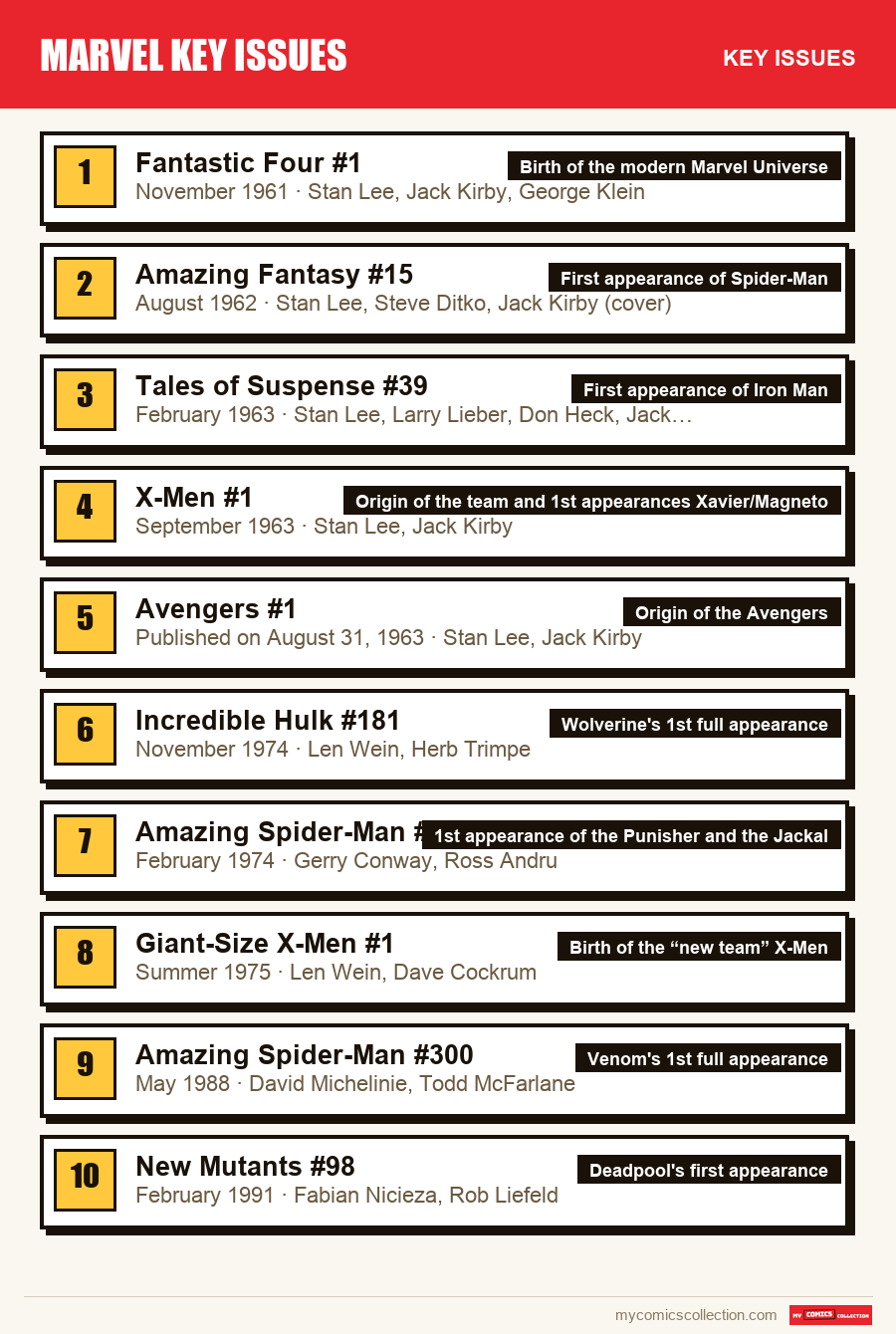
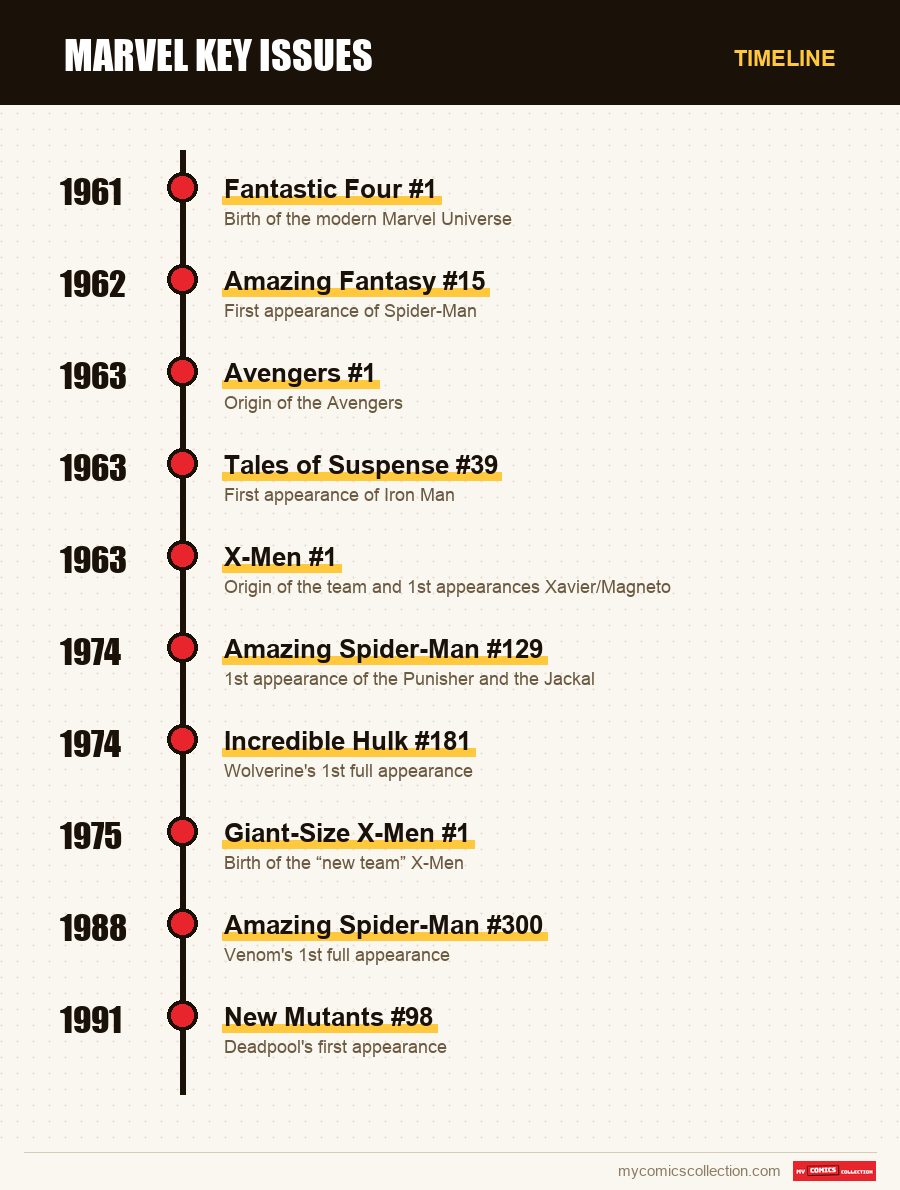
The most sought-after key Marvel issues cover two distinct golden ages: the birth of the universe in 1961-1963 (Fantastic Four #1, Amazing Fantasy #15, Spider-Man #300, New Mutants #98). Their value depends above all on three verifiable criteria: the original mintage, the current CGC census and the actual history of auction sales: not on a simple character reputation.
Talking about a “key number” at Marvel often means talking about two different things at the same time: a precise editorial moment (the first appearance of a character, the origin of a team, a major storyline turning point) and a market reality, made up of print runs, graded population and documented sales. The two do not always coincide. A comic can be historically seminal without being rare, or rare without being historically significant. The work of the serious collector consists precisely in distinguishing the legend from the data. This article lists ten issues whose editorial importance AND market traceability are firmly established, with for each the creators, the date of publication, the situation in the CGC census and actual sales documented by Heritage Auctions, ComicConnect or CGC itself. No invented estimate: when a price range is given, it comes from an observed transaction or a published Overstreet value. When only the census rarity is available, this is what is indicated.
This classification is not intended to retrace the entire editorial history of the house: for that, our complete overview of Marvel from 1939 to 2026 covers the label's entire timeline, from the 1930s pulps to the cinematic era. Here, the focus is narrowed on the objects themselves: which precise numbers to buy, why they matter, and at what price level they will actually trade in 2026.
Two golden ages, two logics of scarcity
Understanding why a Marvel issue is worth what it is requires putting each title in its print context. Between 1961 and 1963, Marvel, then led by Stan Lee under the leadership of publisher Martin Goodman, emerged from near editorial bankruptcy and printed its comics in modest quantities, without knowing that Fantastic Four #1, Amazing Fantasy #15 or X-Men #1 would become the birth certificates of an entire universe. These Silver Age issues have almost no copies in very high grade: the CGC census of Fantastic Four #1 only lists two copies graded 9.6, none above. This physical rarity, combined with a demand that has become global thanks to cinema, explains sales of more than two million dollars for a single copy. Conversely, the key issues of the Bronze Age (1970s) and especially the Copper Age (late 1980s-1990s) (Hulk #181, Amazing Spider-Man #300, New Mutants #98) were printed in much larger volumes, in a comic book industry then in full commercial and speculative expansion. New Mutants #98 alone has more than 28,000 copies in the CGC census: rarity therefore does not depend on the existence of the number, but on the state of conservation. A copy graded 9.8 sells for several thousand dollars while an “ordinary” 9.6 costs a few hundred. This is a radically different market mechanic than the Silver Age, and it explains why two "key" numbers can have completely different value curves. Marvel has also diversified its editorial ecosystem well beyond the classic shared universe, notably with labels like Icon, dedicated to creator-owned series: a part of the label's history that we detail in our article on the history of the Icon imprint at Marvel. The key numbers that interest us here, on the other hand, all belong to the main shared universe: this is where most of the collector and investor demand is concentrated.
Fantastic Four #1
The very first issue of the first superhero team of the Silver Age Marvel: origin and first appearance of Mister Fantastic, Invisible Woman, Human Torch and The Thing, as well as the first antagonists Mole Man and Giganto. Written by Stan Lee and drawn by Jack Kirby (inking George Klein, colors Stan Goldberg), it is the concrete starting point of the Marvel universe as we know it today. The CGC census has only two examples graded 9.6, none above: a very high grade rarity among the most extreme in the entire Silver Age.
Amazing Fantasy #15
Published in an anthological title then in the process of being canceled, this issue introduces a character that no one, at the time, imagined would become the commercial pillar of Marvel: Peter Parker. The CGC census lists around 3,200 examples graded in all conditions in the first quarter of 2026, including only four in 9.6 and none above: a grade ceiling which has never been crossed. The distribution by grade bracket is extremely tight at the top of the range: less than twenty copies above 9.0.
Tales of Suspense #39
Published on February 28, 1963 at a cover price of 12 cents, this anthology issue introduced Tony Stark and his original gray armor, drawn by Don Heck from a script co-written by Larry Lieber. It occupies 9th place in Overstreet's Top 50 Silver Age, with a reference value of $54,000 at grade 9.2. Like many anthological comics of the time, he was long underestimated compared to solo titles, before the character became one of the commercial pillars of the Marvel film studio.
X-Men #1
This seminal issue features the full origins of the original team (Cyclops, Marvel Girl, Angel, Beast, Iceman) as well as the very first appearances of Professor X and Magneto. The CGC census lists around 2,500 graded copies, including only 338 in grade 7.0 or higher, and two unique copies in 9.8, none above. The Pacific Coast pedigree example, graded CGC 9.8, sold for $492,938 in July 2012: long a gold standard for this title.
Avengers #1
Thor, Iron Man, Hulk, Ant-Man and Wasp unite for the first time to face Loki: it is the founding act of the largest permanent crossover in Marvel history, the one that gave its name to the studio's biggest cinematic success. The CGC census only counted, in January 2024, five copies in grade 9.6, with no higher copies identified. The Overstreet 2023 benchmark for a 9.2 grade is $60,000.
Incredible Hulk #181
Wolverine actually appears for the first time in a simple cameo on the last page of issue #180 - but it is #181, written by Len Wein and drawn by Herb Trimpe under the editorial direction of Roy Thomas, which delivers his first full appearance and his real entry into the story. This issue occupies 2nd place in Overstreet's Top 25 Bronze Age, just behind Amazing Spider-Man #129. The distinction between cameo (#180) and full appearance (#181) remains one of the most commented on in the entire Bronze Age, and continues to fuel debates between collectors on the “real” key number.
Amazing Spider-Man #129
Frank Castle debuted in the pages of Amazing Spider-Man as a mercenary hired against Peter Parker, before becoming one of the most enduring antiheroes in Marvel's catalog. This issue also introduces the Jackal, future antagonist of the Clone saga. He occupies 9th place in Overstreet's Top 25 Bronze Age. Prices have been volatile in recent years: a CGC 9.8 copy traded for $57,000 in 2022, before being valued at around $27,500 at the start of 2023, illustrating the sensitivity of this title to market cycles.
Giant-Size X-Men #1
This giant one-off format introduces the formation that will relaunch the entire title starting in issue #94: Tornado, Nightcrawler, Colossus and Thunderbird join Wolverine and Cyclops to form an international team radically different from the original team of 1963. It was this issue, written by Len Wein and drawn by Dave Cockrum, that made the X-Men Marvel's most lucrative franchise in the following decades. He appears in 5th place in Overstreet's Top 25 Bronze Age.
Amazing Spider-Man #300
Spider-Man's 25th anniversary issue, it also marks Todd McFarlane's first full pencil and ink work on the title, with a style that will redefine the character's aesthetic for an entire generation. The black alien suit, previously worn by Peter Parker, merges with journalist Eddie Brock to give birth to Venom in his final form. Unlike the Silver Age issues, this title was printed in very large quantities: the CGC census exceeds 12,000 graded copies, including more than 767 in grade 9.8 - the rarity is therefore absolutely not comparable to that of the issues from the 1960s.
New Mutants #98
Wade Wilson debuts as a simple disposable mercenary, with no indication that he would become one of the most profitable characters in Marvel's cinematic catalog. The issue also introduces Copycat (as Domino) and Gideon. With more than 28,500 copies in the CGC census, this is one of the most abundant key issues on the entire list: a single copy was graded CGC 10 Gem Mint, selling for $15,449. The difference in value between grades is spectacular: a newsstand school copy, rarer than the direct-market version, generally trades at a premium.
Collecting this series?
Track what you own, what you are missing and what your collection is worth. 7 day trial.
Start my trial →The impact of adaptations on the rating
The Marvel key issue market cannot be understood without looking at Hollywood. The X-Men franchise launched in 2000 by Bryan Singer brought to the screen, for the first time, the characters born in Giant-Size X-Men #1 and X-Men #1 - Tornado, Diablo, Colossus, Professor Wolverine, star of this franchise with Hugh Jackman, was then entitled to three solo films (X-Men Origins: Wolverine in 2009, The Wolverine in 2013, Logan in 2017), keeping Incredible Hulk #181 on the constant radar of buyers. As for the Marvel Cinematic Universe, it was Iron Man in 2008, directed by Jon Favreau with Robert Downey Jr., which launched the machine: putting Tales of Suspense #39 back in the spotlight after decades of relative discretion in the face of solo titles. Amazing Fantasy #15 and Fantastic Four #1 benefit from a different dynamic: their status as "first modern Marvel issue" or "first appearance of Spider-Man" places them outside of the release cycle, in a category of cultural assets compared by auction houses to major historical collectibles rather than box office merchandise. Deadpool has followed an opposite and spectacular trajectory: for a long time a secondary character in The Punisher, popularized more recently by the television series led by Jon Bernthal, maintains a stable demand for Amazing Spider-Man #129, while Venom, played by Tom Hardy in three feature films between 2018 and 2024, has kept Amazing Spider-Man #300 on the radar despite its massive circulation. This phenomenon, the increase in collector demand at the announcement or release of an adaptation, is documented at each major Marvel cinematographic event, without it changing the actual physical rarity of the oldest issues: only their short-term market liquidity changes.
Buying guide
Buying a key Marvel issue is never a trivial gesture, especially beyond a few hundred euros. Here are the points of vigilance that really make the difference between a good and a bad purchase:
- Distinguish between restoration and raw grade. The Silver Age issues (Fantastic Four #1, Amazing Fantasy #15, A “Universal” copy (unrestored) and a “Restored” copy of the same numerical grade do not have the same value, sometimes with a difference of several tens of percent.
- Understand the gap between senior ranks. On titles like Amazing Spider-Man #300 or New Mutants #98, the difference between a 9.6 and a 9.8 can represent a price factor of 3 to 5, while visually the two copies appear almost identical to the naked eye. Our detailed guide to the difference between CGC 9.0 and 9.8 explains precisely what justifies this difference and how to evaluate it yourself before bidding.
- Check known pedigrees. Certain historical collections (Pacific Coast, Suscha News, Curator) bring together examples of exceptional provenance and conservation; their mention on the CGC label constitutes a real argument of value, as we saw with X-Men #1 Pacific Coast sold for nearly $493,000.
- Distinguish between newsstand and direct edition for titles 1980-1990. On New Mutants #98 or Amazing Spider-Man #300, the copies distributed on newsstands are statistically rarer in very high grade than the direct-market copies sold in specialized stores, because they have undergone rougher handling.
- Cross several recent sales, never just one. Prices posted by individual sellers vary widely; only rely on concluded and documented sales (Heritage Auctions, ComicConnect, CGC) rather than never-realized sale prices.
- Prioritize the editorial story on the character's name alone. An issue that contains a complete origin (Fantastic Four #1,
- Distribute your budget between eras rather than aiming for a single “grail”. The dynamics of Silver Age rarity (low mintage, very few high grades) and that of the Bronze/Copper Age (massive mintage, rarity concentrated on grades 9.8+) obey different market logics; a balanced portfolio limits exposure to a single speculative cycle.
Before any significant purchase, it remains useful to compare the item in question to the most recent actual sales rather than to the theoretical estimates of a price guide. To follow your own collection throughout these variations, the collection management application allows you to centralize numbers, grades and estimates in one place.