There are at least seven proven ways to make money with comics in 2026: buy-and-flip at conventions, grading arbitrage through CGC/CBCS, MCU speculation ahead of announcements, long-term key issue appreciation, selling raw collections in bulk, digital arbitrage on international markets, and building a dealer booth. This guide covers every method with real numbers, realistic timelines, and the pitfalls most beginners miss.
Disclaimer: This information is provided for informational purposes only. My Comics Collection is not an investment advisor. Values vary based on condition, rarity, and market trends.
Making money with comic books is no longer a fringe hobby reserved for dusty shop owners. In 2026, the global comic collectibles market exceeds $5 billion annually, fueled by superhero movies, nostalgia, and a new generation of collectors who grew up watching the MCU. Whether you have $50 or $50,000 to invest, there is a strategy that fits your budget, risk tolerance, and time horizon.
This guide breaks down every proven method to profit from comics, from flipping dollar-bin finds to building a serious portfolio of graded keys. We include real price data, honest profit margins, and the mistakes that sink most newcomers before they ever turn a profit.
Method 1: Buy Low, Sell High -- The Classic Flip
The most accessible way to profit is the straightforward flip: buy an undervalued comic and sell it for more than you paid. This sounds simple, but it demands knowledge. You need to recognize a key issue sitting in a bargain bin, know what condition translates to real value, and understand which platforms yield the best prices.
Where to find undervalued comics:
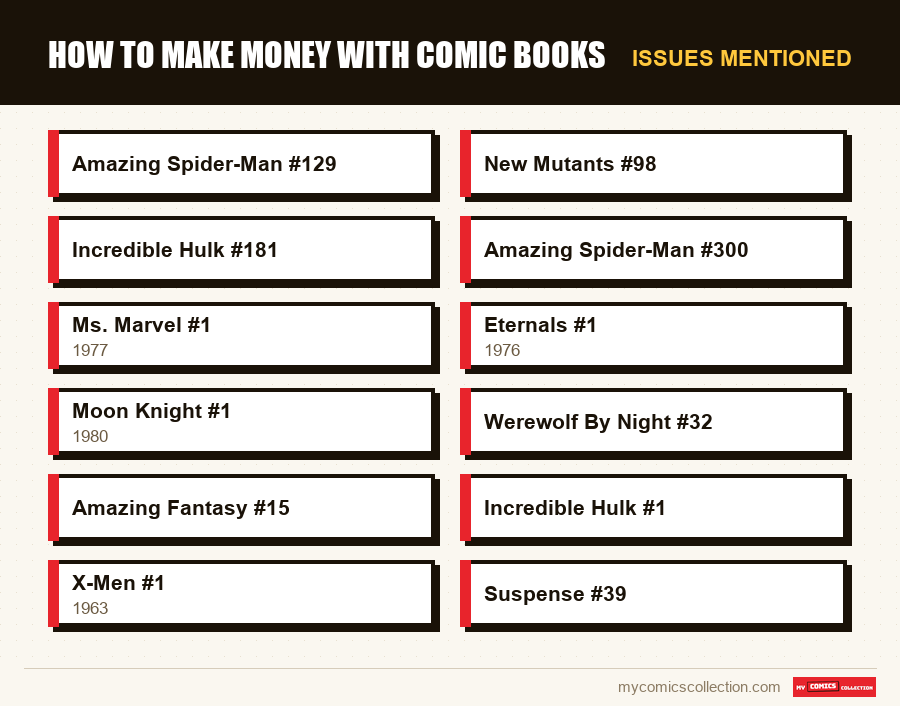
- Garage sales and estate sales -- The classic goldmine. Families clearing out attics often have no idea that a beat-up Amazing Spider-Man #129 is worth $300+ even in low grade.
- Dollar bins at conventions -- Dealers dump non-key issues to clear inventory. But keys slip through. A sharp eye can spot a New Mutants #98 (1st Deadpool) misfiled among common X-Men issues.
- Facebook Marketplace and Craigslist -- Sellers listing "old comics" in bulk lots often price by volume, not value. A $100 lot might contain a single book worth $500.
- Thrift stores -- Goodwill, Salvation Army, and local thrift shops occasionally receive donated collections. Check weekly.
Realistic profit margins: Expect 30-100% return on individual flips when buying from non-collector sellers. A raw Incredible Hulk #181 purchased for $800 at a garage sale might sell for $1,500-$2,000 on eBay depending on condition. But factor in eBay fees (13%), shipping ($5-15), and your time. Net margins on small flips ($20-50 profit) often fall below minimum wage when you account for sourcing time.
Method 2: Grading Arbitrage
Grading arbitrage is one of the most reliable profit strategies for experienced collectors. The concept is simple: buy a raw (ungraded) comic that you believe will grade higher than the seller expects, submit it to CGC or CBCS, and sell the slabbed book at the graded price.
How it works in practice:
- You spot a raw Amazing Spider-Man #300 listed on eBay for $350, described as "VF condition."
- Based on the photos, you believe it could grade CGC 9.4 or higher.
- You purchase it, submit to CGC ($40-75 depending on tier), and wait 30-90 days.
- It comes back CGC 9.6. Market value: $850-$950.
- Your total cost: $350 + $75 (grading) + $15 (shipping) = $440. Net profit after eBay fees: approximately $300.
The risk: If that same book comes back CGC 8.5 instead of 9.4, its graded value might be $400 -- and you've lost money after fees. Grading arbitrage rewards people who can accurately assess condition from photos. Study CGC's grading standards obsessively before attempting this.
Method 3: MCU and Media Speculation
When Marvel Studios announces a new movie or Disney+ series, the first appearance of every character involved spikes in price. This has been the single most powerful price driver in the comic market since 2014. The key is getting in before the announcement.
Examples of past MCU speculation wins:
- Ms. Marvel #1 (1977) -- Rose from $50 to $400+ after the Disney+ series announcement.
- Eternals #1 (1976) -- Jumped from $30 to $200+ when the film was confirmed.
- Moon Knight #1 (1980) -- Went from $75 to $350+ after Oscar Isaac was cast.
- Werewolf By Night #32 (1st Moon Knight) -- Surged from $300 to $2,000+ in high grade.
How to predict the next MCU spike: Follow Marvel Studios patent filings, trademark registrations, and casting calls. When Marvel trademarks a character name for "entertainment services," a project is likely in development. Reddit communities like r/MarvelStudiosSpoilers track these signals in real time.
Method 4: Convention Flipping
Comic conventions create a unique economic environment where hundreds of dealers compete for foot traffic. Prices at cons are often 15-30% below online prices because dealers prefer cash sales with no fees. Smart buyers spend the first day scouting, comparing prices across booths, and buying on the final day when dealers slash prices rather than pack inventory home.
Best conventions for buying: Smaller regional shows (100-200 dealers) typically offer better deals than mega-events like SDCC or NYCC, where dealers inflate prices for tourist traffic. Shows like Baltimore Comic-Con, HeroesCon, and WonderCon strike the ideal balance of selection and fair pricing.
Method 5: Long-Term Key Issue Appreciation
If you have patience and capital, the safest comic investment strategy is simply buying blue-chip key issues and holding them for 5-10 years. The data is compelling: Golden Age and Silver Age keys have appreciated at an average rate of 8-15% annually over the past two decades, outperforming the S&P 500 in many periods.
Blue-chip keys with proven track records:
- Amazing Fantasy #15 (1st Spider-Man) -- CGC 4.0 went from $15,000 in 2015 to $45,000+ in 2025.
- Incredible Hulk #1 -- CGC 3.0 climbed from $8,000 in 2016 to $22,000+ in 2025.
- X-Men #1 (1963) -- CGC 5.0 rose from $4,000 in 2015 to $12,000+ in 2025.
- Tales of Suspense #39 (1st Iron Man) -- CGC 4.0 went from $3,000 in 2016 to $9,500+ in 2025.
Method 6: Bulk Collection Buying and Reselling
Buying entire collections -- sometimes hundreds or thousands of comics -- at a bulk rate, then cherry-picking the valuable issues and reselling the rest. This is how many comic shop owners build their initial inventory. The trick is paying the right price for the lot. A good rule of thumb: never pay more than 30-40% of the estimated retail value of the identifiable keys in the collection.
How to source bulk collections:
- Estate sales and auctions -- Families liquidating a deceased collector's holdings often accept wholesale offers for convenience. Local estate auction houses frequently have comic lots that serious collectors overlook.
- Craigslist and Facebook Marketplace -- Sellers listing "old comics" by the box are your prime targets. Respond quickly and be prepared to pick up same-day for the best deals.
- Retiring dealers -- Comic shop owners closing their businesses sometimes sell remaining inventory at 20-30 cents on the dollar to avoid the hassle of individual listings.
- Storage unit auctions -- Occasionally yield collections that the previous owner abandoned or couldn't maintain. The risk is higher (you may not be able to inspect beforehand) but the entry price is often extremely low.
The resale strategy: Once you've acquired a bulk collection, sort it into three tiers. Tier 1 (keys and high-value books) gets listed individually on eBay. Tier 2 (decent mid-range books, $5-20 each) gets grouped into themed lots. Tier 3 (common books worth under $3) gets sold in bulk to other dealers or donated for a tax write-off. The profit comes from Tier 1; Tiers 2 and 3 recover your base cost.
Method 7: International Market Arbitrage
Comic prices vary significantly between countries. A CGC 9.8 copy of a modern key that sells for $200 on the US eBay might sell for $300+ on eBay UK or eBay Australia, where supply is thinner. Conversely, European comics (Tintin, Asterix first editions) are often cheaper in the US than in their home markets. Understanding these price differentials creates arbitrage opportunities.
How to exploit international price gaps:
- Use eBay's international sites (ebay.co.uk, ebay.com.au, ebay.de) to compare prices for the same CGC-graded book. Shipping costs and import duties must be factored into the equation.
- UK pence variants from the 1970s-1980s are often underpriced in the US (where collectors prefer standard editions) but command premiums in the UK market.
- Japanese manga first editions and European album-format comics (Tintin, Asterix, Lucky Luke) are frequently undervalued at US conventions and overvalued in their home markets.
Building Your Comic Investment Toolkit
Regardless of which method you choose, you need reliable tools to track prices, manage inventory, and identify opportunities. A comic collection management app is essential for tracking your purchase prices, current values, and profit/loss across your portfolio. Free price guides like GPA Analysis (for CGC census data) and eBay sold listings are indispensable for research.
Essential resources for comic investors
- GPA Analysis -- Historical CGC sale prices across all grades
- GoCollect -- Fair market value estimates and trend charts
- eBay sold listings -- Real-time market data (always check "sold" not "listed")
- Key Collector Comics app -- Identifies key issues and tracks spec targets
- My Comics Collection -- Manage and value your entire portfolio
Common Pitfalls That Destroy Profits
Most newcomers lose money in their first year. Here are the traps to avoid:
- Chasing hype too late -- By the time a book is trending on social media, the profit window has closed. You're buying someone else's exit liquidity.
- Ignoring fees -- eBay takes 13%, PayPal takes 2.9%, shipping costs $5-15, and CGC grading runs $25-150 per book. These fees eat into thin margins fast.
- Overgrading your own books -- Sellers consistently overestimate their books' condition by 1-2 grades. Be brutally honest.
- Emotional buying -- Falling in love with a book and overpaying because you "must have it." Investment and collecting require different mindsets.
- Neglecting storage -- A $500 comic stored improperly loses value every day. Invest in acid-free bags, boards, and climate-controlled storage.
How Much Can You Realistically Earn?
Let's be honest about expectations. Here are realistic annual income ranges for each method, assuming part-time effort (10-15 hours per week):
- Flipping (dollar bins, garage sales): $2,000-$8,000/year. Highly variable, dependent on sourcing access and local market.
- Grading arbitrage: $3,000-$12,000/year with $5,000+ in working capital and accurate grading skills.
- MCU speculation: $1,000-$20,000/year. The most volatile method -- one perfect call can fund a year, one bad call can wipe out months of gains.
- Convention flipping: $1,000-$5,000/year if you attend 4-6 shows annually.
- Long-term appreciation: 8-15% annual return on invested capital, unrealized until you sell. On a $20,000 portfolio, that's $1,600-$3,000/year in paper gains.
- Bulk collection reselling: $5,000-$15,000/year with sufficient capital and sourcing network.
Tax Implications for Comic Investors
In the United States, profits from selling comics are subject to capital gains tax. Comics held for more than one year qualify for long-term capital gains rates (0-20% depending on income). Comics held for less than one year are taxed as ordinary income. Keep meticulous records of purchase prices, dates, and sale prices. A comic collection management tool that tracks acquisition costs is invaluable at tax time.
For high-volume sellers (more than 200 transactions or $20,000 in gross sales per year), eBay will issue a 1099-K. Consult a tax professional if you're operating at scale.
Frequently Asked Questions
You can start with as little as $50-100 by focusing on dollar-bin finds and undervalued modern keys. However, serious grading arbitrage or key issue investing typically requires $500-2,000 in starting capital to see meaningful returns.
For long-term holds and high-value keys, graded (slabbed) comics are preferable because they offer authentication, condition certainty, and easier resale. For quick flips under $200, raw books are often more profitable because you avoid grading fees and turnaround time.
Silver Age keys (1956-1970) have historically offered the most consistent appreciation, averaging 10-15% annually over the past 20 years. Bronze Age keys (1970-1984) offer better entry prices with strong upside. Modern keys (2000+) are more volatile but can deliver explosive short-term gains tied to media adaptations.
For speculation plays tied to movie announcements, sell within 2-4 weeks of the news cycle peak. For blue-chip keys, a minimum 3-5 year hold is recommended. Historical data shows that 7-10 year holds on Silver Age keys consistently outperform shorter holding periods.
A small number of dealers and investors do earn a full-time income, but it typically requires $50,000+ in inventory, years of experience, strong dealer relationships, and diversified revenue streams (conventions, online sales, grading services). Most successful comic investors treat it as a profitable side income rather than a primary career.