You've lived this moment. A friend discovers your collection, their eyes light up, they grab a comic and say: "Oh can I borrow this? I'll give it back next week, promise." You hesitate, that issue has value, but friendship wins out.
You've lived this moment. A friend discovers your collection, their eyes light up, they grab a comic and say: "Oh can I borrow this? I'll give it back next week, promise." You hesitate, that issue has value, but friendship wins out. And three months later, when you think about that comic, you don't even dare ask anymore. Next week became never.
The loaned comic that never returns is one of the most universal collector experiences. Every collection has its gaping hole, that missing issue whose borrower's first name you know but whom you no longer dare ask. This guide exists so it never happens to you again, without becoming someone who lends nothing.
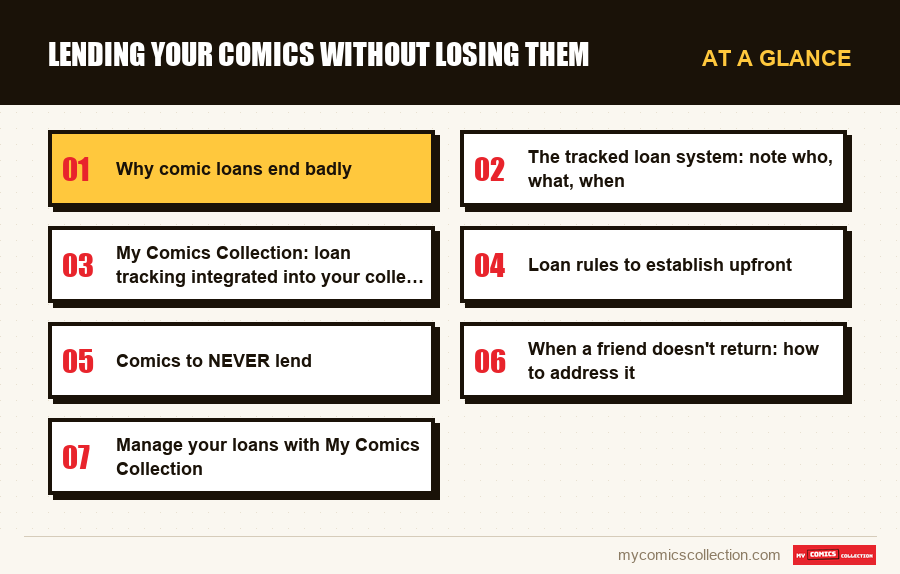
Why comic loans end badly
It's not about bad faith. Most friends who borrow comics sincerely intend to return them. It's memory that slips, and circumstances that take over. The classic scenarios:
Mutual forgetting
You and your friend both forget the loan exists. Without written record, it disappears from collective memory as easily as it left your shelf.
The move
Your friend moves, maybe across the country. The comic follows the boxes. You see them once a year. The topic never comes up at the right moment.
Mutual awkwardness
The more time passes, the more asking becomes awkward. You don't want to seem petty, your friend knows they should return it: result: no one says anything.
The cascade loan
Your friend lends your comic to another friend. You no longer really know the chain. The comic tours the neighborhood before disappearing into thin air.
The good news: all these problems have a common solution. The tracked loan. No romanticism: just a quick note that changes everything.
The tracked loan system: note who, what, when
Tracked loans are simple: you record each loan at the moment it happens, with three minimum pieces of info. Borrower's name, exact comic title (issue included), loan date. That's it. This tiny gesture makes all the difference.
Why does it work? Because the written record changes the psychological nature of the loan. Your friend knows you have a list. You know you have a list. The comic is no longer "somewhere": it's with someone, with a date. And you can follow up without awkwardness, because you're not asking for memory, you're consulting a record.
Record the loan immediately
At the exact moment you hand the comic to your friend (not later, not "tonight") open your app and record the loan. Borrower's full name, exact title, issue, today's date. 30 seconds flat.
Set a deadline verbally
Naturally mention a timeframe: "Take your time, but try to get it back to me within a month." It's not an ultimatum: just setting clear expectations without ambiguity or future resentment.
Note the return date
My Comics Collection stores each loan with the borrower and the date, but sends no reminder, so add the expected return date to your phone's calendar. You follow up with your friend naturally, as if it were obvious: because it is.
Mark return upon receipt
When the comic comes back, check it off in your tracking immediately. Quickly verify condition (no detective inspection, just a glance) and archive the loan. Your list stays clean, your collection stays complete.
My Comics Collection: loan tracking integrated into your collection
Keeping track in a notebook or spreadsheet works, but has a major flaw: it's a separate list from your collection. When you consult your inventory, you don't see that the issue is currently with someone else. You might even think it's gone.
My Comics Collection natively integrates loan tracking into your collection inventory. Each loaned comic is automatically marked "On loan" in your list, visible at a glance, inseparable from your overall management. You always know what's at home and what's circulating elsewhere.
Concrete benefit: Before a convention, when you check your missing-comics list, My Comics Collection accounts for loaned issues. You won't rebuy a comic that's simply temporarily absent from your shelf.
Loan rules to establish upfront
The best rules are those announced naturally, before the loan, without sounding like a notarized contract. One sentence is enough:
- One-month maximum: enough to read comfortably, not enough to forget.
- Return in same condition: in the sleeve if it was in one, without extra creases.
- No sub-lending: your friend doesn't lend your comic to a third party without telling you.
- Key issues excluded: you don't lend issues of special importance. Period.
Phrased simply: "Happy to lend it, just two rules: give it back within a month, and don't lend it to someone else without telling me. There are a few issues I never lend, but this one's fine." No one finds this shocking. It's mutual respect.
Collecting this series?
Track what you own, what you are missing and what your collection is worth. 7 day trial.
Start my trial →Comics to NEVER lend
Some comics should never leave your shelf in someone else's hands. The list is short but firm:
The untouchable list
- Key issues: character first appearances, major deaths, rare variant covers
- CGC-graded comics: slabs don't get loaned: breakage risk is too high
- First editions: any issue that's a "first edition" of a series or arc
- Any comic worth more than $55: if you'd hesitate to insure it, don't lend it
- Hard-to-find issues: if you took months to find it, keep it
Honest phrasing with a friend: "That one I never lend: it's a general rule. But I can find you the TPB with the same arc if you want to read it anyway." Offering an alternative shows good faith without sacrificing the irreplaceable.
When a friend doesn't return: how to address it
The golden rule: follow up early, follow up lightly. The longer you wait, the more the situation loads with awkwardness. A follow-up at 5 weeks is natural. A follow-up at 8 months feels like an accusation, even if totally legitimate.
The phrasing that preserves everything: "Hey, by the way, did you finish that Saga #1 I lent you? I was thinking about my collection and just wanted to know if you'd read it." This phrase: doesn't presume bad faith, reminds exactly what it is, and offers a natural exit ("I finished it, I'll bring it this weekend").
If after two friendly follow-ups there's still nothing, be direct but kind: "You can keep it a bit longer, but I need it back: that issue has real value in my collection." Mentioning value isn't petty: it anchors reality. A friend who doesn't know they're holding something precious can't gauge the stakes.
As a last resort: If the comic has significant value and follow-ups go unanswered, a photo of the loan recorded in your app, with date and exact issue, constitutes proof in case of dispute. No need to go that far in most cases, but it's reassuring to know the record exists.
FAQ: Lending your comics
Manage your loans with My Comics Collection
Track every loaned comic from your inventory. Who has what, since when, at a glance: without ever losing track of an issue.
🚀 Free 7-day trial, no commitment