The Korvac Saga reading order runs through Avengers #167 and 168, then #170 to 177, published from January to November 1978. Jim Shooter and David Michelinie wrote it, with art by George Perez and David Wenzel. No prelude is required, but Giant-Size Defenders #3 (January 1975) is the first appearance of Korvac. Read the series straight through, with no tie-ins: the story lives entirely within the pages of Avengers.
Few late-1970s stories are still cited as a benchmark for the team. The Korvac Saga is one of them, and it has a practical advantage: it reads within a single series, across ten issues you can stack without hesitation. What remains is placing the landmarks correctly, because two numbering details and a few late echoes puzzle newcomers.
As always in this guide, only verified information (creators, issue numbers, dates) is stated as fact; the analysis is our own, with no reproduction of pages or protected dialogue.
What to read first
The saga is aimed at a reader who already knows the spirit of the series: a large team, rotating members, a roster spanning several generations. You do not, however, need any specific arc. Here are the useful landmarks, from most relevant to most optional.
- Giant-Size Defenders #3 (January 1975): the first appearance of Korvac, created by Steve Gerber on script and Jim Starlin on art. At this point the character has no first name. Our page on the Defenders places that series in context.
- Thor Annual #6 (1977): this annual was meant to make Korvac an opponent of the Guardians of the Galaxy, but the series that hosted them, Marvel Presents, was canceled before it came out. It is a historian's curiosity, not a prerequisite.
- The last issues of Avengers before #167: reading a few single issues just before gives you the state of the team as it enters the saga, useful for recognizing the members present in January 1978.
If you are short on time, open #167 directly. The series introduces its characters well enough that an attentive reader can find their footing, and the references to Korvac's past are understood from context.
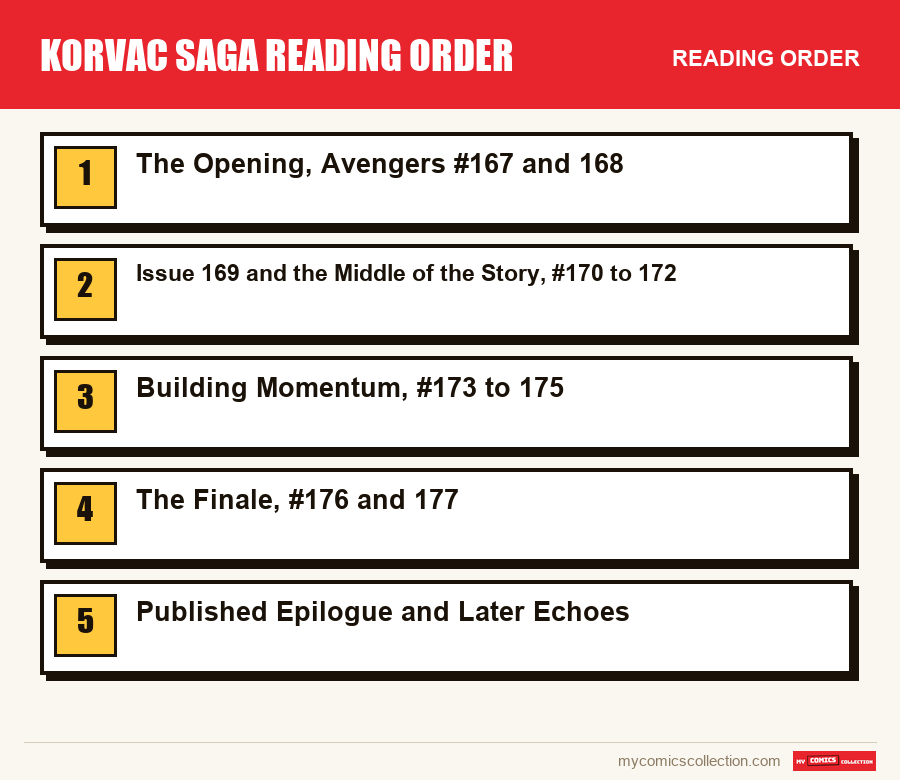
Phase 1: The Opening, Avengers #167 and 168
The story begins in January 1978. Jim Shooter and David Michelinie write the saga, and this pair of authors explains the tone: a patient plot that lets the scale of the danger reveal itself bit by bit. The art falls to George Perez and David Wenzel, who trade off over the issues of 1978.
These two issues set the scene without any need to say more. Our reading advice: take your time, because the saga is built over the long haul, and the pleasure comes from the gradual climb. Readers used to contemporary stories, where the stakes are announced on the cover, will find a more serialized rhythm here.
To understand the importance of the art in this period, our page on the work of George Perez traces his career, of which these Avengers issues are a milestone.
Phase 2: Issue 169 and the Middle of the Story, #170 to 172
A numbering detail surprises: the saga consists of #167, #168, then #170 through #177. Issue #169 sits between the two, in the continuous run, and a reader following the single issues in order will necessarily come across it. The landmark to remember is the saga's boundaries, which skip this issue. If you want a read with no gap, slip it in between #168 and #170; for the strict sequence, go straight from one to the other.
Issues #170 to 172 continue the plot opened at the start of the year. Since publication was monthly, readers at the time waited a month for each installment. Reading at that pace is a luxury they did not have; you can swallow the block in one evening and see how the construction spreads out its high points.
A reading tip: keep mental notes on the members present, because the roster is large. Our Avengers reading guide helps identify the periods when the team's lineup changes.
Phase 3: Building Momentum, #173 to 175
This block sits at the center of the saga. We detail nothing of the plot: the pleasure of the saga lies in the fact that it cannot be summed up. Keep in mind that the cast widens as the issues go on, and that the Guardians of the Galaxy join forces with the Avengers in the saga by Jim Shooter and David Michelinie.
Two habits help with reading. First: read these three issues right after those of the previous phase. Second: do not look for tie-ins elsewhere. Everything that matters happens in the series, and opening another title would risk pulling you away from a thread that is self-sufficient.
If you collect, this is where your reading frame becomes a storage frame: this run of three consecutive single issues is easy to isolate in a box, with a label naming the event.
Phase 4: The Finale, #176 and 177
The saga ends in November 1978 with #177. We will say nothing about the ending, which we leave for you to discover. Keep in mind that these two issues should be read in one go, and that it is better to have an evening ahead of you, because stopping between the two breaks the intended effect.
The single issues in question bear the graphic stamp of George Perez and David Wenzel. For a collecting run, the condition of #177, which closes the story, deserves close inspection when you buy.
Once #177 is closed, the reading is finished: there is no direct sequel to follow up with. The pages that come after are echoes, which Phase 5 covers.
Do you collect this series?
Track what you own, what you are missing and what your collection is worth. 7-day trial.
Start my trial →
Phase 5: Published Epilogue and Later Echoes
Korvac has returned several times since 1978, in titles very different from one another:
- Avengers Annual #16 (1987), another appearance of Korvac.
- What If? #32 (1982) and the second series of What If? #36 (1992), other appearances of Korvac.
- In 1991, four annuals tied to a crossover: Fantastic Four Annual #24, Thor Annual #16, Silver Surfer Annual #4 and Guardians of the Galaxy Annual #1.
- Captain America (third series) #17 to 19, then Avengers Academy #11 (2011).
- Captain America: The Korvac Saga (December 2010), a condensed story tied to the release of the film Captain America: The First Avenger.
Worth mentioning too is the 1991 collected edition, which reprinted the saga with a new epilogue written by Mark Gruenwald and drawn by Tom Morgan. Tom Brevoort removed it when the saga was reprinted in Avengers Legends, volume 2, in 2003.
The Tie-Ins You Can Skip
The answer is simple: all of them. The titles in Phase 5 postdate 1978 and read as echoes. None is needed to follow the saga, and most make sense only once you know the original.
The four 1991 annuals deserve a particular mention. These four single issues belong to a 1991 operation that crosses several Marvel titles, and they will please anyone who likes to meet a villain from the past in neighboring series. Reading them is not essential, but they let you measure how alive the figure of Korvac remained thirteen years after publication.
As for the two issues of What If?, they are read after the saga, out of curiosity: they are reader bonuses rather than chapters of the story. Our file on Avengers annuals and specials places these out-of-series issues.
As a reminder, here are the three stages of collecting: spot the opening (#167), check the continuity of the middle (#170 to 176), then secure the conclusion (#177). This progression keeps you from buying out of order and ending up with a gappy run.
Single Issues or Collected Editions: How to Read It
To read the saga, the ten original single issues (#167, 168, 170 to 177) are enough. On the collected edition side, we can mention the 1991 edition, which added an epilogue, and the reprint in Avengers Legends volume 2 (2003), which removed it. If that Mark Gruenwald epilogue interests you, the difference between the two editions is worth knowing before you buy, because only the 1991 one contains it.
Our advice on method: start with a trade paperback, which saves you from chasing issues, then complete with single issues if the collection tempts you. An alternative is to buy the three or four most sought-after issues, and read the rest in a trade.
Know, finally, that a collected edition sometimes reorganizes the contents: check that it does cover issues #167, #168 and #170 to 177, and see whether or not it includes #169. It is a question of contents, to settle before you buy. To organize your storage, our Avengers collecting guide offers a method that applies to any large series.
One tip for a single-issue reader: these eleven 1978 issues fit in one box, but keep #169 apart, filed between #168 and #170. You can read the saga in one sitting while knowing exactly where the issue that sits outside the story is, which saves you from thinking your run has a gap.
The Key Issues to Know
- Giant-Size Defenders #3 (January 1975): the first appearance of Korvac by Steve Gerber and Jim Starlin, the character's original reference.
- Avengers #167: the opening of the saga, sought after by fans of arc openers.
- Avengers #177: the conclusion, whose grade determines the value of a reassembled set.
- Avengers #170 to 176: the body of the story, more affordable individually, but useful for completing the sequence.
- Thor Annual #6 (1977): interesting for the small history of the missed link with the Guardians of the Galaxy.
To price a buying session, cross-check completed sales of copies close to yours, examine the spine, corners and cover, then account for how complete the sequence is. A run of ten issues in one piece sells and stores differently from an isolated issue. If you hesitate over reading the grade, careful reading of a grading label is preferable to the bare number.
Recap: The Complete Order
- Giant-Size Defenders #3 (optional, first appearance of Korvac)
- Avengers #167 and 168 (from January 1978)
- Avengers #169 (the issue between the two blocks, in the continuous run)
- Avengers #170 to 172
- Avengers #173 to 175
- Avengers #176 and 177 (November 1978, conclusion)
- Avengers Annual #16, What If? #32, What If? (second series) #36 (optional echoes)
- 1991 annuals: Fantastic Four Annual #24, Thor Annual #16, Silver Surfer Annual #4, Guardians of the Galaxy Annual #1 (optional)
Frequently Asked Questions
The saga comprises Avengers #167, 168 and 170 to 177, published from January to November 1978. Jim Shooter and David Michelinie wrote it, with art by George Perez and David Wenzel. Issue #169 sits between the two blocks in the continuous run.
In Giant-Size Defenders #3, dated January 1975, created by Steve Gerber and Jim Starlin. The character does not yet have a first name there. That reading is optional: the 1978 Avengers can be understood without it.
No. The saga unfolds in the Avengers series. The titles cited as follow-ups, from What If? #32 to the 1991 annuals, are later and optional: they serve as echoes for those who have already closed #177.
Yes. A 1991 edition added an epilogue by Mark Gruenwald and Tom Morgan; the reprint in Avengers Legends volume 2, in 2003, removed it. A condensed story, Captain America: The Korvac Saga, came out in December 2010.
George Perez and David Wenzel share the art on the issues of the saga, from January to November 1978. Keep in mind that both artists contribute: naming only one would be inaccurate for the whole sequence, from #167 to #177.
Do you own 1978 issues of Avengers? Get your run valued before you complete it.
Value my comic