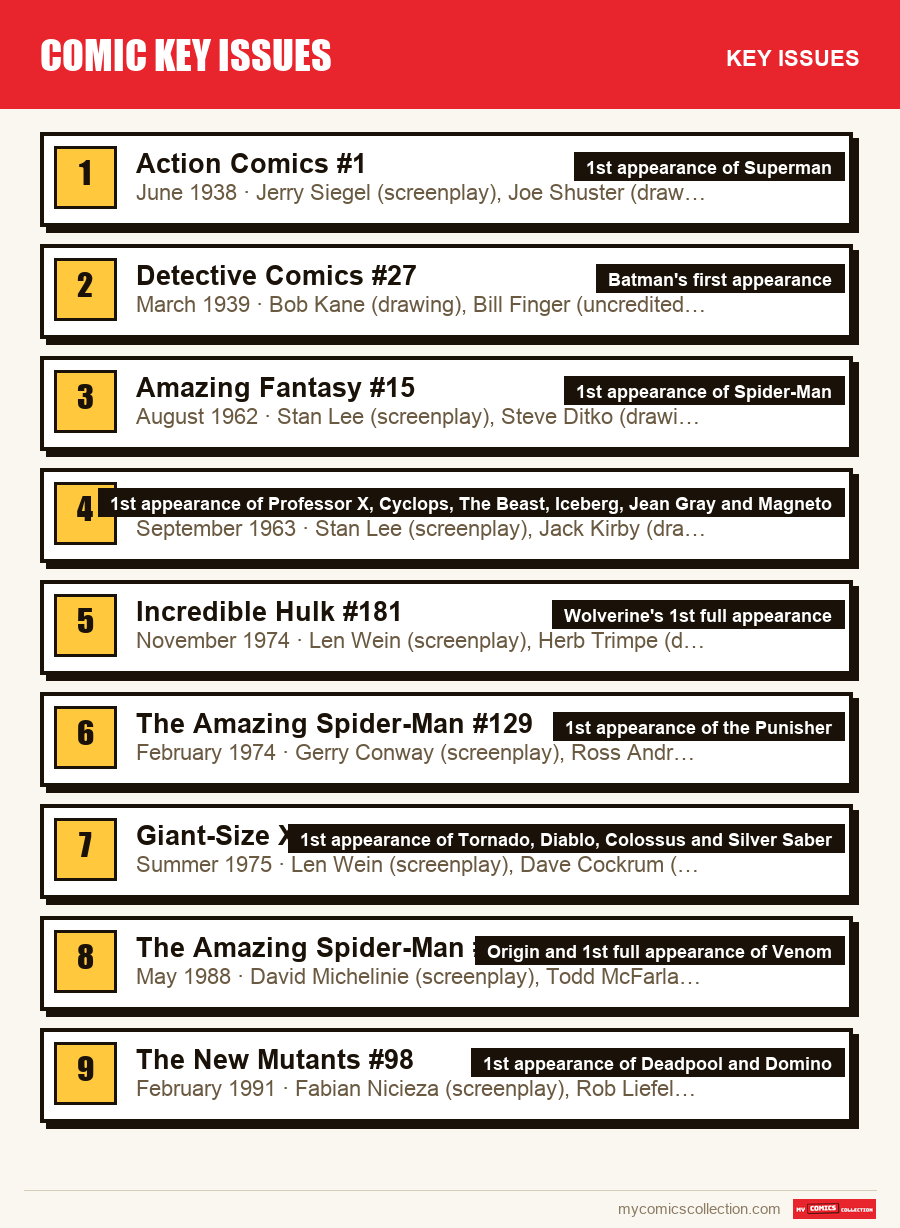
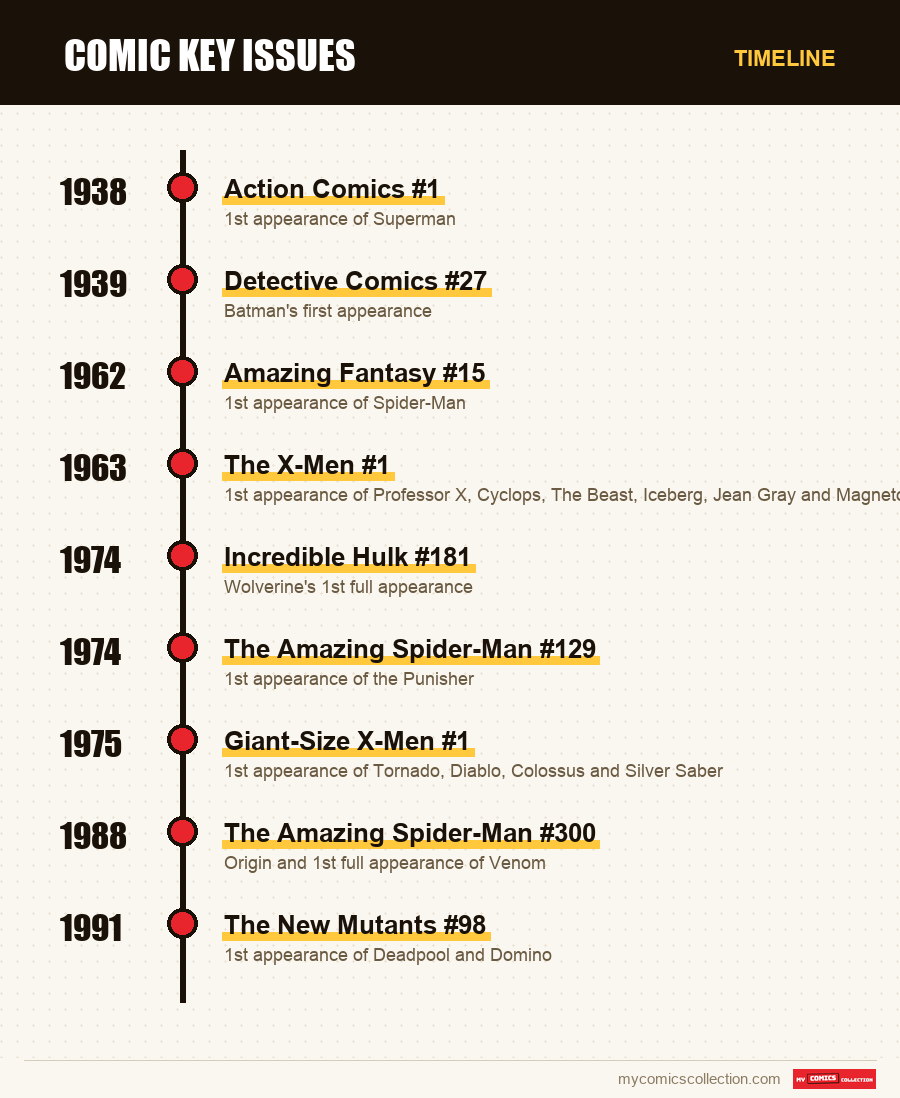
A key issue is a comic book whose importance goes far beyond its simple publication: first appearance of a major character, death or significant origin, arrival of a cult creator, or editorial turning point which permanently changes a franchise. The most emblematic examples remain Action Comics #1 (1938, 1st appearance of Superman, sold for $6 million in 2024), Detective Comics #27 (1939, birth of Batman) and Amazing Fantasy #15 (1962, 1st appearance of Spider-Man, sold for $3.6 million). Their value depends on three verifiable factors: actual rarity (period print run and number of surviving copies), the CGC census (how many copies were graded and in what condition) and demand, often boosted by film and series adaptations.
Looking for key comic issues means trying to understand why certain issues worth ten or twelve cents are worth tens or even millions of dollars today, when thousands of other releases from the same period sleep in longboxes without ever exceeding their face value. The answer lies neither in chance nor in marketing: it lies in editorial history itself, at this precise moment when a character, a creative team or a plot has shifted from an anecdotal status to a founding status for an entire narrative universe.
This article doesn't just list popular titles. It retraces, copy by copy, the publication context, the creators involved, the circulation and rarity data when documented, and the price trajectory observed on the major auction houses (Heritage Auctions, ComicConnect, CGC) and on the eBay market over the last few years. We intentionally cover very different titles and eras (DC Golden Age, Marvel Silver Age and Bronze Age, up to the turn of the 1990s) to give a transversal vision of what makes an ordinary comic fall into the category of key issues. If you are looking for a file dedicated to a specific character rather than a selection of flagship titles from all series, head to our dedicated surveys on Bullseye's editorial history or on the Old Man Logan saga, which each carve out a full story arc rather than a selection of first appearances.
An important clarification before diving into the files: the rating of a key issue varies enormously depending on the state of conservation, and the same title can display a price difference of several thousand percent between a damaged copy and an almost perfect copy. This is why the CGC grade (0.5 to 10.0) is systematically mentioned in the reference sales cited below: understanding this scale is a prerequisite for correctly reading any market data on old comics.
What is a key number, and how is its rarity determined?
A key issue (“key issue” in Anglo-Saxon jargon) is defined by an irreversible editorial event: a first appearance of a character who will become central, an origin told for the first time, the death or return of a major hero, or the arrival of a creator whose style will redefine a title. None of this is decreed a priori: it is historical hindsight and the subsequent success of the character or arc that transforms an innocuous booklet into a sought-after object. Amazing Fantasy #15 was just a one-off issue of an anthology on the verge of being canceled when Stan Lee and Steve Ditko inserted Spider-Man as a last ditch attempt; no one in 1962 would have bet on the $3.6 million that the best-preserved CGC 9.6 copy would fetch in 2021 at Heritage Auctions.
Rarity is built from the beginning. Comics from the Golden Age (late 1930s-1940s) were printed on cheap newsprint, sold on newsstands, read, loaned, sometimes cut up for their advertisements, then thrown away once finished reading: no one considered them collector's items. Action Comics #1 thus had an estimated circulation of 200,000 copies in 1938, an enormous figure for the time, but experts today agree on only a hundred surviving copies in all conditions, and only 78 copies recorded in the CGC census. This extremely low survival ratio (less than one copy in 2,000) alone explains why this issue remains, with Detective Comics #27, one of the two absolute Holy Grails of the hobby.
From the 1960s and especially 1970-1980, distribution practices evolved, collectors began to keep their purchases in sleeves, and the survival rate increased mechanically. This is why the rarity of a key issue from the Bronze Age like Incredible Hulk #181 (1974) or Amazing Spider-Man #129 (1974) is no longer measured in tens of copies, but in tens of thousands of copies listed in the CGC: the real rarity variable then becomes the quality of very high grade conservation, not the survival of the copy itself. A read copy, folded, with a worn binding, remains common; an almost new example graded CGC 9.8 or 9.9 becomes extremely sought after. This distinction between absolute rarity (few copies exist) and relative rarity (many copies exist, but very few in high grade) is the key to understanding why two key issues from the same decade can have radically different rating trajectories, as we detail in our comparison on the difference in value between a CGC grade 9.0 and 9.8.
Action Comics #1
The very first issue of the series that gave its name to the “Golden Age” of comic books. Superman appears on the cover lifting a car, a visual that will become one of the most reproduced images in 20th century popular culture. The original print run is estimated at around 200,000 copies, but National Allied Publications (the ancestor of DC Comics) absolutely did not imagine creating a collector's item: the newsprint used was designed to be read and then thrown away. As a result, barely a hundred examples would have survived all conditions, including only 78 recorded by CGC to date, and only a handful above grade 8.0.
Detective Comics #27
“The Case of the Chemical Syndicate”, six pages which lay the foundations of the masked vigilante of Gotham, barely a year after the launch of Superman from the same publisher. It is one of only two comics, along with Action Comics #1, to repeatedly sell in excess of seven figures at auction. Estimates of the number of surviving copies vary depending on the source, between 75 and 200 copies in all conditions: a level of rarity comparable to that of a printed incunabula, which explains a continuous increase in auctions for fifteen years.
Amazing Fantasy #15
Published in the very last issue of an anticipation anthology doomed to cancellation, this booklet introduces in one go Peter Parker, the bite of the radioactive spider and the death of Uncle Ben: the most repeated origin in the Marvel catalog. The character was not even entitled to his own series for several months, proof that nothing predestined this issue to become the absolute reference of the Silver Age. The auction trajectory illustrates the typical appreciation mechanics of a top-tier key number: $454,100 for a CGC 9.4 copy in 2016, $795,000 for a copy of the same grade in 2020, then a spectacular jump to $3.6 million for the only CGC 9.6 copy listed, sold at Heritage Auctions in September 2021.
The X-Men #1
The launch of an entire franchise in a single issue: the entire original team, Charles Xavier and his school for mutants, as well as Magneto as the great antagonist. The title experienced decades of uneven success before becoming, under the leadership of Chris Claremont in the 1970s and 1980s, one of the pillars of the publisher: which retroactively propelled the rating of this very first issue. A copy of the so-called “Pacific Coast” edition, graded CGC 9.8 NM/M, had already reached $492,938 in 2012; the record has since climbed to $872,000 for a CGC 9.6 copy sold in 2022, the same copy having traded ten years earlier for $200,000, a strong signal of the appreciation of the vintage comics market over the period.
Incredible Hulk #181
Wolverine had already been seen in the very last pages of the previous issue, but it is here, in this fight against the Wendigo in Canada, that he gets his first full appearance as a character in his own right. The title is now ranked number 2 in Overstreet's Top 25 Bronze Age, an indicator that reflects the sustained demand from collectors for this specific period of the Marvel catalog. A CGC 9.8 copy reached $146,000, with only a CGC 9.9 copy sold in 2011 for $150,000 having done better to date: a gap which illustrates the extent to which, on this type of relatively widespread edition, the very high grade concentrates most of the value.
The Amazing Spider-Man #129
This issue introduces Frank Castle, ex-Marine turned armed vigilante, as well as the Jackal in the background, in a story which will become the starting point for one of the most adapted live-action franchises in the Marvel catalog (Netflix series then Disney+ The Punisher, appearances in Daredevil). Ranked 9th in Overstreet's Top 25 Bronze Age, this stock has seen heavy speculation in recent years: a CGC 9.8 copy peaked at $57,000 in 2022 before stabilizing around $27,500 in early 2023, a typical correction to key numbers driven by a one-time spike in media interest rather than structural scarcity.
Giant-Size X-Men #1
After the relative commercial failure of the X-Men series in the early 1970s, Marvel attempted a risky editorial gamble with this giant special issue: disbanding the original team and replacing it with a totally international group: Tornado, Colossus, Diablo, Silver Saber joined Wolverine (in only his second appearance) within a new formation which would become the basis of the "Claremont-Cockrum era", the creative golden age of the title. The market clearly distinguishes intermediate grades from very high grades: a CGC 9.8 copy sold for around $60,000, while the only example listed at grade CGC 9.9 remains the absolute reference of the series with no known equivalent at this level.
The Amazing Spider-Man #300
The dark symbiote had been hanging around in the title since Secret Wars (1984) and several issues of the parent series, but it's here that he bonds with Eddie Brock and becomes Venom for the first time under that identity, in an iconic cover drawn by Todd McFarlane at the height of his popularity. Unlike the issues from the Golden or Silver Ages, this title was massively retained by collectors upon its release: the CGC census lists more than 12,000 graded copies, including 767 at the maximum grade 9.8, making it one of the most abundant key issues in very high grade in the entire history of the hobby. The rating therefore remains significantly more accessible than the other titles on this list, even if announcements around the Venom films have occasionally increased demand.
The New Mutants #98
Deadpool arrives there as a simple mercenary antagonist sent to eliminate Cable, without the slightest hint that he would become one of the most lucrative characters in the Marvel catalog three decades later, carried by two feature films and an integration into the MCU. More than 3,900 copies have been submitted to the CGC over the years, a volume that reflects the mass production of the early 1990s, but only one has ever reached the perfect 10.0 grade: that single copy sold for $15,449 at ComicLink, a public auction record, while a private transaction on a CGC 9.9 copy reportedly reached $42,000.
Collecting this series?
Track what you own, what you are missing and what your collection is worth. 7 day trial.
Start my trial →The impact of adaptations on the rating
The key numbers market almost always reacts to cinema and television announcements, but with very different amplitudes depending on the structural scarcity of the title in question. Amazing Fantasy #15 is the most spectacular example: the launch of the Sam Raimi trilogy in 2002, then the two subsequent reboots (Amazing Spider-Man with Andrew Garfield, then the arrival of Tom Holland in the MCU from 2016) accompanied an almost continuous increase in prices over twenty years, up to the record of $3.6 million in 2021: also driven by the general appetite of the collectibles market during the period. post-2020.
The case of New Mutants #98 illustrates a different phenomenon: the title's rating had remained relatively stable and confidential for two decades, until the announcement of the Deadpool film with Ryan Reynolds in 2016, which multiplied demand across all gradations in a few months. The massive print run of the issue (more than 3,900 copies in the CGC census) however prevented a surge comparable to that of the Golden Age titles: the relative rarity in very high grades explains why only the unique CGC 10.0 copy reached peaks, while the intermediate grades remain significantly more accessible.
Amazing Spider-Man #300 follows a similar logic with the Venom films (2018 and 2021): each casting or release date announcement generated peaks in searches and bidding, without lastingly transforming the rating, precisely because the CGC census displays more than 12,000 graded copies. Conversely, on titles where rarity is absolute (Action Comics #1, Detective Comics #27) even the absence of any new adaptation does not prevent continued appreciation, driven solely by the finite number of copies available in the face of a constantly growing global collector base.
This dynamic is also found in more peripheral characters whose rating faithfully follows the cycles of media exposure: this is notably the case of Bullseye, whose full editorial history shows how appearances in the Netflix Daredevil series revived interest in his first comics, or even in the saga Old Man Logan, whose original mini-story by Mark Millar and Steve McNiven enjoyed a resurgence in popularity after partially inspiring the 2017 film Logan.
Buying guide: how to approach the purchase of a key number
- Systematically check the grade before the displayed price. The same title can display a difference of several thousand percent between a CGC grade 6.0 and a 9.8: never compare two advertisements without knowing precisely their condition.
- Distinguishes absolute rarity and high grade rarity. On a Golden Age title like Action Comics #1 or Detective Comics #27, the smallest copy has value simply because of its survival. On a more recent title like Amazing Spider-Man #300, only the high grades (9.6 and above) concentrate the value, the rest of the census remaining affordable.
- Beware of undeclared restorations. Copies of the Golden and Silver Ages have often undergone repairs (spine re-gluing, color retouching) which, if unreported, artificially inflate the appearance of the grade-a CGC “Restored” or “Qualified” label should always be checked before purchase.
- View actual sales history, not just the listed price. Auction platforms and completed eBay sales give a much more reliable image of the real price than a simple current announcement, often overvalued by the seller.
- Look at the CGC census before paying a premium for “rarity”. A seller who mentions a generic rarity without giving figures must warn: the exact number of copies graded at each level is public and verifiable data.
- Anticipates adaptation cycles. Announcements of films or series create temporary peaks in demand, particularly marked on high circulation titles: buying just before a major release exposes you to paying a premium which may be absorbed after the film's release.
- Don’t neglect the “satellite” numbers. Around a highly sought-after key number, the immediately preceding or following episodes (teaser, epilogue) are often more accessible while sharing part of the historical importance of the main title.