The most expensive Joker comic is Batman #1 (Spring 1940), the first appearance of the Clown Prince of Crime: a CGC 9.4 copy sold for $2,220,000 at Heritage Auctions in January 2021. Far behind but still exceptional, Detective Comics #168 (February 1951), which reveals the Joker's origin under the Red Hood mask, sold for $324,000 (CGC 9.4, Heritage Auctions, November 2022).
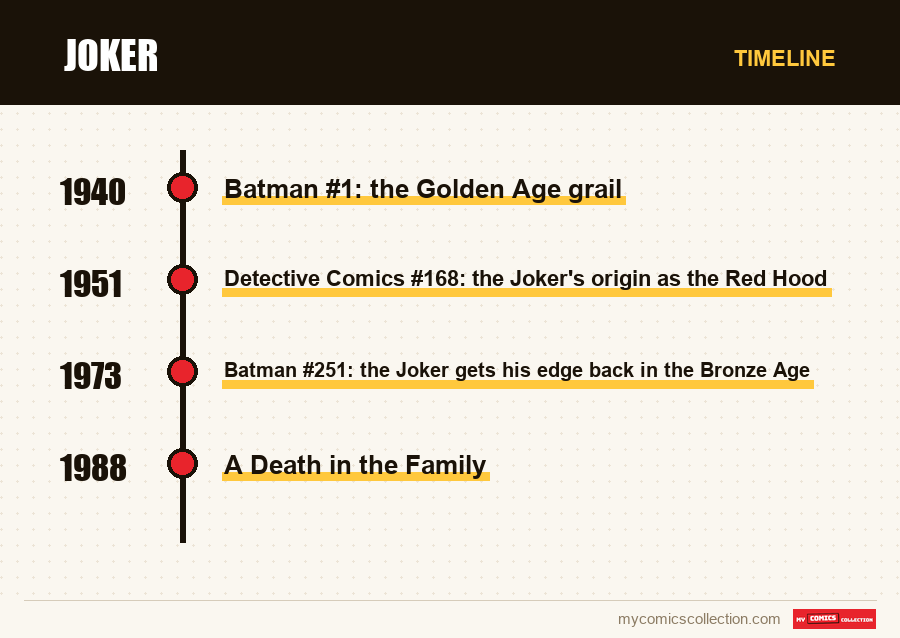
The Joker is arguably the most famous supervillain in comics history. Created by Bill Finger, Bob Kane, and Jerry Robinson, he made his first appearance in Batman #1 in Spring 1940: the same issue that introduced Catwoman. After a period of reduced prominence in the 1950s and 1960s Silver Age, he was restored as a merciless killer in 1973 by writer Denny O'Neil and artist Neal Adams (Batman #251). The decades that followed gave the character some of DC's most acclaimed works: Alan Moore's The Killing Joke (1988), the death of Jason Todd in A Death in the Family (1988-1989), and Scott Snyder's runs in the early 2010s.
This guide sticks to the verifiable: eBay medians from our estimator (eBay.fr + eBay.com, June 2026) and records documented by Heritage Auctions and specialist press. One critical warning: our tool returns a median of €7 for Batman #1 across 100 listings, but those listings are overwhelmingly reprints and facsimile editions: that figure in no way reflects the value of the 1940 original, which is a six-figure grail even in lower grades. Detective Comics #168 has only 4 active listings: no eBay median is cited for that issue.
Joker key issue ranking (documented records and eBay data, June 2026)
The two absolute grails:Batman #1 and Detective Comics #168: are too scarce and too sparsely represented on eBay to yield a reliable median. Auction room records are the only credible price reference for those issues. Batman #251, on the other hand, has a solid eBay median backed by 65 listings.
| Issue | Significance | eBay data (all grades) | Documented record |
|---|---|---|---|
| Batman #1 (Spring 1940) | 1st appearance of the Joker and Catwoman | Median not cited: dominated by reprints | $2,220,000 (CGC 9.4, Heritage Jan. 2021) |
| Detective Comics #168 (Feb. 1951) | Joker origin: the Red Hood unmasked | 4 listings: insufficient volume | $324,000 (CGC 9.4, Heritage Nov. 2022) |
| Batman #251 (Sep. 1973) | "Joker's Five-Way Revenge": his return as a killer | Median €9 · 65 listings | Not publicly documented |
| Batman #429 (Jan. 1989) | End of A Death in the Family: death of Jason Todd | Median €28 · 32 listings | Not publicly documented |
| Batman: The Killing Joke (1988) | Alan Moore & Brian Bolland: modern masterpiece | See note* | CGC 9.8 (1st print): $150-250 |
*Our estimator does not cover The Killing Joke as a distinct series. Record sources: Heritage Auctions, CGC Comics News, GoCollect, Bleeding Cool.
Batman #1 (1940): the Golden Age grail
Batman #1, published in Spring 1940, is one of the cornerstone issues of the Golden Age. It contains two Joker stories, the villain appearing in the very first issue of the Batman series, as well as the first appearance of Catwoman. Script by Bill Finger, art by Bob Kane and Jerry Robinson. Credit for the Joker's creation has long been contested; comics historians today broadly attribute the character's visual conception to Robinson and the narrative development to Finger, while Kane's tendency to rely on ghost artists has been well documented.
Our eBay estimator returns a median of €7 across 100 listings for Batman #1, but that figure is entirely skewed by modern reprints and facsimile editions that flood the market under the same title. It must never be read as the value of the 1940 original. The original is a six-figure grail even in low grade: at the high end, a CGC 9.4 (white pages) sold for $2,220,000 at Heritage Auctions in January 2021: the all-time record for this issue. A CGC 8.0 copy from the FANTAST collection later realised $1,110,000 at Heritage.
Detective Comics #168 (1951): the Joker's origin as the Red Hood
Published in February 1951, Detective Comics #168 is a landmark issue: it reveals the Joker's origin for the first time, presenting him as a criminal chemist who had operated under the Red Hood mask before falling into a vat of acid during a confrontation with Batman. That origin: which Alan Moore would draw on directly for The Killing Joke thirty-seven years later: makes this one of DC's most sought-after keys. Published at the tail end of the Golden Age, it is extraordinarily scarce in high grade.
Our eBay estimator returns only 4 active listings for this issue: the volume is too low for a reliable median. Auction records are the only reference: a CGC 9.4 copy (white pages) sold for $324,000 at Heritage Auctions in November 2022. Lower-grade copies (CGC 1.0 to 3.0) have traded for a few hundred to a few thousand dollars in documented sales on eBay and ComicLink.
Batman #251 (1973): the Joker gets his edge back in the Bronze Age
Published in September 1973, Batman #251 contains "The Joker's Five-Way Revenge", a story written by Denny O'Neil and drawn by Neal Adams. This issue is pivotal in the character's history: it breaks with the campy, harmless Joker of the Silver Age and re-establishes him as a cold, sadistic killer. The Adams cover (the Joker rising from the water, surrounded by sharks) is one of the most iconic images in the medium. It set the template for every serious take on the character that followed, from Christopher Nolan's films to animated series.
Our estimator returns a median of €9 across 65 listings: a solid volume that reflects an active entry-level market. As with most Bronze Age comics, the bulk of listings are ungraded or mid-grade copies; a CGC 9.8 or 9.6 would command significantly more, though no such record has been publicly documented. The issue appears regularly on Overstreet's lists of essential Bronze Age keys.
A Death in the Family (Batman #426-429, 1988-1989)
The A Death in the Family arc (script by Jim Starlin, art by Jim Aparo) spans Batman #426 to #429 and culminates in the death of Jason Todd, the second Robin, beaten by the Joker with a crowbar and then killed in an explosion. This arc is unique in comics history: DC ran a telephone vote to decide Jason Todd's fate, and readers chose death by 5,343 votes to 5,271. The Joker is shown at his most unambiguously cruel throughout.
Our estimator returns a median of €28 across 32 listings for Batman #429 (the conclusion of the arc): a reliable signal for the entry-level market. Batman #426 (the opening chapter) has only 11 listings: too few to cite a median reliably. These issues remain accessible in mid-grade but trade at substantially higher levels in high-grade CGC.
Batman: The Killing Joke (1988) and the Joker in the modern era
Published in 1988, Batman: The Killing Joke is a standalone story written by Alan Moore and illustrated by Brian Bolland. It draws directly on the Red Hood origin from Detective Comics #168, reframing the Joker's story as a tragedy: an ordinary man driven to madness by "one bad day." The story includes the sequence in which the Joker shoots Barbara Gordon / Batgirl, paralyzing her. The Killing Joke is one of DC's all-time bestselling works and an essential reference point for any Joker collector.
Our estimator does not cover this album as a distinct series. First printings (identifiable by the embossed lime-green title lettering) in CGC 9.8 trade in the range of $150 to $250 based on recent documented sales: an accessible level compared to the headline grails. The Todd Phillips film Joker (2019, starring Joaquin Phoenix) grossed $1.079 billion worldwide, becoming the first R-rated film to pass the billion-dollar mark. Heath Ledger had already brought the character to global prominence in Christopher Nolan's The Dark Knight (2008), which grossed over $1 billion worldwide and earned Ledger a posthumous Academy Award for Best Supporting Actor. These cultural milestones have sustained collector demand for Joker keys well beyond the traditional long-box audience.
Own a Joker comic? Get a free valuation with our tool based on real eBay sales to find its low, median, and high value.
Frequently Asked Questions
Batman #1 (spring 1940), which contains the first appearance of the Joker and Catwoman, with a script by Bill Finger and art by Bob Kane and Jerry Robinson. The original is a grail even in low grade, and you should beware of modern reprints and facsimiles circulating under the same title.
Published in February 1951, it reveals the Joker's origin for the first time: a criminal chemist who operated under the Red Hood mask before falling into a vat of acid. This origin directly inspired The Killing Joke thirty-seven years later, and the issue is extremely rare in high grade.
This September 1973 issue, "The Joker's Five-Way Revenge", by Denny O'Neil and Neal Adams, turns the Joker back into a cold, sadistic killer after the harmless Silver Age Joker. Adams's cover, with the Joker rising from the water surrounded by sharks, is one of the most iconic in the medium.
This arc by Jim Starlin and Jim Aparo (Batman #426 to #429, 1988-1989) ends with the death of Jason Todd, killed by the Joker. DC had set up a phone-in vote, and readers chose his death by 5,343 votes to 5,271.
First printings of this Alan Moore and Brian Bolland story, published in 1988, are recognizable by their lime-green title. The book builds on the Red Hood origin of Detective Comics #168 and contains the sequence where the Joker shoots Barbara Gordon.