Investing in Spawn means betting on the most widely distributed independent series in history: Spawn #1 (May 1992) was printed in roughly 1.7 million copies, a record for a creator-owned single issue. The direct result: #1's eBay median is just €15 (102 active listings, all editions and grades combined, June 2026). Liquidity is excellent, but its ubiquity in high grade caps the upside. This is not financial advice.
Spawn debuted in 1992 (Modern/Image age), so there is no "Silver Age" or "Bronze Age" grail of the character. The sought-after issues cluster around a handful of 1990s first appearances and the series' milestones (the round hundreds).
This guide sticks to the verifiable: real-time eBay medians via our estimator and documented facts. When a precise figure isn't reliable (too few listings), we state it qualitatively rather than inventing it.
The Spawn keys and their real values (June 2026)
Values = median of active eBay listings, all editions and grades combined (our estimator, eBay.fr + eBay.com). The listing count measures liquidity: the higher it is, the deeper the market and the more reliable the price.
| Issue | Significance | eBay median | Liquidity |
|---|---|---|---|
| Spawn #1 (May 1992) | First Spawn appearance, ~1.7M copies | €15 | 102 listings |
| Spawn #9 (1993) | First appearance of Angela (Neil Gaiman) | €13 | 100 listings |
| Spawn #5 (1992) | Early issues, strong demand | €10 | 100 listings |
| Spawn #8 (1992) | Early issues | €9 | 101 listings |
| Spawn #100 (2000) | Major milestone, death of a key character | €47 | 17 listings |
| Spawn #300 (2019) | Longest-running creator-owned superhero comic | €25 | 30 listings |
Median source: mycomicscollection.com eBay estimator, June 24, 2026. #1 print-run source: Wikipedia / Comichron.
Liquidity: Spawn's real strength
For an investor, liquidity, the ability to resell fast at a predictable price, matters as much as the headline value. On that front, Spawn is reassuring:
- #1, #5, #8 and #9 each show ~100 active listings at all times. You'll always find a buyer and a reference point. That's rare and valuable.
- Milestones #100 and #300 have fewer listings (17 and 30), hence higher values (€47 and €25), but the market stays thin: one or two large lots can skew the median.
- Beware the "in-between" issues. Many 1990-2010 issues have fewer than 15 listings: at that level, the median is no longer reliable. Never base a purchase on a value drawn from 4 or 5 listings.
Trap #1: "common in high grade"
This is the point every Spawn investor must understand. The colossal print run of #1 (~1.7 million) means countless pristine copies exist. Based on the CGC census, over 2,300 copies of #9 are graded CGC 9.8 (census April 2022): a "grail" comic has no scarcity when thousands of perfect copies circulate.
The consequence: slabbing a standard Spawn #1 to CGC 9.8 doesn't necessarily create value. High-grade copies stay modest, around $60-85 documented for a standard #1 in 9.8 (source: SellMyComicBooks). Grading costs can exceed the gain. The rule: on massive print runs, high grade isn't enough: you need added scarcity.
Where scarcity really exists: newsstand editions
The nuance that changes everything: newsstand editions (cover barcode, thinner paper) were only a fraction of the run and were read, not hoarded. They're therefore far rarer in high grade. A Spawn #1 newsstand in CGC 9.8 trades at roughly 3 to 4 times the price of the equivalent direct edition, with a documented copy at $367 (sources: SellMyComicBooks, GoCollect). That's where scarcity creates the premium: not grade alone.
Investor strategy (grounded in real data)
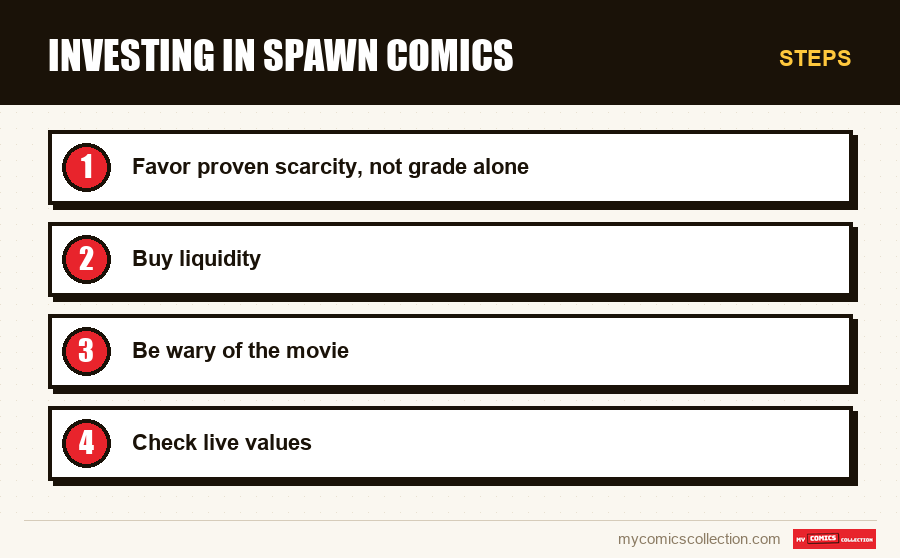
- Favor proven scarcity, not grade alone. On massive print runs like #1, target newsstand variants or genuinely rare states, not a plain direct-edition 9.8 slab.
- Buy liquidity. #1 and #9 (~100 listings) always resell; issues under 15 listings are illiquid bets.
- Be wary of the movie. A Spawn reboot has long been in development (Jason Blum, Jamie Foxx attached): "film" speculation is volatile and already partly priced in. Don't buy on that promise alone.
- Check live values. The medians above are from June 24, 2026, and they move.
This is not financial advice. Comics are a passion asset: illiquid and volatile; only commit what you're prepared to tie up, and first and foremost for the joy of collecting.
Own a Spawn comic? Get a free valuation with our tool based on real eBay sales to find its low, median and high value.
Frequently asked questions
Because Spawn #1 (May 1992) had a print run of about 1.7 million copies, a record for a creator-owned single issue. There are therefore countless flawless copies: more than 2,300 copies of #9, for example, are graded 9.8 in the April 2022 census.
Spawn #9 (1993), an issue written with Neil Gaiman. It is one of the most sought-after issues of the series after #1, with abundant supply on the market.
In the newsstand editions (barcode on the cover, thinner paper). They made up only a fraction of the print run and were read rather than hoarded, so they are far scarcer in high grade: that is where scarcity creates the premium, not in grade alone.
Spawn #100 (2000), which marks the death of a key character, and Spawn #300 (2019), the longest-running creator-owned superhero comic. The market for these issues remains thin: one or two large lots can skew the reading of prices.
Not on that alone. A reboot has long been in development, and speculation around a film is volatile and already partly priced in. Comics remain a passion asset, illiquid and volatile: this is not financial advice.