From an investing angle, two issues hold most of the value in Neil Gaiman's series: The Sandman #1 (January 1989, first appearance of Dream / Morpheus) and The Sandman #8 (August 1989, first appearance of Death of the Endless). But the most important signal isn't price: it's liquidity . #1 shows an €8 eBay median across 76 active listings (June 2026), abundant and easy to resell, while the far pricier #8 surfaces only a handful of listings, which makes any "precise" value misleading. This is not financial advice.
Gaiman's series began in 1989, making it a Copper/Modern-age title. There is therefore no "Silver Age" or "Bronze Age" issue of THIS Sandman: a point many buyers get wrong (see the namesake-character nuance below). The investment case rests on a handful of first appearances and on high-grade scarcity.
This guide sticks to the verifiable: real-time eBay medians (our estimator) and documented facts. When listing volume is too thin for a number to be reliable, we say so plainly rather than inventing it.
The key issues and their real values (June 2026)
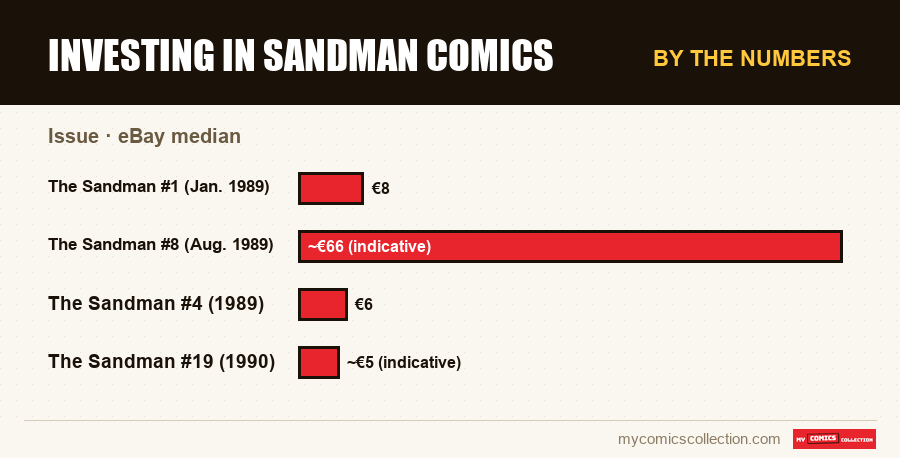
Values = median of active eBay listings, all editions and grades combined (eBay.fr + eBay.com). The "volume" column is decisive: a high price on 3 listings is worth less than a modest price on 76 listings.
| Issue | Significance | eBay median | Volume (reliability) |
|---|---|---|---|
| The Sandman #1 (Jan. 1989) | First appearance of Dream / Morpheus | €8 | 76 listings: reliable |
| The Sandman #8 (Aug. 1989) | First appearance of Death of the Endless | ~€66 (indicative) | 8 listings: too thin |
| The Sandman #4 (1989) | Notable Lucifer appearance | €6 | 16 listings: borderline |
| The Sandman #19 (1990) | "A Midsummer Night's Dream," World Fantasy Award | ~€5 (indicative) | 3 listings: too thin |
Median source: in-house eBay estimator. Facts: Wikipedia, DC, Heritage Auctions, GoCollect.
#1: the liquid anchor
For an investor, #1 is the only issue in the series that pairs historical weight (the first appearance of Morpheus) with a deep market: 76 active listings at any time, which is exceptional for a 1989 comic. The direct consequence is that it buys and sells fast, and the "all grades combined" median of €8 is dragged down by raw copies and lots. The real value sits in high grade: CGC 9.8 copies trade in the hundreds of dollars (records documented on GoCollect / Heritage), well above the raw median. That's where the upside lives.
#8: the pricey… and illiquid scarcity
The Sandman #8 introduces Death of the Endless, the most beloved character in the series. It is, logically, the most expensive issue after #1. But our estimator surfaces only about 8 active listings: too few to publish a "precise" median. The web confirms it: a CGC 9.6 copy sold around $600, and the 2021 Overstreet value in NM- 9.2 was $125 (sources: Bleeding Cool, GoCollect). Take the investor lesson here: a sought-after but rarely-offered issue can show a high price and be hard to resell quickly. Scarcity is not liquidity.
The Netflix effect: a real driver, not a permanent one
The Netflix series (season 1, August 2022) lifted demand across the whole Sandman back catalogue, led by #1 and #8. But that engine has an announced end date: in January 2025 Netflix confirmed that season 2 (July 2025) would be the last (sources: Variety, Deadline). For the investor, that's a classic warning: screen-driven spikes are often temporary. A purchase motivated solely by the Netflix news carries a real correction risk once the buzz fades.
The nuance that traps buyers: three different "Sandmen"
Before you invest, know what you're buying. The name "Sandman" covers three distinct characters:
- Wesley Dodds, the Golden Age Sandman (first appearance Adventure Comics #40, 1939): a different character, a different market.
- The Kirby & Simon Sandman (1974, Bronze Age), yet another character.
- Dream / Morpheus by Neil Gaiman (1989): the one this guide is about.
The practical consequence: if you're hunting a "Silver Age" Gaiman Sandman, it doesn't exist. Don't conflate the titles, and always check the exact issue number and year before buying.
Risks to factor in
- Variable liquidity. #1 resells easily; #8 and the late issues (#19, #75) sit in thin markets where a single sale can move the price.
- Grade is everything. On #1 and #8 alike, the gap between a raw copy and a high-grade CGC slab runs into the hundreds of dollars. The upside is in the slab, not the stack.
- Catalyst risk. The end of the Netflix series and the context around the author can compress values. Buy for love first, math second.
Own a Sandman comic? Get a free valuation with our tool based on real eBay sales to find its low, median and high value before you invest.
Frequently asked questions
Two issues of Neil Gaiman's series: The Sandman #1 (January 1989), first appearance of Dream / Morpheus, and The Sandman #8 (August 1989), first appearance of Death of the Endless. The most important signal to watch is not price but liquidity.
#1 is abundant, with dozens of active listings at all times: it is bought and resold quickly. #8 has a thin market, where each sale can move the price. A high price seen on very few listings is not worth a modest price seen on many.
Not for this Sandman: Gaiman's series began in 1989, a Copper Age and modern title. The name covers three distinct characters: Wesley Dodds (first appearance in Adventure Comics #40, 1939), the Kirby and Simon Sandman (1974) and Dream / Morpheus. Always check the exact issue and year before buying.
Not necessarily. The show boosted demand across the whole back catalog from its first season in August 2022, but its second season (July 2025) was announced as the last. Screen-driven spikes are often temporary: a purchase motivated only by current news carries risk.
Three: variable liquidity (#1 resells easily, later issues much less so), grade, which makes all the difference (the potential is in the graded copy, not in the pile), and catalyst risk, if interest in the series fades. Buy for taste first, for calculation second.