Investing in Wolverine comics in 2025 offers a price spectrum from $50 (Wolverine Limited Series #1 raw) to $50,000+ (Incredible Hulk #181 CGC 9.6). The optimal strategy combines anchoring on historical key issues (Hulk #181, Giant-Size X-Men #1) and speculative bets on legacy characters (X-23, Daken).
Wolverine is the most collected Marvel character in the world, and for good reason: his bibliography spans fifty years, his key issues range from a few tens to several hundred thousand dollars, and his integration into the MCU guarantees sustained demand for decades to come. Investing in Wolverine comics is not a fad: it's a wealth strategy for the discerning collector.
This guide presents a structured approach to investing in Wolverine comics, from essential blue chips to high-potential speculative bets. Each recommendation is accompanied by concrete market data to allow you to make informed decisions based on your budget and investment horizon.
Tier 1: Wolverine blue chips ($10,000+)
These comics are the equivalent of blue-chip stocks in an investment portfolio. Their value has been established for decades, their liquidity is maximum, and they constitute an almost indestructible floor of value.
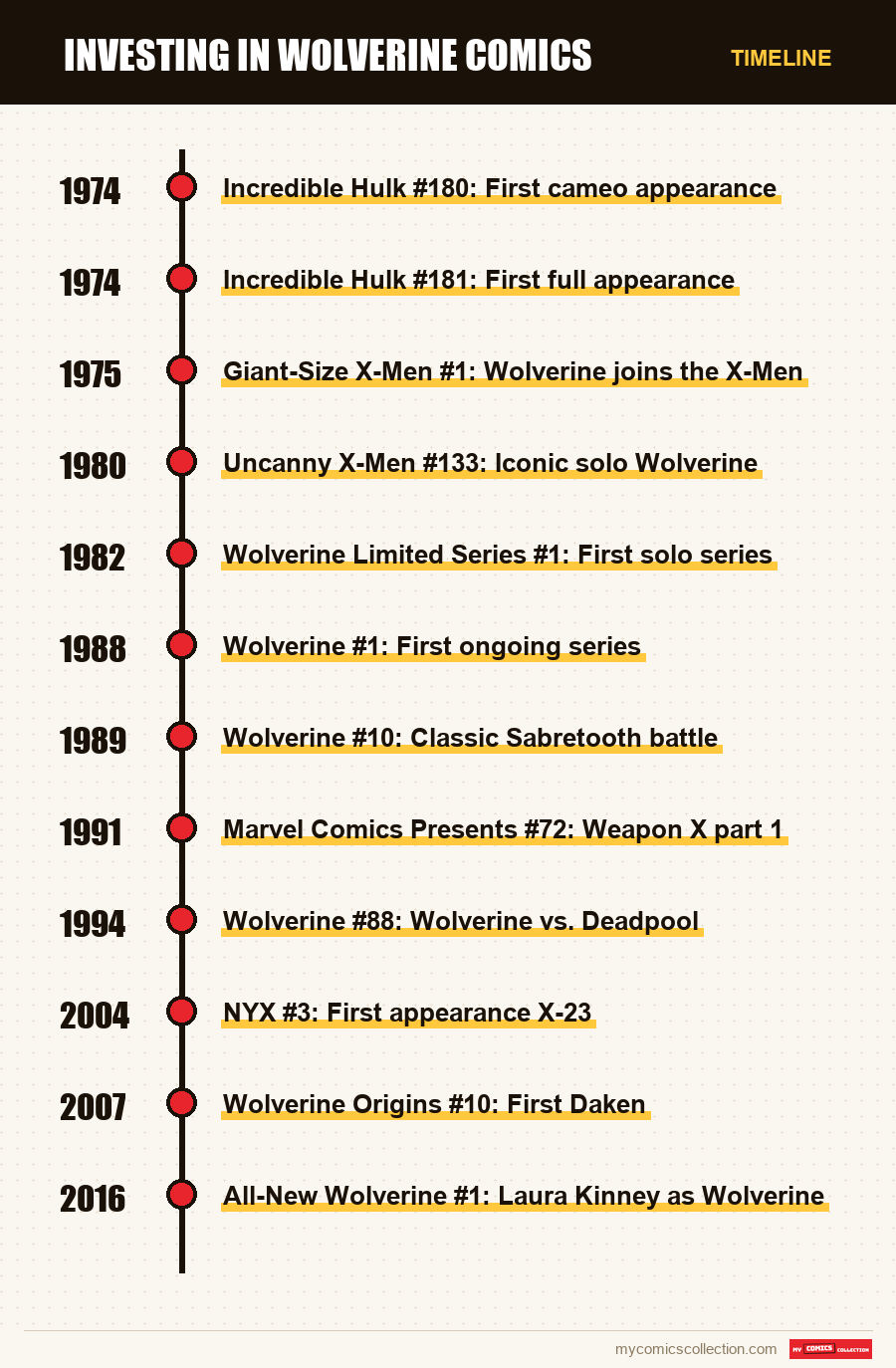
Incredible Hulk #181 (1974): First full appearance
- CGC 9.8: $150,000-$250,000 (record: $360,000 in 2021)
- GCC 9.6: $40,000-$60,000
- GCC 9.4: $20,000-$30,000
- CGC 9.0: $10,000-$15,000
- CGC 7.0-8.0: $4,000-$8,000
- CGC 5.0-6.0: $2,500-$4,000
- Annualized return over 20 years: around 12-15% per year
Giant-Size X-Men #1 (1975): Wolverine joins the X-Men
- CGC 9.8: $80,000-$120,000
- GCC 9.6: $25,000-$40,000
- GCC 9.4: $12,000-$18,000
- CGC 8.0: $4,000-$6,000
- Annualized return over 20 years: around 10-13% per year
Incredible Hulk #180 (1974): First cameo appearance
- CGC 9.8: $25,000-$40,000
- GCC 9.6: $8,000-$12,000
- GCC 9.4: $4,000-$6,000
- Advantage : still less expensive than #181 but benefits from the same halo effect.
Tier 2: established key issues ($500-$10,000)
These numbers have a confirmed value and an upward trajectory in the long term. They offer better accessibility than blue chips while maintaining strong liquidity.
Uncanny X-Men #133 (1980): Iconic solo Wolverine
- CGC 9.8: $2,500-$4,000
- GCC 9.6: $800-$1,200
- Argument : legendary Byrne/Austin cover, Wolverine alone against the Hellfire Club. Founding moment.
Wolverine Limited Series #1 (1982): First solo series
- CGC 9.8: $1,500-$2,500
- GCC 9.6: $400-$700
- Argument : Miller/Claremont. Defines Wolverine as a samurai. Iconic cover.
Wolverine #1 (1988): First ongoing series
- CGC 9.8: $500-$800
- GCC 9.6: $150-$250
- Argument : the Patch era begins. First issue of the series which will last 189 issues.
NYX #3 (2004): First appearance X-23
- CGC 9.8: $3,500-$5,000
- GCC 9.6: $1,800-$2,500
- Argument : Low circulation, central character, maximum MCU potential.
Tier 3: speculative bets with high potential ($50-$500)
These comics are undervalued compared to their potential. They represent the best risk/reward ratio for the investor who accepts some uncertainty.
Wolverine Origins #10 (2007): First Daken
- CGC 9.8: $250-$400
- MCU Potential: multiplication by 3-5 in case of casting.
Marvel Comics Presents #72 (1991): Weapon X part 1
- CGC 9.8: $200-$350
- Argument : BWS art, founding story, undervalued in relation to its artistic value.
Wolverine #10 (1989): Classic Sabretooth battle
- CGC 9.8: $150-$250
- Argument : iconic cover, iconic rivalry, constant demand.
All-New Wolverine #1 (2016): Laura Kinney as Wolverine
- CGC 9.8: $80-$150
- Potential : if X-23/Laura becomes Wolverine in the MCU, this issue blows up.
Wolverine #88 (1994): Wolverine vs. Deadpool
- CGC 9.8: $200-$350
- Argument : crossover of Marvel's two most popular characters.
Wolverine Comics Investing Principles
1. The CGC grade rule
For pure investing, focus on grades 9.6 and 9.8. Comics of lower quality maintain a floor value but do not experience the same percentage increases during market peaks. Exception: for Bronze Age comics (1970-1985), a CGC 9.4 is often an exceptional grade and behaves like a 9.8 in terms of demand.
2. Temporal diversification
Spread your purchases over time. The comics market experiences cycles: peaks after MCU announcements, troughs at the start of the calendar year, corrections after speculative bubbles. Buying regularly (dollar-cost averaging) smooths out risk.
3. Liquidity vs yield
Blue chips (Hulk #181) are very liquid: they sell out within days on eBay. Speculative bets can take weeks to find takers. Keep a mix of 60% liquid / 40% speculative.
4. The MCU effect
MCU announcements cause increases of 50 to 300% on the key issues concerned, but these increases are not always sustainable. Buy BEFORE the announcements (on rumor) and do not sell in panic if a correction follows the initial peak.
Recommended allocation by budget
Budget $500
- Wolverine Limited Series #1 CGC 9.4: ~$250
- MCP #72 CGC 9.6: ~$120
- Wolverine Origins #10 raw NM: ~$60
- All-New Wolverine #1 CGC 9.8: ~$100
Budget $2,000
- Wolverine #1 (1988) CGC 9.8: ~$650
- NYX #3 CGC 9.4: ~$1,200
- Wolverine Origins #10 CGC 9.8: ~$350
Budget $10,000
- Incredible Hulk #181 CGC 7.5: ~$5,500
- UXM #133 CGC 9.6: ~$1,000
- Wolverine LS #1 CGC 9.8: ~$2,000
- NYX #3 CGC 9.6: ~$2,000
Budget $50,000+
- Incredible Hulk #181 CGC 9.4: ~$25,000
- Giant-Size X-Men #1 CGC 9.4: ~$15,000
- NYX #3 CGC 9.8: ~$4,500
- UXM #133 CGC 9.8: ~$3,500
- Diversification on 5-6 speculative bets: ~$3,000
Do you own Wolverine comics? Estimate the value of your collection for free to know their current rating.
Frequently asked questions
The optimal strategy combines an anchor in historic key issues (Incredible Hulk #181, Giant-Size X-Men #1) with speculative bets on legacy characters such as X-23 and Daken. Choose each recommendation according to your budget and your investment horizon.
Incredible Hulk #181 (1974), the first full appearance, Giant-Size X-Men #1 (1975), where Wolverine joins the X-Men, and Incredible Hulk #180 (1974), his first cameo. Their value has been established for decades and their liquidity is maximal; #180 remains cheaper than #181 while enjoying the same halo effect.
NYX #3 (2004, first appearance of X-23), Wolverine Origins #10 (2007, first Daken), All-New Wolverine #1 (2016, Laura Kinney as Wolverine) and Marvel Comics Presents #72 (1991, start of Weapon X). Their potential depends largely on a possible casting in film.
For pure investment, focus on grades 9.6 and 9.8. Exception: a CGC 9.4 on a Bronze Age comic (1970-1985) is often an exceptional grade. Also spread your purchases over time (dollar-cost averaging) to smooth the risk of a cyclical market.
No: these announcements cause significant rises on the key issues concerned, but they are not always lasting. Buy before announcements, on rumor, and do not sell in a panic if a correction follows the initial peak. Also keep a mix of liquid issues and speculative bets, which can take weeks to find a buyer.