
Golden Age comics (1938-1956) are the blue chips of comic collecting, offering the strongest long-term appreciation in the hobby. Entry-level Golden Age keys start around $500-1,000, while trophy books like Action Comics #1 have sold for over $6 million. Pedigree copies from famous collections command additional premiums of 20-100%.
The Golden Age of comics represents the birth of the superhero genre and the foundation of an entire industry. Comics from this era are genuinely scarce: most were read to pieces by children during the 1940s, discarded by parents, or destroyed in wartime paper drives. Unlike Modern Age comics where millions of copies were preserved by collectors, Golden Age survival rates are estimated at less than 1-3% of original print runs. This inherent scarcity, combined with enormous historical significance, makes Golden Age comics the most reliable long-term investments in the hobby.
Why Golden Age comics are the safest investment
No new supply will ever enter the market. Unlike stocks where companies can issue new shares, or even Modern Age comics where warehoused copies occasionally surface, the supply of Golden Age comics only decreases over time as copies are lost, damaged, or permanently entombed in private collections. This supply dynamic fundamentally supports long-term price appreciation.
Historical performance
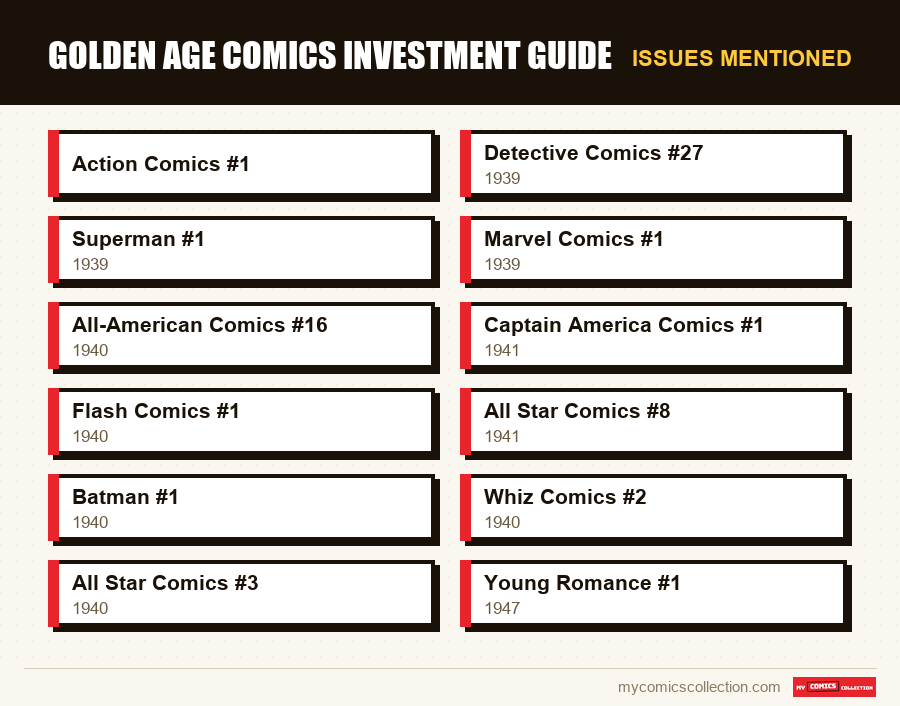
- Action Comics #1 (1938): The comic that started it all. A CGC 6.0 copy sold for $3.25 million in 2014. A CGC 8.5 copy set the record at $6 million in 2024. Even low-grade copies (CGC 0.5-1.0) sell for $200,000-$500,000.
- Detective Comics #27 (1939): First Batman. A CGC 7.0 sold for $2.2 million. CGC 2.0 copies trade around $400,000-$600,000.
- Superman #1 (1939): CGC 8.0 sold for $5.3 million. Even coverless copies sell for $30,000-$50,000.
- Marvel Comics #1 (1939): First Human Torch and Sub-Mariner. CGC 9.2 (Pay Copy) sold for $2.4 million.
Over the past 20 years, top Golden Age keys have appreciated at 10-20% annually, outperforming most traditional asset classes.
Entry-level Golden Age investments ($500-$5,000)
You do not need millions to enter the Golden Age market. Numerous opportunities exist for collectors with modest budgets.
Affordable Golden Age keys
- All-American Comics #16 (first Green Lantern, 1940): Low-grade copies (CGC 0.5-1.5) can be found for $3,000-$5,000. A genuine Golden Age first appearance of a major DC character.
- Captain America Comics #1 (1941): Coverless or incomplete copies occasionally appear for $3,000-$5,000. Even in poor condition, this is one of the most iconic covers in comic history.
- Flash Comics #1 (1940): Low-grade copies of the first Flash start around $4,000-$6,000.
- All Star Comics #8 (first Wonder Woman, 1941): Low-grade copies start around $5,000-$8,000. One of the most important female character debuts in comic history.
The affordable Golden Age tier ($500-$2,000)
- Non-key Golden Age superhero comics: Issues from runs like All-Star Comics, More Fun Comics, or Sensation Comics in lower grades can be found for $500-$2,000.
- Golden Age horror and crime comics: Pre-Code horror titles (Tales from the Crypt, Vault of Horror) in low-to-mid grades are available for $300-$1,500.
- Timely (pre-Marvel) comics: Non-key issues from Captain America, Human Torch, and Sub-Mariner runs in lower grades start around $500-$1,500.
- Golden Age war comics: Titles like Wings Comics and Military Comics offer stunning cover art at accessible prices.
The trophy tier: comics worth $50,000 and beyond
For serious investors with significant capital, the trophy tier of Golden Age comics represents the ultimate alternative asset.
The "Big Three" Golden Age keys
- Action Comics #1 (1938): The most valuable comic in existence. Only around 100 copies are known to exist in any condition. Any copy in any grade is a legitimate trophy.
- Detective Comics #27 (1939): First Batman. Perhaps 200 copies survive. Low-grade copies start around $300,000.
- All-American Comics #16 (1940): First Green Lantern. Far scarcer than most collectors realize, with fewer than 100 copies tracked in the CGC census.
Second-tier trophy books ($50,000-$500,000)
- Batman #1 (1940): First appearances of Joker and Catwoman. CGC 4.0 copies trade around $150,000-$200,000.
- Captain America Comics #1 (1941): Simon and Kirby classic. Mid-grade copies command $100,000-$300,000.
- Whiz Comics #2 (1940): First Captain Marvel (Shazam). A genuinely rare book with strong demand.
- All Star Comics #3 (1940): First Justice Society of America: the first superhero team. Values range from $20,000-$200,000 depending on grade.
Understanding pedigree collections
In Golden Age collecting, pedigree refers to a copy from a famous, verified collection known for exceptional preservation. Pedigree copies command premiums of 20-100% or more over equivalent non-pedigree copies.
The most prestigious pedigrees
- Mile High / Edgar Church Collection: The most famous pedigree in the hobby. These copies are consistently the highest-graded examples known, preserved in near-perfect condition since the 1940s. A Mile High pedigree adds 50-200% to a comic's value.
- Allentown Collection: Another legendary pedigree known for exceptional preservation. Premiums of 30-75%.
- San Francisco (Reilly) Collection: High-grade copies with consistent quality. Premiums of 20-50%.
- Promise Collection: Discovered relatively recently with outstanding quality across thousands of Golden Age books.
- Larson Pedigree: Known for exceptional DC Comics from the early 1940s.
Why pedigrees matter for investors
Pedigree copies provide provenance: a documented history of ownership and preservation. In a market where restoration and fraud are concerns, a pedigree designation from CGC provides an additional layer of authentication and desirability. Pedigree copies also tend to appreciate faster than non-pedigree copies because serious collectors actively seek them out.
Golden Age genres beyond superheroes
While superhero titles dominate Golden Age collecting, other genres offer compelling opportunities at more accessible price points.
Pre-Code horror (1947-1955)
Before the Comics Code Authority sanitized the industry in 1955, publishers like EC Comics produced horror, crime, and suspense titles with graphic content that shocked America. These are now highly collectible:
- Tales from the Crypt, Vault of Horror, Haunt of Fear: EC Comics horror titles with stunning cover art by artists like Johnny Craig and Graham Ingels. Mid-grade copies range from $300-$2,000 depending on issue and cover appeal.
- Crime Does Not Pay: The original crime comic. Issues with lurid covers command significant premiums.
- Weird Fantasy and Weird Science: EC's science fiction titles, featuring early work by Al Feldstein and Wally Wood.
Golden Age romance and funny animal comics
- Young Romance #1 (1947): Created by Simon and Kirby, this is the first romance comic. A genuinely important historical artifact that remains underpriced relative to its significance.
- Walt Disney's Comics and Stories: Carl Barks' Duck comics from the 1940s-1950s are masterpieces of the medium. Key issues with classic Barks covers are steadily appreciating.
Risks and considerations
- Restoration: Many Golden Age comics have been restored (color touch, piece replacement, cleaning). Restored copies are worth 30-70% less than unrestored copies of equivalent apparent grade. Always check CGC labels for restoration notes.
- Liquidity: High-value Golden Age comics can take weeks or months to sell. This is not a liquid market: be prepared to hold until the right buyer appears.
- Authentication: The high values of Golden Age comics attract forgers. Always buy CGC-graded copies or have raw copies authenticated before purchasing.
- Storage: Golden Age comics require careful climate-controlled storage. Paper from the 1940s is fragile and susceptible to environmental damage.
- Insurance: Any Golden Age comic worth more than $1,000 should be specifically listed on your insurance policy.
Where to buy Golden Age comics
Sourcing Golden Age material requires different channels than buying Modern Age books. The most reliable sources include:
- Heritage Auctions: The dominant platform for high-value Golden Age sales. Transparent hammer prices, excellent photography, and rigorous authentication. The buyer's premium (20%) is steep but the selection is unmatched.
- ComicConnect: A strong alternative with lower buyer's premium (10%) and competitive selection of Golden Age material.
- Established dealers: Specialized retailers and local convention specialists offer fixed-price sales with return policies. You pay a slight premium over auction prices for the convenience and buyer protection.
- Private sales: Networking within collector communities can surface private deals at below-market prices. These require trust and due diligence but can yield the best values.
Tax and estate considerations for Golden Age holdings
Golden Age comics at significant values create tax and estate planning considerations that collectors need to understand.
- Collectibles capital gains rate: In the United States, collectibles held over one year are taxed at a maximum 28% capital gains rate: higher than the rate on stocks and bonds.
- Cost basis documentation: Keep detailed records of purchase prices, dates, and associated costs (auction premiums, grading fees). Without documentation, the IRS may assign a zero cost basis, meaning you owe tax on the full sale price.
- Estate valuation: Golden Age comics must be appraised at fair market value for estate tax purposes. A professional appraisal from a qualified comic book appraiser is essential for collections above $50,000.
- Charitable donation potential: Donating appreciated Golden Age comics to qualified museums or institutions can provide significant tax deductions while preserving these cultural artifacts for public enjoyment.
- Insurance: Standard homeowner's insurance typically has a low cap on collectibles coverage. Dedicated collectibles insurance or a scheduled personal property endorsement is essential for any Golden Age comic valued above $5,000.
The long view on Golden Age: In 50 years of documented market history, no major Golden Age key has ever declined in value over a 10-year period. Individual years may show flat or modest declines, but the long-term trajectory has been consistently upward. For patient investors, Golden Age comics are as close to a guaranteed appreciation as physical collectibles get.
Frequently Asked Questions
Non-key Golden Age superhero comics in lower grades can be found for $200-$500. For genuine key issues (first appearances of notable characters), expect to spend at least $1,000-$3,000 for low-grade copies. Golden Age horror and crime comics from publishers like EC offer stunning art at even lower price points.
For major keys like Action Comics #1, Detective Comics #27, or Captain America Comics #1: absolutely. Even coverless or heavily damaged copies of these books hold substantial value because of their extreme scarcity. For lesser keys, mid-grade copies (CGC 3.0-5.0) offer the best balance of affordability and appreciation potential.
The safest approach is to buy CGC-graded copies. For raw comics, look for period-correct paper quality, printing methods, and binding. Professional authentication through CGC or a reputable dealer is essential for any significant purchase. Be especially cautious of Golden Age comics offered at below-market prices from unknown sellers.
A pedigree comic comes from a famous, verified collection known for exceptional preservation: collections like Mile High, Allentown, or Promise. CGC notes the pedigree on the label. Pedigree copies are prized because they offer provenance (documented ownership history), typically superior condition, and historical significance. They command premiums of 20-200% over non-pedigree copies.
The fundamental supply-demand dynamics strongly favor continued appreciation. No new Golden Age comics can be created, surviving copies are being permanently absorbed into long-term collections, and demand continues to grow as new wealth enters the hobby. Major Golden Age keys have appreciated through every market downturn in the past 50 years, making them among the most resilient collectible investments.