
Aquaman #1 (1962) in CGC 9.0 exceeds $25,000, Aquaman #35 (1st Black Manta) in CGC 8.0 approaches $12,000, and Geoff Johns' New 52 run offers an investment entry point under $100 in 9.8. Optimal strategy: target Silver Age key issues in mid-grade and modern ones in near-mint slabbed.
Investing in Aquaman comics represents a smart contrarian approach to the DC market. While Batman and Superman capture most of the speculative attention, The King of Atlantis offers still reasonable entry points on numbers whose upside potential remains significant, driven by an active film franchise and an ever-expanding fan base.
This guide details a structured investment strategy for Aquaman comics, with up-to-date market data, realistic price ranges and risk/reward analysis by time period. Whether you have $500 or $50,000, there's an Aquaman segment to fit your wallet.
Aquaman Market Analysis: Trends and Fundamentals
The Aquaman market has experienced three distinct phases since 2015. The first, pre-film (2015-2017), saw an organic increase of 30 to 50% on Silver Age key issues following the announcement of Jason Momoa's casting. The second phase (2018-2020) corresponds to the post-film explosion with peaks of +200% on certain issues. The third phase (2021-2026) marks a healthy correction followed by stabilization at levels significantly above pre-speculative prices.
The fundamentals remain solid: active film franchise, character integrated into the expanded DC universe, and a relatively small catalog of key issues which concentrates demand on a few issues. The supply/demand ratio works in favor of long-term holders.
Tier 1: premium investments ($5,000+)
The high-end segment offers the best capital protection with regular growth potential:
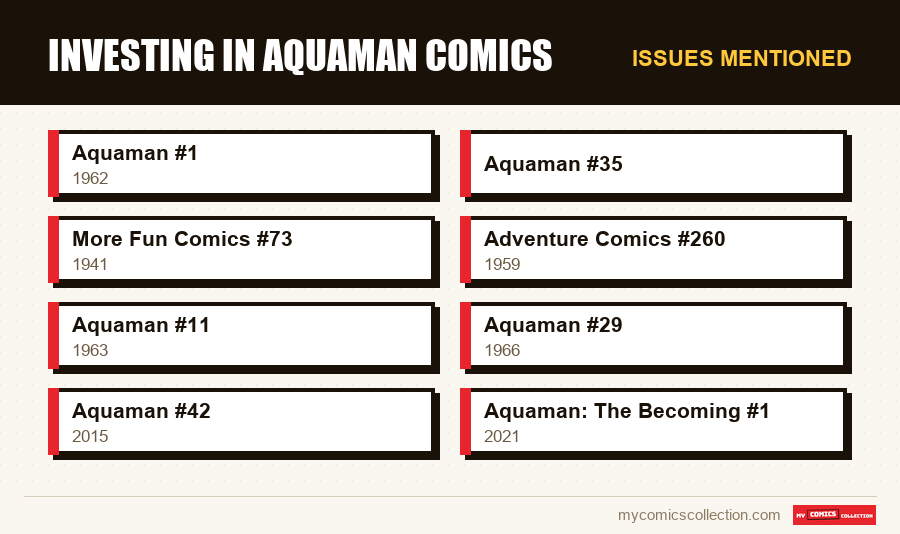
- More Fun Comics #73 (1941): first appearance of Aquaman. In CGC 4.0, count $15,000-20,000. Historically undervalued compared to early appearances of other members of the Justice League.
- Aquaman #1 (1962): first solo title. CGC 8.0 around $15,000, CGC 9.0 above $25,000. High rarity in high condition.
- Aquaman #35 (1967): first appearance of Black Manta. CGC 8.0 approaches $12,000, CGC 9.0+ extremely rare. Black Manta is a tier-1 villain at DC, which supports the request.
- Adventure Comics #260 (1959): first origin story. CGC 7.0+ between $5,000 and $8,000.
Tier 2: intermediate investments ($500-5,000)
This segment offers the best risk/return ratio for a patient investor:
- Aquaman #11 (1963): first appearance of Mera. CGC 6.0 around $1,500-2,500. Mera has become a central character in the DCU, her importance will only grow.
- Aquaman #29 (1966): first appearance of Ocean Master. CGC 7.0 between $800 and $1,200. Recurring villain with cinematic potential.
- Aquaman #35 (1967): in lower grade (CGC 3.0-5.0), accessible between $1,500 and $4,000. Historically profitable mid-grade strategy.
- Aquaman #1 (2011, New 52): in CGC 9.8, between $80 and $120. High sales volume, excellent liquidity.
Tier 3: calculated speculation (under $500)
For more modest budgets, several speculative angles deserve attention:
- Aquaman #1 (1994): start of the Peter David run which redefined the character. CGC 9.8 under $100. If this era is adapted into animation or live-action, the rise will be rapid.
- Aquaman #1 (2016, Rebirth): CGC 9.8 under $50. Minimum entry point for a graded key issue.
- Aquaman #42 (2015): variant cover by Josh Middleton, potential cover art collection. Under $80 in 9.8.
- Aquaman: The Becoming #1 (2021): introduction of Jackson Hyde as the main Aquaman. CGC 9.8 under $40. Character diversification = new audience.
Grading strategy and timing
Selective grading is crucial to optimize ROI. Practical rules:
- Only grade examples with a potential 9.6+ for Modern (post-1985) and 7.0+ for Silver Age.
- The CGC grading cost ($50-150 depending on the tier and declared value) must represent less than 30% of the expected added value.
- Prioritize grading before film/series announcements: CGC deadlines lengthen after announcements and raw prices rise before graded copies return.
The ideal buying timing is 12 to 18 months after a film's release, when the post-hype correction stabilizes prices at a new low. The optimal sales timing is 2 to 4 weeks before the release of a new media project.
Diversification within the Aquaman portfolio
A balanced Aquaman portfolio should distribute the investment as follows: 40% on Silver Age key issues in mid-grade (capital protection), 35% on Bronze/Copper Age keys in high condition (moderate growth), and 25% on modern speculations in CGC 9.8 (bullish leverage). This allocation makes it possible to resist market corrections while capturing rising phases.
Avoid concentrating more than 50% of the wallet on a single number, regardless of its rarity. Liquidity is a factor that is often overlooked: the most expensive numbers sometimes take months to find a buyer at the desired price.
Risks and factors to watch out for
Every investment involves risks. For Aquaman specifically: abandoning the film franchise could cause a 20-40% correction on moderns. However, Silver Age keys are relatively protected because their value is based on the character's intrinsic rarity and historical status. Monitor DC Studios announcements, box office results, and the evolution of CGC censuses (the more graded copies of an issue, the stronger the downward pressure on common grades).
Do you own Aquaman comics? Estimate the value of your collection for free to know their current rating.
Frequently asked questions
Batman and Superman attract most of the speculative attention, while Aquaman still offers reasonable entry points. His list of key issues is short, which concentrates demand on a few books, and the film franchise is still active.
The Silver Age key issues in mid-grade: More Fun Comics #73 (first appearance), Aquaman #1 (1962) and Aquaman #35 (1967, first appearance of Black Manta). Their value rests on scarcity in high grade, which shields them better from corrections than modern issues.
Aquaman #1 (1994, start of Peter David's run), Aquaman #1 (2016, Rebirth) and Aquaman: The Becoming #1 (2021, Jackson Hyde) in CGC 9.8. They are minimal entry points for a graded key issue.
Only if the copy has 9.6+ potential for modern books (after 1985) or 7.0+ for the Silver Age. It is better to do it before film or series announcements, because turnaround times grow afterwards.
The guide suggests 40% on mid-grade Silver Age key issues, 35% on high-grade Bronze and Copper Age keys and 25% on modern speculation in CGC 9.8. It advises against putting more than 50% on a single issue, since the most expensive books are often slow to sell.