Inheriting a comics collection means tackling four steps in order: a systematic photo inventory without removing comics from their bags, a free valuation through an app or an expert for pieces worth more than $1,000, a storage audit (humidity below 55%, temperature below 72°F / 22°C), then deciding whether to keep everything, sell everything, or sell selectively. On the tax side, the direct-line inheritance exemption in France reaches €100,000 per child. Major pieces worth more than €5,000 are best sold through Drouot or ComicConnect.
A dusty box: sometimes several cartons found in an attic after a loved one passes away: an inherited comics collection rarely lands in the hands of someone who knows the hobby. The heir discovers an asset they can't read, appraise, or protect. The first mistakes happen within fifteen days: comics pulled from their bags to "see what's in there," the collection moved to a damp basement, a hasty sale to a flea-market dealer for €200: a pile that was worth €8,000. This 2,000-word guide lays out the complete method to apply from the moment you physically take possession of those boxes, with a precise timeline (Day 0 through Day 90), free valuation tools available in France, the inheritance tax thresholds for direct-line heirs, and recognized sales channels for pieces worth more than €5,000. By the end, you'll have a decision framework you can put into action in under a month.
Step 1: Systematic photo inventory without handling
The golden rule for the first 72 hours: don't remove a single comic from its plastic bag. Every time an untrained heir handles a book, it can drop the potential CGC grade by half a point: a typical value loss of 15 to 40% per issue. On an 800-comic collection inherited from an uncle who collected through the 1970s-1990s, careless early handling can represent €5,000 to €12,000 in lost value before a single buyer ever shows up.
The photo inventory method requires only a smartphone, indirect natural light, and a neutral background (a white sheet or a light-wood table). Photograph each comic with a minimum of two shots: the full cover and the back with the barcode if one is present. Number the photos in discovery order (Box 1 (Comic 001, Box 1) Comic 002). For 800 issues, this step takes 6 to 10 hours spread across 2 or 3 sessions. Don't try to do it all at once: fatigue increases mistakes and the temptation to pull out a comic "for a closer look."
Build the text inventory in parallel, either in a spreadsheet or directly in a dedicated app. Three minimum columns: series title + issue number (readable on the cover), publisher (Marvel, DC, Image, Dark Horse), year if visible. If you don't recognize a series, note "to identify" and move on: sorting comes in Step 2. For the complete method, the article cataloging your comics: method guide covers the standard naming conventions and classic pitfalls.
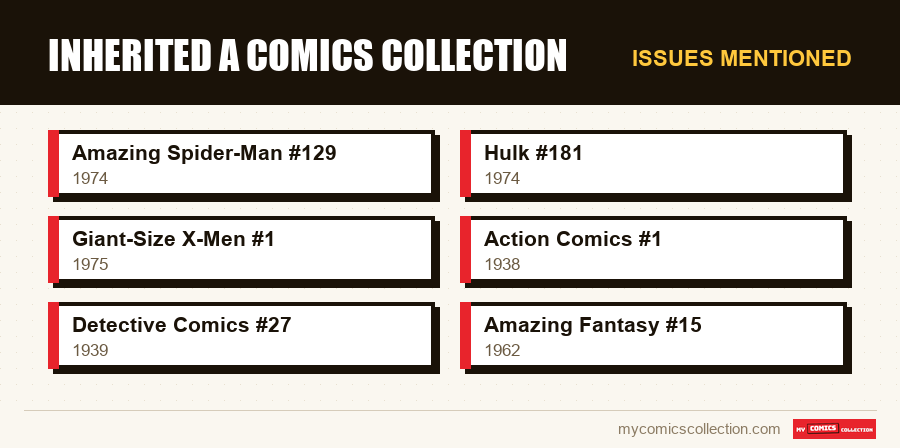
Even at this stage, keep an eye out for indicators of major keys: without handling them. An Amazing Spider-Man #129 (1974, first appearance of the Punisher) is worth between €800 (Fine condition) and €12,000 (CGC 9.4). A Hulk #181 (1974, first full appearance of Wolverine) reaches €2,500 in Fine and surpasses €30,000 in CGC 9.6. Giant-Size X-Men #1 (1975) sits between €600 and €4,000 depending on condition. Action Comics #1 (1938) remains exceptional: a restored copy sold for €360,000 in 2022, while a high-grade copy tops $6 million. Spotting these issues visually without pulling them out is what stops them from walking out the door for €50 at a yard sale.
Step 2: Free valuation via app or expert
The valuation happens in two successive passes. The first covers 100% of the collection using a free app. The second focuses only on the pieces identified as major keys, and goes through a recognized expert.
App-based valuation works through a comics collection app with a pre-populated database. The process: you enter or scan each reference, and the record automatically populates with live eBay pricing broken down by grade: Raw, CGC 9.0, CGC 9.4, CGC 9.6, CGC 9.8. For 800 comics, budget 4 to 8 hours of data entry. The free eBay valuation tool calculates a total value based on sales from the past 90 days, giving you a realistic range rather than an optimistic sticker price.
This first pass typically tells you three things: the median value of the collection (95% of comics are worth less than €50 each), the precise identity of the 5 to 30 pieces that account for 60 to 80% of the total value, and the comics the database doesn't recognize at all (European indie, fanzine, old comic strip) that require separate expertise.
For the second pass on major pieces, two routes exist in France. First route: the Drouot auction house, which has specialized BD-comics experts. Sending high-resolution photos triggers a response within 10 to 15 business days, free of charge for a simple valuation request. Drouot charges its commission (typically 15-20% HT seller-side + 25-30% TTC buyer-side) only if a sale takes place. Second route: ComicConnect, a US platform specializing in CGC-graded comics, accessible from France for pieces worth more than $5,000. ComicConnect systematically requires high-grade copies for their Event Auctions, which often means having the book graded by CGC beforehand (cost: $30-80 per comic plus shipping).
Avoid off-the-cuff valuations via Facebook messages or Craigslist-style classifieds. A buyer who comes to your home "to appraise for free" walks out nine times out of ten with your key issue at 10% of its real value. The guide estimating the value of a collection covers the classic scams in detail.
Step 3: Storage audit and preservation
The storage audit runs alongside the Step 1 inventory. Three critical parameters: relative humidity, temperature, and light exposure. A €15 digital hygrometer from any hardware store gives you an exact reading in 5 minutes.
Relative humidity must stay between 40 and 55%. Above 60%, the paper absorbs atmospheric moisture, staples oxidize, and mold develops within weeks on pulp-paper comics (typically 1938-1980). An unventilated basement often reads 75 to 85% humidity: a collection left there for 6 months loses 70 to 90% of its value: damage that is usually irreversible. Attics pose the opposite problem in summer: 95 to 120°F (35-50°C) during a heat wave yellows covers and weakens staples.
The ideal temperature hovers around 65-72°F (18-22°C) with a maximum variation of 9°F (5°C) over 24 hours. A living room heated to 68°F (20°C) in winter and air-conditioned to 75°F (24°C) in summer works perfectly. An unheated guest room in a country house that swings from 41°F (5°C) in winter to 82°F (28°C) in summer does not.
Direct light exposure (sunlight, powerful fluorescents) bleaches red and blue pigments within months. Never store comics behind a sunny window. Acid-free cardboard boxes, a Long Box (500 comics) or Short Box (250 comics), run €15 to €25 each and provide neutral protection. For key issues, a Mylar sleeve plus an acid-free backing board costs €1 to €2 per comic: a worthwhile investment as soon as a book is worth more than €100. Full details in protecting your comics: a preservation guide.
If you find the collection in a degraded storage environment (damp basement, overheated attic), your absolute priority is to move everything within 7 days to a temperature-controlled, dry space. Do not wash, dry, or brush any stained comics: any treatment by a non-specialist makes the damage worse. If you spot mold, immediately isolate the affected comics in separate plastic bags and consult a professional conservator before touching them further.
Step 4: Decisions: keep, sell everything, or sell selectively
Once the inventory and valuation are done, three decision scenarios emerge. The right choice depends on four factors: personal interest in reading the comics, estimated total value, storage constraints, and tax situation.
Scenario A: keep everything. Makes sense if the total value stays under €5,000 and you have suitable, climate-controlled storage. The collection then becomes a family asset to pass on, best managed through an app so you can track its value over 10 to 20 years. The upfront time and money investment (inventory + sleeves + acid-free boxes) runs about €200-400 for 800 issues. This is also the default scenario if you want to take time to learn and decide later. See comics: passion vs. investment for a thinking framework.
Scenario B: sell the entire lot. The right move when the estimated value stays under €3,000 and you have no personal interest in comics. The recommended channel: an independent specialty dealer or a French BD-comics shop, which buys lots at 25-40% of the eBay price. The sale takes 1 to 3 weeks, with immediate payment. To avoid: a general-purpose flea-market dealer (will buy at 5-10% of value), posting the full collection on classified listings like Le Bon Coin (endless negotiations, scam risk), or eBay as a single lot (serious buyers skip single-lot auctions, the listing sits unsold).
Scenario C: sell the major pieces, keep the rest. The most rational option once the collection is worth more than €5,000. Identify the 5 to 30 issues that account for 60-80% of the total value and sell them through an expert channel (Drouot, ComicConnect, eBay solo with professional photos). Keep the remaining 750-1,000 comics worth €5-30 each: selling them individually would take hundreds of hours for €50-200 a month. The time-to-money ratio only makes sense above €50 per comic. The expert selling method is covered in detail in buying and selling comics in France.
Tax considerations: inheritance and filing in France
An inherited collection is included in the estate declaration as personal property. Two regimes exist: a flat-rate assessment at 5% of the gross estate (the default, with no detailed inventory), or a detailed assessment prepared by a licensed auctioneer or notary. For a collection valued at more than €10,000, the detailed assessment avoids the flat-rate over-taxation and provides a solid baseline for any future sale.
The direct-line exemption (parent → child) stands at €100,000 per parent per child, renewable every 15 years. In practice: a child inheriting from a parent whose entire estate (real estate, bank accounts, personal property, comics collection) stays under €100,000 pays zero inheritance tax. The comics collection (which falls between €1,200 and €15,000 in 95% of cases) comfortably fits under that threshold. Above it, a progressive scale applies: 5% up to €8,072, 10% between €8,072 and €12,109, 15% between €12,109 and €15,932, 20% between €15,932 and €552,324.
For collateral heirs (nieces/nephews, cousins), the exemptions drop sharply (€7,967 for nieces and nephews, €1,594 for others) and the rates spike (55% above the exemption for a nephew, 60% for an unrelated heir). A €25,000 collection passed to a nephew typically generates €9,000 to €11,000 in taxes: 36-44% of the value.
The estate declaration must be filed within 6 months of the date of death (12 months if the death occurred abroad). After that, penalties apply: 0.2% interest per month plus a 10% surcharge starting in the 7th month. For a comics collection whose exact value requires expert assessment, it's better to start the valuation process in the 2nd or 3rd month after the death.
Practical example. Marie, 42, inherits alone from her father. Total gross estate: a Paris apartment valued at €380,000, bank accounts of €45,000, personal property assessed at the flat rate, and a comics collection worth €18,000. Gross total: €443,000. After the €100,000 exemption, the taxable base is €343,000. Tax calculated on that basis: approximately €65,000. The comics collection, if sold shortly after for €14,000 net (75% of market value), covers part of the tax bill. If Marie keeps the collection, key issues typically appreciate 4 to 8% per year: €720 to €1,440 annually on the initial base.
Expert sales: Drouot, ComicConnect, and alternatives
For pieces worth more than €5,000, the sales channel determines the final price. The wrong platform can cost you 30-50% of the potential value.
Drouot remains the French benchmark for comics, bandes dessinées, and antiquarian books. Dedicated BD-comics sales take place 4 to 6 times a year, with identified specialists (cabinet Baudoin-Lebon, étude Christophe Joron-Derem, and others). The process: send high-resolution photos plus a description, receive a valuation estimate within 10-15 days, sign a consignment agreement, physically deliver the pieces to Drouot, have them cataloged, and sell at public auction. The seller's commission runs around 15-20% HT; the buyer's premium is 25-30% TTC. The time from signing the consignment to receiving payment runs 3 to 5 months. For a Hulk #181 that hammers at €4,200, the heir nets approximately €3,360 to €3,570.
ComicConnect targets the American and international market for CGC-graded comics. Their Event Auctions (four per year, in February, May, August, and November) generate the highest prices in the world for this category. To qualify, the book must be CGC-graded and meet a minimum value threshold (typically $3,000). Grading is done through a French facilitator (grouped submission), at a cost of $30-80 per comic plus insurance and return shipping. Total lead time: 4 to 7 months from shipping to grading to receiving auction proceeds. ComicConnect's seller commission ranges from 0 to 15% depending on value (free above $50,000).
Heritage Auctions, an American alternative to ComicConnect, offers weekly Comics Auctions (low threshold, open to pieces worth $200-3,000) and quarterly Signature Auctions for major keys. More accessible for comics in the $1,000-5,000 range, with seller fees around 10-12%.
For pieces worth €500 to €5,000, a direct eBay listing with professional photos and a precise grade stated remains competitive if you know how to write a solid listing. eBay + PayPal fees: 13-15% total. Time to payment: 7 to 30 days depending on the book. Avoid 7-day flash auctions for pieces worth more than €2,000: bidding on a 10-day listing typically surges in the final 24 hours, which maximizes the final price.
Common mistakes heirs make
Five mistakes show up consistently in inherited comics collection cases. Avoiding them preserves 30 to 70% of the potential value.
Mistake 1: rushing to a flea-market dealer. In the 30 days following a death, many heirs want to "clear out the house fast." A general-purpose dealer typically buys an entire collection for €50 to €300-2 to 10% of actual market value. An €8,000 catalog-value collection regularly sells for €150. The rule: no sales before a complete inventory and valuation.
Mistake 2: pulling comics out of their bags to "read them." Handling by an untrained person can drop the grade. On an Amazing Spider-Man #129 in CGC 9.4 estimated at €8,500, handling that creates a minor crease can push the book down to CGC 8.5, typical value €3,800. The loss: €4,700 in 30 seconds.
Mistake 3: confusing modern limited print runs with genuine rarity. Modern "1:25" or "1:100" ratio variants show high price points on paper, but their value fluctuates wildly. A genuine Silver Age rarity holds 90% of its value over time. Details in variant covers: complete guide and 1:25 and 1:100 ratio variants explained.
Mistake 4: ignoring European comics and Franco-Belgian BDs. An heir focused on "American comics" can walk right past a 1955 Tintin first edition (L'Affaire Tournesol) worth €800-2,500, or a 1961 Asterix first edition worth €4,000-15,000 depending on condition. The initial valuation must cover all comics in the collection: not only Marvel and DC.
Mistake 5: under-declaring in the estate. A collection valued at €18,000 declared at €2,000 in the estate exposes the heir to a tax audit if the authorities cross-reference subsequent sales with the original declaration. The adjustment includes back interest plus a 40% penalty for willful omission. An honest declaration based on a professional estimate is always the better play.
FAQ: Inheriting a comics collection
Do you have to declare an inherited comics collection in an estate?
Yes, the collection is included in the estate declaration as personal property. Two options: a flat-rate assessment at 5% of the gross estate, or a detailed assessment by an expert. Above €10,000 in estimated value, the detailed assessment avoids the flat-rate over-taxation and provides a solid baseline for any future sale.
What is the inheritance exemption for a child heir in France?
The direct-line parent-to-child exemption is €100,000 per parent per child, renewable every 15 years. A comics collection valued at €12,000 fits comfortably within that threshold with no inheritance tax for an estate under that total. Above the exemption, a progressive scale starts at 5% and rises in brackets.
How do you get a free valuation of an inherited comics collection?
A comics management app with a pre-populated database lets you complete a first valuation in a few hours for a collection of 800 issues. The pricing is based on eBay sales from the past 90 days, broken down by grade. For pieces worth more than €1,000, follow up with a free appraisal from Drouot or a recognized specialty dealer.
Can you sell inherited comics without paying taxes?
Yes, under two conditions: the acquisition value (inheritance) is less than or equal to the sale price, and the sale is part of managing private personal property. Capital gains on personal property are exempt when the individual sale price is under €5,000. Above that threshold, taxation is 6.5% (5% flat rate + 0.5% CRDS) or you can opt for the capital gains regime.
Which old comics are worth the most?
The major keys are Action Comics #1 (1938, Superman), Detective Comics #27 (1939, Batman), Amazing Fantasy #15 (1962, Spider-Man), Hulk #181 (1974, Wolverine), Giant-Size X-Men #1 (1975). Values range from €4,000 to several million depending on condition and grade. See most expensive comics in 2026 for the full list.
Should you have inherited comics CGC-graded before selling?
Only for pieces estimated above €1,500 in raw condition. CGC grading costs $30-80 per comic plus shipping and takes 2 to 6 months. The return on investment is positive only if achieving a CGC 9.4 or higher multiplies the value by 2 to 5x. For comics under €1,000 raw, selling ungraded is the more rational choice.
What should you do with a collection that was stored in a damp basement?
Transfer everything immediately, within 7 days, to a climate-controlled space (65-72°F / 18-22°C, 40-55% humidity). No washing, brushing, or DIY drying. Isolate any comics with visible mold in separate plastic bags and consult a professional conservator before handling them. The guide protecting your comics covers the emergency steps.
How long does selling a collection through Drouot take?
Budget 3 to 5 months from signing the consignment agreement to receiving payment. Typical timeline: initial valuation 10-15 days, consignment signed, physical delivery of the pieces, catalog placement 4-8 weeks before the sale, public auction, buyer payment within 30 days, seller wire transfer within 15 days of receipt. The total timeline fits within the 6-month estate declaration deadline.
Related articles
- Estimating the value of a collection: complete guide
- Cataloging your collection as a beginner
- Protecting your comics: a preservation guide
- Buying and selling comics in France
- Investing in comics: a strategic guide
- Most expensive comics in 2026
- Getting your comics CGC-graded: complete guide
- Comics: passion vs. investment