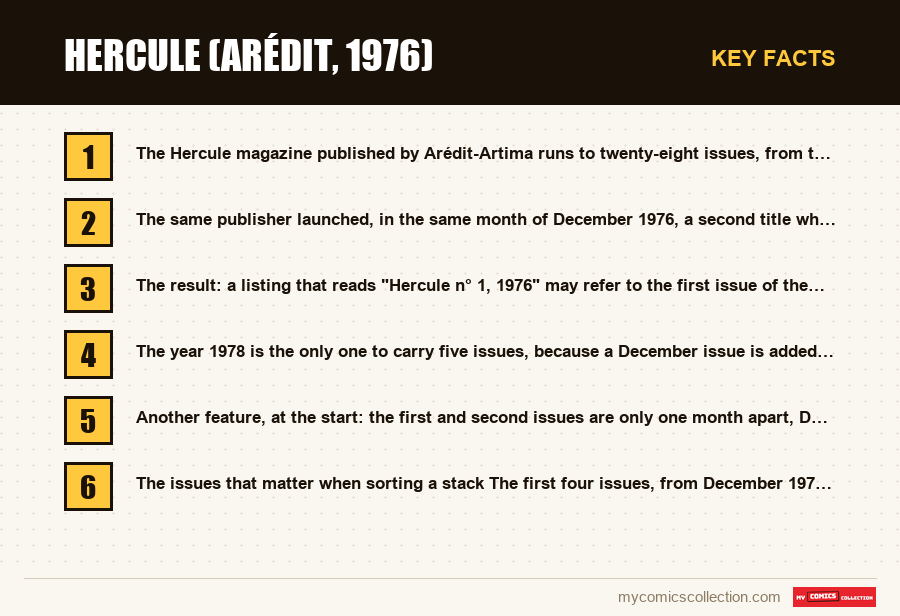
The Hercule magazine published by Arédit-Artima runs to twenty-eight issues, from the first dated December 1976 to the last dated July 1983. The numbering skips no step, but the quarterly rhythm shifts four times, which blurs the dating. The key point: none of the recorded story titles names Hercule, whereas another title from the same publisher carries "Hercule" as the title of its first issue.
You have a stack of issues bearing the name Hercule, and you want to know how many you are missing, which ones are worth hunting for, and how to avoid buying the same one three times. The difficulty of this series is not its length: twenty-eight issues fit in a single box. It lies elsewhere, in the fact that the hero's name printed on the cover says almost nothing about what the issues contain, and that it circulates across two different titles from the same publisher launched the same month.
As always on this guide, only verified information (creators, issue numbers, dates) is stated as fact; the analysis is our own, with no reproduction of artwork or protected dialogue.
What the magazine published, judging by the recorded titles
The catalogue keeps one story title for each issue. Set side by side, these twenty-eight titles form an anthology, not a series built around a single hero. Among them are "Les pêcheurs de l'espace", "Le secret du sphinx lunaire", "La prison spatiale" and "Robinson Crusoé du ciel": a clearly dominant vein of science fiction. Alongside them, "Les robots de la Table Ronde" and "Le mousquetaire souriant" lean toward historical adventure, "La colère de Set" toward mythology, and "Bowling ensorcelé", the title of the first issue, toward something far more domestic.
This overview is the first useful fact for you. If you buy this series hoping for narrative continuity, you will be disappointed: nothing in the recorded titles indicates that a story continues from one issue to the next. Two titles echo each other at a distance, "L'homme qui trichait avec la vie" and then "L'homme qui trompait la mort", but they are separated by two publications and nothing allows us to say they belong to the same cycle. The series is therefore collected by units, each issue standing on its own, which changes the buying strategy: you can acquire issues in any order without creating a gap that disrupts reading.
A second observation, with heavier consequences: among these twenty-eight titles, none contains the word Hercule. The name that gives the magazine its title never appears in the stored story titles. We cannot infer from this that the character is absent from the issues, because the catalogue keeps only one title per issue whereas the creator records clearly name several. But for a buyer, the practical conclusion is clear: do not count on the story titles to tell you what is inside. You have to open the copy.
The word "Hercule" means two things in listings
Here is the point that wastes time and money. The same publisher launched, in the same month of December 1976, a second title whose first issue carries "Hercule" precisely as its recorded story title, and where that title recurs twice more afterward. The result: a listing that reads "Hercule n° 1, 1976" may refer to the first issue of the Hercule magazine, or to the first issue of the other series, described by a seller who copied the story title instead of the magazine title.
We make no claim about what these issues actually contain: we have only one title per issue, and a title is not a table of contents. What we do observe is verifiable and enough to protect you: two distinct series from the same publisher, launched the same month, can legitimately produce the word Hercule in a listing title. The method for removing the doubt is simple. Ask for a photograph of the cover's masthead strip, not the artwork. Ask for the date printed on the issue. And cross-check with the number: the two series do not end at the same time, one stopping at its twenty-eighth issue, the other running one step further.
The other series has its own guide, which we do not cover here. Just remember that a character's name is never an edition identifier, and that in this case the trap is not theoretical: it stems from a calendar coincidence between two launches.
The rhythm: a quarter, except four times
The series runs to a quarterly rhythm. Of the twenty-seven intervals separating consecutive issues, eighteen are exactly three months. This is a comfortable regularity: from a date read on one copy, you can estimate the position of another in the series without much error.
But four intervals stretch to four months, and they are not grouped: they fall between the eleventh and twelfth issues, between the sixteenth and seventeenth, between the eighteenth and nineteenth, and then at the very end of the series. Four other intervals, on the contrary, tighten to two months. This irregular breathing has a direct consequence for sorting: if you file your collection by the date read on the cover, you get the right order, but you cannot deduce a missing number from a simple calendar calculation. A season without a release is not proof that an issue is missing from your collection.
The count by year sheds light on the rest. The year 1978 is the only one to carry five issues, because a December issue is added to the usual four; the five full years that follow each carry four. Another feature, at the start: the first and second issues are only one month apart, December 1976 then January 1977. These two issues therefore circulated almost together, and they are often found in the same original lot. If you have one, look for the other with the same seller before going elsewhere.
The issues that matter when sorting a stack
The first four issues, from December 1976 to July 1977, form a visually coherent block: the same artist, José Luis García-López, is credited on all four, and no other name holds such an unbroken run at the front of the series. For a collector, this is the segment to target first, because it combines graphic interest with the usual difficulty of early issues, which are always the most mistreated in a series.
The fourteenth issue, dated December 1979, is an anomaly in the record: it is the only one of the twenty-eight to carry just one writer and one artist, Bob Rozakis and Dick Ayers, where all the others list three. We cannot assert that this issue contains only one story, only that its record is shorter. It is nonetheless the issue to open first if you want to understand how the magazine was built, because it is the only one where a title and a signature match without ambiguity.
The nineteenth, dated April 1981, also deserves attention. Its record brings together signatures associated with material considerably older than the rest of the series, including those of Jack Kirby and Steve Ditko, under the title "Robinson Crusoé du ciel". We advance no original match, since the sources diverge on the make-up of these issues. The presence of these names at that date nonetheless explains why two neighbouring copies can look very different.
Recognising the edition, and accepting that a record is partial
Three elements identify a copy without discussion: the magazine title as printed, the issue number, and the date on the object. Nothing else. Neither the character on the cover nor a creator's name is sufficient, and the reason can be measured: Carmine Infantino appears in the records from the second issue through to the twenty-eighth, which is almost the whole life of the series. A seller who tells you "an issue with Infantino" has taught you nothing about the issue's position.
The same reasoning applies to Trevor Von Eeden, whose name runs through the second half of the series, from the thirteenth to the twenty-seventh issue. These wide spans are useful in the other direction: if a lot is described to you by names, you know straight away that the description does not allow dating, and you ask for the cover.
One last point of honesty, which applies to all your inventory work: the catalogue keeps one story title per issue, whereas the creator records name several. The full contents of an issue are therefore not documented, and they can only be verified on the copy itself, pages in hand. When you enter your collection, record what you see, not what you deduce.
Do you collect this series?
Track what you own, what you are missing and what your collection is worth. 7-day trial.
Start my trial →
Condition: what deteriorates on these issues
The series has spanned more than forty years, and defects always concentrate in the same places. The spine speaks first: a reading crease marked at the centre of the cover signals a copy read and re-read. Next come the corners, which round off, and the top edge of the first signature, often rubbed by upright storage.
For the first four issues, from December 1976 to July 1977, add a specific check: these are the oldest, and so the ones most often used at the bottom of a stack, and paper cockling caused by damp is more frequent there than at the end of the series. Check that the issue lies flat before you look at anything else.
Finally, check the pagination in hand: an issue missing its central booklet does not close properly and loses most of its value.
Pitfalls when buying
The first pitfall is the one with the word Hercule, detailed above: it exposes you to buying an issue of another series while believing you are completing this one. Always require the printed magazine title, and compare the date to the quarterly grid.
The second pitfall comes from the absence of the hero's name in the story titles. Some listings make up for it by describing the contents from memory, sometimes sincerely, sometimes not. A description of contents is not an edition detail, and we advise buying on description only if the seller accepts returns.
The third pitfall is the "complete" lot announced without a count. The series runs to twenty-eight numbered issues with no break: a seller acting in good faith can therefore give you the exact list of what he has. If he does not, treat the lot as incomplete and negotiate accordingly. The fourth pitfall concerns the very end of the series, whose last issue is dated July 1983, four months after the previous one: final issues are often printed in smaller runs, and that is usually where the most expensive gaps to fill are found.
Completing the twenty-eight issues
Start with a written inventory, issue by issue, with the date beside each. On a series of this size, the list of gaps fits in three lines and saves you from duplicates, which are the real hidden cost of a magazine collection: you buy again out of uncertainty, not out of desire.
Next, work in blocks rather than one at a time. The issues of a given year have often stayed together with the same former reader, and buying an annual set of four almost always costs less per copy than four separate purchases. The first two issues, published a month apart, are frequently found as a pair, and the end of the series must be approached differently: there, you have to accept waiting for an opportunity rather than chasing it.
For persistent gaps, put them on a search list and let it work. A short, regular series like this one resurfaces in whole lots during collection sales, and patience costs you less than bidding against others. Our other collecting guides describe the same method on longer series.
Value, and how to track it
No figure belongs in a guide: an issue's value depends on its condition, its completeness and what the market offers when you are searching. What is stable are the ratios. The first four issues structurally trade above the rest, for a combination of two effects: their age and the unbroken lead billing of a single artist. A copy with an unfolded spine stands clearly apart from a read copy in a series that has circulated widely. And a complete set sells for more than the sum of its parts, because it spares the buyer the search work you have just done.
To track a collection of this size, the right granularity is the issue: its number, its date, and its condition noted by your own hand. If you add a line, add what you verified on the object, for example the presence of the central booklet, and leave blank what you did not check. An honest inventory is worth more than a complete but assumed one, and it is much easier to revise.
Frequently asked questions
Twenty-eight issues, numbered from one to twenty-eight with no break. The first is dated December 1976, the last July 1983. It is a short series that fits in a single box, and whose list of gaps fits in a few lines, which makes it a reasonable collection to complete for anyone willing to wait for good opportunities.
Because the same publisher launched, in December 1976, another title whose first issue carries "Hercule" as its recorded story title. A seller who copies the story title instead of the magazine title produces an ambiguous listing. Ask for a photograph of the masthead strip and the date printed on the issue.
The story titles recorded for the twenty-eight issues never name Hercule. That does not prove his absence: the catalogue keeps only one title per issue, whereas the creator records indicate several episodes per issue. The only reliable answer comes from reading the copy, with the contents in hand.
Quarterly in the large majority of cases: eighteen of the twenty-seven intervals between consecutive issues are three months. Four intervals stretch to four months, spread across the middle and end of the series, and four tighten to two months. An empty season therefore does not mean that an issue is missing from your collection.
The first four, from December 1976 to July 1977, whose record carries the same artist at the front, José Luis García-López. They combine graphic interest with the rarity typical of series beginnings. The fourteenth, dated December 1979, stands out differently: it is the only one whose record lists just one writer and one artist.