The Batman Adventures #12 (September 1993), the first comics appearance of Harley Quinn, now circulates in three distinct forms: the original at $1.25, the Dollar Comics reprint at $1.00 (February 2020), and the DC facsimile edition at $3.99 (March 2025). A genuine original in CGC 9.8 traded around $3,250 (direct edition) and $5,280 (newsstand edition) based on 2024 market data: against $3.99 for a brand-new facsimile. Knowing how to read a cover can save a collector from a very costly mistake.
Harley Quinn was created by Paul Dini and Bruce Timm for Batman: The Animated Series, where she first appeared on September 11, 1992 in the episode "Joker's Favor." Her transition to print was almost immediate: The Batman Adventures #12, published in September 1993, written by Kelley Puckett and drawn by Mike Parobeck and Rick Burchett, contains her first printed appearance. This is a modern Copper Age comic: not a Golden Age, Silver Age, or Bronze Age book. Harley Quinn simply did not exist before 1992. Yet it has become one of the most sought-after keys of the post-1980 era, driven by the global success of Suicide Squad (2016, $749.2 million worldwide box office) and the Harley Quinn animated series (2019, voiced by Kaley Cuoco).
The secondary market has seen multiple reprints circulate under the same title, making identification of the original essential before any purchase. This guide walks through the concrete differences between the three versions in circulation, and between the two variants of the original itself: newsstand and direct edition.
The three versions in circulation: comparison table
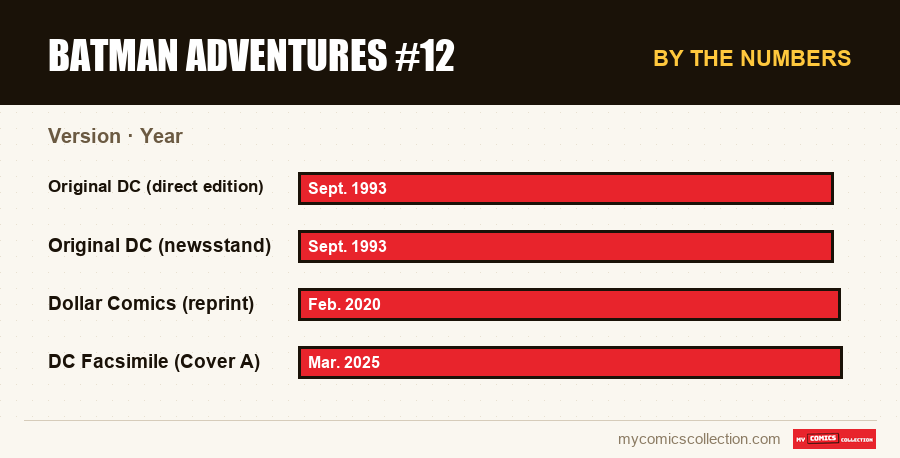
| Version | Year | Cover price | Visual identifier | Collector value |
|---|---|---|---|---|
| Original DC (direct edition) | Sept. 1993 | $1.25 | DC bullet logo in price box, no UPC barcode | ~$3,250 in CGC 9.8 (2024) |
| Original DC (newsstand) | Sept. 1993 | $1.25 | Full UPC barcode on front cover | ~$5,280 in CGC 9.8 (2024) |
| Dollar Comics (reprint) | Feb. 2020 | $1.00 | "Dollar Comics" banner at top of cover, Diamond code NOV190518 | Reading copy only |
| DC Facsimile (Cover A) | Mar. 2025 | $3.99 | Modern barcode on back cover, "Facsimile Edition" label, no period ads | Reading copy only |
How to identify the genuine 1993 original
The September 1993 original is identified first by its cover price: $1.25 US / $1.75 Canada, printed in the price box at the top left. Any copy showing a different cover price is a reprint. The price box itself also distinguishes the two variants of the original:
- Direct edition: the price box contains a DC bullet logo (or publisher code marker) in place of a UPC barcode. This variant was sold exclusively through specialty comic shops.
- Newsstand edition: the price box contains a standard UPC barcode, identical in format to newsstand magazines sold at general retailers. By the conventions of the period, the second number group in the barcode contains two digits for newsstands versus five digits for direct editions. Newsstand copies are significantly scarcer in high grade: direct edition copies were bought by collectors from the outset and stored in bags and boards immediately; newsstand copies went through general retail, were handled by casual readers, and survived in far lower numbers at high grades.
Forum discussions (notably on CBCS) have raised the question of a cover color variation (the newsstand reportedly appearing bluer, the direct edition more purple) but this criterion is considered unreliable and may reflect ink aging rather than a genuine production difference. The presence or absence of a UPC barcode remains the only objective marker.
The Dollar Comics reprint (2020)
DC Comics released a $1 reprint in February 2020 as part of its Dollar Comics line, designed to make key issues accessible to new readers (Previews code: NOV190518). Identification is straightforward: the cover price is $1.00 US and a "Dollar Comics" banner runs across the top of the cover. The editorial content (story, letter column) is identical to the original, but the paper and printing are modern. This version carries no secondary-market premium beyond its original retail price.
A word of caution: some sellers display these copies in protective bags without explicitly disclosing they are reprints. Always check the cover price before purchasing any ungraded copy.
The DC facsimile edition (March 2025)
DC published an official facsimile of The Batman Adventures #12 on March 12, 2025, available in multiple cover variants: standard Cover A at $3.99, foil variant at $7.99, Super Powers variant at $4.99, and blank sketch cover at $4.99. The facsimile faithfully reproduces Mike Parobeck and Rick Burchett's original cover art as well as the period advertisements and letter pages, printed on paper similar to the original newsprint stock.
Three checkpoints identify it instantly: the cover price (at least $3.99), the "Facsimile Edition" label on the cover or inside cover, and a modern back-cover barcode accompanied by a content age rating absent from the 1993 original. A brand-new facsimile copy cannot realistically be confused with the original if these three points are checked. Some buyers nonetheless submit facsimile copies to CGC, which correctly labels them under a distinct series entry in its census.
Why does the newsstand command such a premium?
In 1993, the overwhelming majority of direct edition comics were purchased by collectors who immediately bagged and boarded them. Newsstand copies, aimed at the general public, went through transportation, rack exposure, and handling by casual readers with no preservation intent. The result is a familiar paradox: newsstand copies are rarer in CGC 9.8 precisely because they survived less well, and scarcity at the top grade drives the price premium. Approximately 9,000 copies of Batman Adventures #12 across all variants have been certified by CGC (2024 data), a modest figure compared with the roughly 25,000 graded copies of New Mutants #98. That relatively contained population keeps even the direct edition at meaningful levels in top grade.
The other key Harley Quinn issues to know
The Batman Adventures: Mad Love (February 1994), written and drawn by Paul Dini and Bruce Timm respectively, is the defining origin story: it establishes Harley as Dr. Harleen Quinzel, a psychiatrist at Arkham Asylum who fell for the Joker. This is the issue where Dini and Timm, her animated-series creators, put their names on a Harley comic for the first time. Batman: Harley Quinn #1 (October 1999, cover by Alex Ross) marks her official entry into the main DC Universe continuity. Her first ongoing solo series, Harley Quinn vol. 1 #1 (December 2000), followed with a Karl Kesel run. The New 52 Suicide Squad #1 (2011) introduced her redesigned look, red and blue, that became the template for Margot Robbie's film portrayal.
Own a copy of Batman Adventures #12 or another Harley Quinn key? Get a free valuation with our tool based on real eBay sales to find its low, median, and high value.
Frequently asked questions
The Batman Adventures #12, published in September 1993, written by Kelley Puckett and drawn by Mike Parobeck and Rick Burchett. The character, created by Paul Dini and Bruce Timm, had first appeared in the animated series in September 1992.
Three: the 1993 original, the Dollar Comics reprint of February 2020 and the official facsimile of March 2025. The original itself exists in two variants, the direct edition and the newsstand.
By the cover price printed in the box at the top left: any copy showing another price is a reprint. The direct edition carries a publisher logo in place of the barcode, the newsstand a UPC barcode.
Three checkpoints: a clearly higher cover price, the "Facsimile Edition" mention on the cover or back cover, and a modern barcode on the back with an age rating mention, absent from the original.
Direct editions were bought by collectors who protected them from the start. Newsstands, which went through newsstands and a public little concerned with preservation, survived less well: they are scarcer in high grade.