The most expensive Harley Quinn comic is The Batman Adventures #12 (September 1993), the character's first printed appearance: a CGC 9.8 direct-edition copy traded around $3,250 on the 2024 market, while the newsstand variant in CGC 9.8 has exceeded $5,000, according to data compiled by Sell My Comic Books. Our eBay estimation tool does not cover the Batman Adventures , Harley Quinn , or Suicide Squad series: no eBay median from that tool is cited in this guide.
Harley Quinn was born in 1992 at the animation studios of Bruce Timm and Paul Dini for Batman: The Animated Series, debuting on television on September 11, 1992 in the episode "Joker's Favor." Her immediate popularity led to a comics appearance the following summer. Originally conceived as a one-episode sidekick for the Joker, she went on to achieve full independence: her own series, an antihero moral arc, and a blockbuster film incarnation by Margot Robbie across three DC films. Harley Quinn is a modern (Copper/Modern Age, 1993) creation: there are no Silver Age or Bronze Age keys for this character, unlike Batman or Joker grails from the 1940s-1970s.
This guide sticks to the verifiable: auction records and market data documented by specialist outlets and reference sites (Sell My Comic Books, GoCollect, Bleeding Cool). Our eBay tool returns no medians for the relevant series (outside the covered parameter set). Where no reliable figure exists, we stay qualitative.
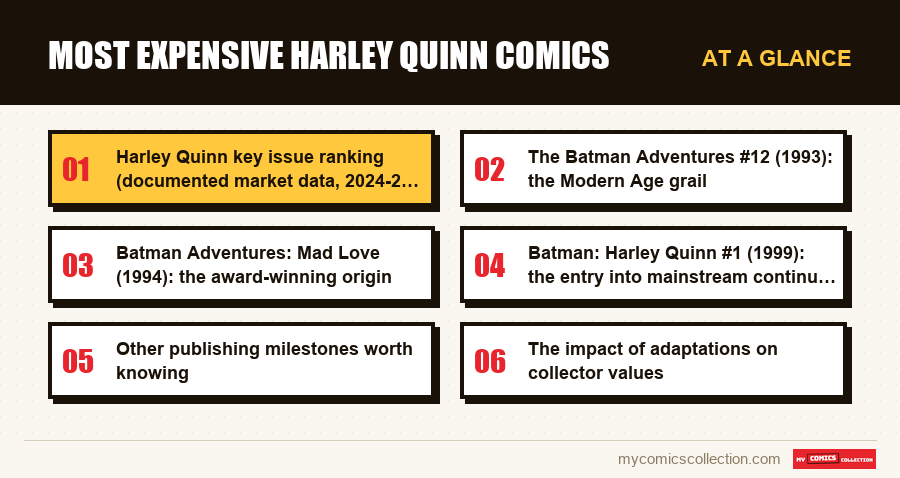
Harley Quinn key issue ranking (documented market data, 2024-2026)
The three major keys for the character all date from the 1993-2000 decade. Since eBay medians are not available through our tool, the ranking draws on sales documented by the specialist press and aggregator sites.
| Issue | Significance | eBay data (tool) | Documented market data |
|---|---|---|---|
| The Batman Adventures #12 (Sep. 1993) | 1st printed appearance of Harley Quinn | Series not indexed: no median available | ~$3,250 CGC 9.8 (direct); ~$5,000-5,280 CGC 9.8 (newsstand) · Sell My Comic Books, 2024 |
| Batman Adventures: Mad Love (Feb. 1994) | Harley Quinn's origin (Dr. Harleen Quinzel): Eisner Award 1994 | Series not indexed: no median available | Qualitatively high in CGC 9.8; no public record figure found |
| Batman: Harley Quinn #1 (Oct. 1999) | 1st appearance in mainstream DC continuity: Alex Ross cover | Series not indexed: no median available | Active market; no public record figure found |
Sources: Sell My Comic Books (2024 market update), GoCollect, Bleeding Cool. This site's eBay tool does not cover the Batman Adventures, Harley Quinn, or Suicide Squad series.
The Batman Adventures #12 (1993): the Modern Age grail
Released on August 3, 1993 (cover-dated September 1993), The Batman Adventures #12 is the cornerstone of any Harley Quinn collection. The script is by Kelley Puckett, with art by Mike Parobeck: Dini and Timm, who created the character for television, did not work on this specific issue. In the story "Batgirl: Day One," Harley teams up with Poison Ivy to crash an exclusive costume party, where she fights Batgirl. Her role is still supporting, but it marks the first time the character exists on paper.
The scarcity of this issue in very high grade (CGC 9.8) is structural: printed for direct-distribution retail at a time when preservation was an afterthought, condition copies are genuinely rare. CGC has certified approximately 9,000 copies across all grades, but 9.8s remain a small minority. The newsstand variant is meaningfully scarcer still. According to data compiled by Sell My Comic Books (2024 update), direct-edition CGC 9.8 copies trade around $3,250 and newsstand CGC 9.8 copies around $5,000-$5,280. In July 2021, a CGC 9.8 copy was already past $2,800 with five hours remaining in a Heritage Auctions sale reported by Bleeding Cool. These figures reflect a resilient market that responds to every major film or animated release featuring the character.
Batman Adventures: Mad Love (1994): the award-winning origin
Published on December 14, 1993 (cover-dated February 1994), The Batman Adventures: Mad Love is a prestige-format one-shot entirely crafted by Paul Dini (script) and Bruce Timm (pencils, inks, colors). It is the first story to reveal how psychiatry intern Dr. Harleen Quinzel, working at Arkham Asylum, was manipulated and seduced by the Joker into becoming his accomplice. The work won the Eisner Award for Best Single Issue and the Harvey Award for Best Single Issue in 1994: a rare double distinction for any comic, let alone one rooted in an animated continuity.
On the secondary market, Mad Love attracts two types of buyers: collectors chasing high-grade CGC slabs for investment, and fans seeking Signature Series copies signed by Timm or Dini. No specific public auction record could be verified for this title in the sources consulted: the market value is qualitatively strong, particularly for first printings in CGC 9.8, which are thinly represented on the CGC census.
Batman: Harley Quinn #1 (1999): the entry into mainstream continuity
Published in October 1999, Batman: Harley Quinn #1 is an oversized one-shot written by Paul Dini with art by Yvel Guichet and a painted cover by Alex Ross. It is Harley Quinn's first appearance in the main DC continuity (outside the animated universe), set against the backdrop of the No Man's Land crossover in which a earthquake has leveled Gotham City. The story deepens the character's origin, Poison Ivy's formula grants her immunity to toxins and enhanced physical abilities, and locks in her ambivalent relationship with the Joker.
The Alex Ross painted cover is the issue's primary draw for collectors: Ross was already acclaimed for Kingdom Come (1996) and Marvels (1994), lending the one-shot a pictorial prestige that is unusual for its era. No public auction record has been found for this title in the sources consulted; the market is active across all grades.
Other publishing milestones worth knowing
Harley Quinn vol. 1 #1 (2000), the character's first ongoing solo series, was written by Karl Kesel with art by Terry Dodson: the series ran for 25 issues. The New 52 relaunch delivered a visually transformed Harley in Suicide Squad vol. 4 #1 (2011, written by Adam Glass), introducing the bleached skin and the red-and-blue palette that mainstream audiences associate with the films. The solo series Harley Quinn vol. 2 (2013-2016), written by Jimmy Palmiotti and Amanda Conner, is widely considered the definitive standalone run on the character. These issues trade actively on the secondary market but without any spectacular documented record to report.
The impact of adaptations on collector values
Harley Quinn is today one of DC's most visible screen characters. Suicide Squad (2016, Margot Robbie) grossed $749 million worldwide; Birds of Prey (2020) $205.5 million ; The Suicide Squad (2021, James Gunn) $169 million. In 2024, Todd Phillips's Joker: Folie à Deux saw Lady Gaga portray a version of the character, grossing $207.5 million worldwide. The animated series Harley Quinn (2019:, voiced by Kaley Cuoco) has also broadened the fanbase considerably. Each major release produces a measurable uptick in demand for The Batman Adventures #12 and Mad Love on auction platforms.
Own a Harley Quinn comic? Get a free valuation with our tool based on real eBay sales to find its low, median, and high value.
Frequently asked questions
The Batman Adventures #12 (September 1993), her first printed appearance. The newsstand variant in very high grade is clearly rarer than the direct edition.
She was born in 1992 in animation, with Bruce Timm and Paul Dini, for Batman: The Animated Series, where she first appears on September 11, 1992 in the episode "Joker's Favor". Her popularity led to a comics adaptation the following summer.
Kelley Puckett wrote it and Mike Parobeck drew it. Dini and Timm, the character's creators for television, did not work on this particular issue.
This prestige-format one-shot, entirely by Paul Dini and Bruce Timm, reveals the story of psychiatrist Harleen Quinzel, manipulated by the Joker. It is prized by high-grade collectors as well as fans of signed copies.
Batman: Harley Quinn #1 (October 1999), a one-shot by Paul Dini and Yvel Guichet, with a cover painted by Alex Ross. It takes place during the No Man's Land crossover.