The definitive Harley Quinn key is The Batman Adventures #12 (September 1993), her first comic appearance: a CGC 9.8 copy traded at around $1,700-$1,800 at the time of Suicide Squad in 2016, then fell as much as 40% after the film's release, before recovering to $2,640 (regular) and $3,800 (newsstand) in 2021, and to $3,250 (regular) and $5,280 (newsstand) in 2024, per SellMyComicBooks. Our eBay estimator tool does not index Harley Quinn's series (batman-adventures , harley-quinn , suicide-squad): no eBay median is cited in this guide.
Harley Quinn was born on September 11, 1992, in the episode "Joker's Favor" of Batman: The Animated Series, created by Paul Dini and Bruce Timm. She was originally written as a one-scene walk-on, a jester to help the Joker pop out of a cake, and her immediate popularity turned her into a recurring character and eventually a DC icon. Her first comics appearance came in August 1993 with The Batman Adventures #12 (cover-dated September 1993), written by Kelley Puckett with art by Mike Parobeck and Rick Burchett: that issue is today the defining key for any Harley Quinn collector.
This guide examines how successive adaptations:Suicide Squad (2016), Birds of Prey (2020), The Suicide Squad (2021), and the animated series Harley Quinn (2019): have moved demand for the key issues on paper. All prices cited are documented by SellMyComicBooks; box-office figures come from Box Office Mojo and The Numbers.
The Batman Adventures #12 (1993): the only true modern-era grail
Harley Quinn is a modern-era creation: she has no Golden Age, Silver Age, or Bronze Age issues. Her reference key, The Batman Adventures #12, is a comic cover-dated September 1993, firmly in the modern age. The CGC census counts approximately 9,000 certified copies: significantly fewer than comparable modern keys like Spawn #1 (around 25,000 certifications): which contributes to the relative scarcity of high-grade copies. The newsstand variant, printed in lower quantities, has become the most coveted edition among serious collectors.
Before 2014 the issue was relatively quiet on the secondary market. It was the editorial relaunch of 2013: the Amanda Conner and Jimmy Palmiotti solo series (Harley Quinn vol. 2 #1): combined with early rumours of a live-action appearance that first drove serious collector interest. By 2015, a Near Mint copy was fetching around $400. By the time Suicide Squad arrived in 2016, CGC 9.8 copies were peaking at $1,700-$1,800.
Suicide Squad (2016): the first major audience shock
David Ayer's Suicide Squad, with Margot Robbie as Harley Quinn, grossed $749.2 million worldwide (Box Office Mojo). It was the first time Harley Quinn reached a mass non-reader audience at that scale. Demand for Batman Adventures #12 climbed in the months leading up to and following the August 2016 release. But the post-film pattern is instructive: after the initial excitement faded, prices fell as much as 40% from their highs, per SellMyComicBooks. A CGC 9.8 that had approached $1,800 during the film's run could be found closer to $1,250-$1,400 in the months that followed.
This cycle (anticipation, peak, correction) is characteristic of comics whose demand is driven by a single adaptation. The correction does not mean collapse: the floor settled meaningfully above pre-film levels, reflecting a genuine and lasting expansion of the collector base interested in the character.
Birds of Prey (2020) and the animated series (2019): more limited market effects
Birds of Prey and the Fantabulous Emancipation of One Harley Quinn (Cathy Yan, 2020) grossed $205.5 million worldwide (Box Office Mojo): below its estimated break-even point of $250-300 million. The film was well received critically but disappointed commercially. Market data on Batman Adventures #12 confirms the limited effect: in 2020, most grades of the issue recorded losses relative to 2019, despite the theatrical release. A film signal alone is not enough to sustain a market if the film underperforms.
The animated series Harley Quinn (DC Universe, then HBO Max), which premiered on November 29, 2019 with Kaley Cuoco in the title role, built a loyal audience over time: five seasons and a special, 57 episodes through March 2025. Its impact on the key-issue market is less spectacular than a blockbuster but more consistent: it keeps the character visible to an adult audience that overlaps meaningfully with the collector base.
The Suicide Squad (2021) and long-term market dynamics
James Gunn's The Suicide Squad (2021) grossed $168.7 million worldwide (Box Office Mojo / The Numbers) against a $185 million budget: well below expectations. Yet 2021 saw Batman Adventures #12 regain significant ground: a regular CGC 9.8 reached $2,640 and a newsstand copy $3,800, representing a roughly 47% rise from 2020's lows, per SellMyComicBooks. That rebound is less attributable to the film itself, which did not perform, than to the broader speculative comic market boom of 2020-2021, fuelled by post-pandemic conditions and renewed interest in modern keys across the board.
By 2024, documented levels remain robust: regular CGC 9.8 around $3,250, newsstand around $5,280, and an ungraded Near Mint copy valued at $650 by SellMyComicBooks. Mid-grade copies (CGC 8.0-9.4) remain accessible in the $550-$1,100 range, offering a lower-speculation entry point for collectors who want to own the key without chasing a perfect copy. Lower-grade copies (CGC 3.5-5.5) saw unusual demand in 2023, a trend that reflects an expanding market less fixated on maximum grade.
The supporting keys: Batman: Harley Quinn #1 (1999) and the solo title
| Issue | Significance | Notes |
|---|---|---|
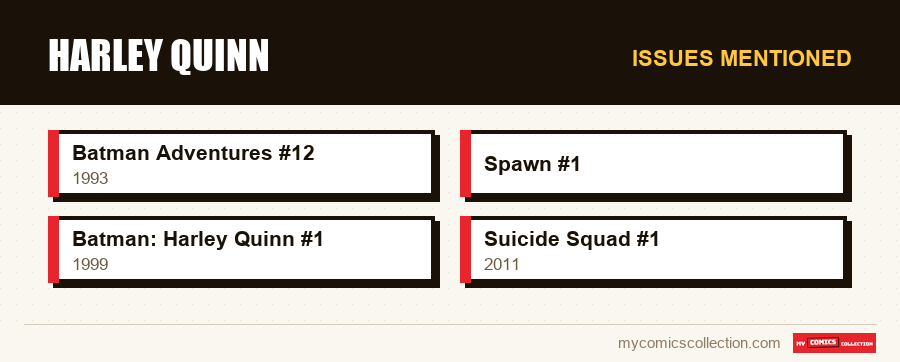
| The Batman Adventures #12 (Sep. 1993) | 1st comic appearance of Harley Quinn | CGC 9.8 regular ~$3,250 / newsstand ~$5,280 (2024, SellMyComicBooks) |
| Batman: The Adventures Continue / Batman: Mad Love (1994) | Harley Quinn origin: Dr. Harleen Quinzel: by Dini & Timm | Key story; no public auction record documented |
| Batman: Harley Quinn #1 (Oct. 1999) | 1st DC Universe mainstream appearance; Alex Ross cover | Accessible modern key; no public auction record |
| Harley Quinn vol. 1 #1 (2000) | First solo ongoing series | Entry-level collectible |
| Suicide Squad #1 (New 52, 2011) | New look debut; landmark pop-culture redesign | High print run; widely available |
Batman: Mad Love (1994), the one-shot written and drawn by Dini and Timm that tells the origin of Dr. Harleen Quinzel, deserves a separate mention: it won multiple Eisner Awards and is widely considered the definitive Harley Quinn story. Batman: Harley Quinn #1 (1999), written by Dini with a cover by Alex Ross, marks her first appearance in the DC Universe proper: outside the animated continuity. Both are essential reads; neither has a publicly documented auction record comparable to Batman Adventures #12, making qualitative rather than quantitative assessment the honest approach here.
Own a Harley Quinn comic? Get a free valuation with our tool based on real eBay sales to find its low, median, and high value.
Frequently Asked Questions
The Batman Adventures #12, dated September 1993, the character's first comics appearance, written by Kelley Puckett. Harley was born on September 11, 1992 in the "Joker's Favor" episode of Batman: The Animated Series, created by Paul Dini and Bruce Timm.
Demand for Batman Adventures #12 climbed before and after the film's release, then prices fell by as much as 40% from their highs. The floor nonetheless settled clearly above pre-film levels, a sign of a lasting broadening of the collector base.
Very little for Birds of Prey (2020), which disappointed commercially: most grades of the issue fell in 2020. The animated series Harley Quinn, launched in 2019, had a less spectacular but steadier impact, keeping the character visible to an adult audience that is often made up of collectors.
The rebound is less attributable to The Suicide Squad itself than to the general return of the speculative comics market in 2020-2021, driven by the post-Covid period and interest in modern keys. A film alone therefore does not explain a rise.
Batman: Harley Quinn #1 (October 1999), written by Paul Dini with an Alex Ross cover, the first appearance in the main DC universe, and Harley Quinn vol. 1 #1 (2000), the first regular solo title. The intermediate grades of Batman Adventures #12 also offer a less speculative entry point.