The essential entry point for any Harley Quinn reader or collector is The Batman Adventures: Mad Love (1994), the Paul Dini and Bruce Timm one-shot that reveals the origin of Harleen Quinzel. For key-issue collectors, The Batman Adventures #12 (1993), the character's first comic book appearance, is the reference piece: CGC 9.8 copies (regular edition) have traded around $3,000 to $3,250 based on documented secondary market sales, with the newsstand variant in CGC 9.8 regularly surpassing $4,000.
Harley Quinn existed on screen before she existed on paper. Paul Dini and Bruce Timm created her for the animated series Batman: The Animated Series, where she first appeared in the episode "Joker's Favor" in September 1992. Her transition to comics came a year later with The Batman Adventures #12 (cover-dated September 1993), published as part of the animated series tie-in line. She belongs firmly to the Modern Era: there are no Golden Age, Silver Age, or Bronze Age Harley Quinn issues. This is worth stating clearly: any listing that implies otherwise is misleading. It also makes her publishing history unusually readable and accessible for a new collector.
This guide covers the essential reads in logical order, the key issues worth knowing if you are building a collection, and the market as it is actually documented. Our internal eBay estimator does not index the Batman Adventures , Harley Quinn , or Suicide Squad series: no internal eBay median is available for these titles. Values cited below come from sellmycomicbooks.com and other publicly documented market sources.
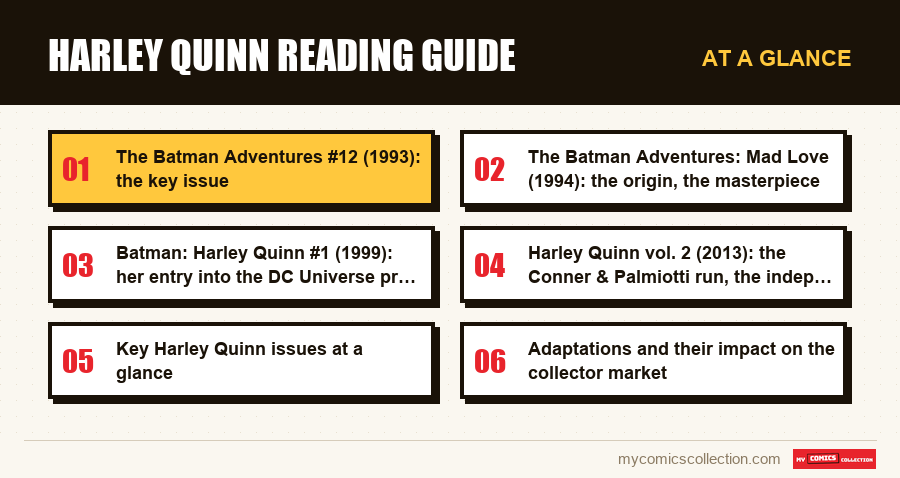
The Batman Adventures #12 (1993): the key issue
The Batman Adventures #12 is Harley Quinn's first appearance in a comic book. The issue was written by Kelley Puckett with art by Mike Parobeck, but the character herself was created by Paul Dini and Bruce Timm for the animated series, and that creative lineage is what gives this issue its symbolic and market weight. It was published with a September 1993 cover date and belongs to the Modern Era; no vintage framing applies. DC released a facsimile reprint edition in 2025, itself a signal of sustained collector demand.
On the secondary market, CGC 9.8 copies of the regular edition have traded around $3,000 to $3,250 based on recently documented sales (sellmycomicbooks.com, 2024 data). The newsstand variant, identifiable by its barcode box, regularly exceeds $4,000 in CGC 9.8 and is the premium target for variant collectors. Below CGC 9.0, copies remain accessible for a few hundred dollars. Our internal eBay estimator does not cover this series: the figures above come from the external sources cited, not our own tool.
The Batman Adventures: Mad Love (1994): the origin, the masterpiece
If The Batman Adventures #12 is the key, Mad Love is the work. This one-shot (cover-dated February 1994, released December 1993) was written and drawn by Paul Dini and Bruce Timm themselves, the character's creators. It tells the story of Harleen Quinzel: a gifted psychiatrist at Arkham Asylum who slides, by degrees, from professional fascination into obsessive love for the Joker and ultimately into complicity. The story is funny, dark, and emotionally intelligent: a real piece of craft that explains why Harley survived the animated series to become one of DC's central characters.
Mad Love won both the Eisner Award and the Harvey Award for Best Single Issue in 1994: a rare double recognition for an animated tie-in book. It is the ideal starting point for any reader, even before Batman Adventures #12 if your goal is to understand the character before thinking about collecting. It is widely available in trade paperback and in a Deluxe hardcover edition.
Batman: Harley Quinn #1 (1999): her entry into the DC Universe proper
In 1999, Paul Dini wrote Batman: Harley Quinn #1, a prestige-format one-shot with a painted cover by Alex Ross that officially introduced Harley into mainstream DC continuity: separate from the animated universe. It is her first appearance in the primary DC Universe. The foil edition and signed copies (limited numbered editions signed by Alex Ross and Paul Dini) carry premium demand among collectors. For anyone building a focused Harley Quinn key-issue collection, this is the logical second piece after Batman Adventures #12.
Harley Quinn vol. 2 (2013): the Conner & Palmiotti run, the independence era
The Amanda Conner and Jimmy Palmiotti run on Harley Quinn vol. 2, launched in 2013 under DC's New 52 banner, is the point where the character fully comes into her own. Harley leaves Gotham for Coney Island, opens a practice, builds her own crew (the Gang of Harleys), and deepens her friendship with Poison Ivy. The tone blends absurdist comedy, slapstick action, and genuine emotional depth. Conner and Palmiotti held the series for several years, producing one of the most consistent and beloved runs in the character's history.
The recommended entry point is the first collected volume Hot in the City (Harley Quinn vol. 2 #0-8), or the two Omnibus editions that compile the full run. Harley Quinn vol. 2 #1 (December 2013) is also a modest collecting key: accessible in lower grades and readable in high-grade CGC for anyone who wants a symbolic first issue from the defining run.
Key Harley Quinn issues at a glance
| Issue | Significance | Documented market value |
|---|---|---|
| The Batman Adventures #12 (1993) | 1st comic book appearance | CGC 9.8: ~$3,000-$3,250 (regular) / $4,000+ (newsstand)* |
| Batman Adventures: Mad Love (1994) | Harley's origin: Eisner Award + Harvey Award | Widely available in TPB; first print qualitatively rising |
| Batman: Harley Quinn #1 (1999) | 1st appearance in DC Universe proper (Alex Ross cover) | Sustained demand; price varies by condition and variant |
| Harley Quinn vol. 2 #1 (2013) | Launch of the Conner & Palmiotti run | Entry-level accessible in raw; high-grade CGC trending up |
*Sources: sellmycomicbooks.com (2024 data), GoCollect. Our internal eBay estimator does not cover these series: no internal eBay median is available.
Adaptations and their impact on the collector market
Harley Quinn's move to live-action film reshaped collector demand for her comics in a measurable way. Suicide Squad (2016, directed by David Ayer), with Margot Robbie in the role, grossed $746.8 million worldwide: a commercial success on a large scale that brought the character to a mass audience. Birds of Prey (2020) posted approximately $205.5 million in global receipts, below expectations but sufficient to sustain visibility. The animated series Harley Quinn: which premiered on November 29, 2019 on DC Universe with Kaley Cuoco voicing the title character: has built a strong critical following and was renewed for a fifth season in early 2025 on Max, confirming the character's firm place in contemporary popular culture. Historically, each major release correlates with renewed interest in Batman Adventures #12 and Mad Love on the secondary market.
Own a Harley Quinn comic? Get a free valuation with our tool based on real eBay sales to find its low, median, and high value.
Frequently asked questions
With The Batman Adventures: Mad Love (1994), the one-shot by Paul Dini and Bruce Timm that tells the origin of Harleen Quinzel. It won the Eisner Award and the Harvey Award for best short story in 1994, and is easy to find in collected and Deluxe editions.
The Batman Adventures #12 (September 1993, cover date), written by Kelley Puckett and drawn by Mike Parobeck. The character had been conceived by Paul Dini and Bruce Timm for the animated series, where she appears in the episode "Joker's Favor" in September 1992.
No, she is a deeply modern character, a product of the 1990s, with no Bronze Age issue to her name. Beware of listings that present The Batman Adventures #12 as anything other than Modern Era.
Batman: Harley Quinn #1 (1999), a prestige format issue with a painted cover by Alex Ross, written by Paul Dini. It is the character's first appearance in main DC Comics continuity, and a logical second key for a thoughtful collection.
The Amanda Conner and Jimmy Palmiotti run on Harley Quinn vol. 2, launched in 2013. Harley leaves Gotham for Coney Island, opens a clinic and forms the Gang of Harleys. The first collected volume Hot in the City or the two Omnibus editions are the best entry points.