Many French comics magazines did not reuse the cover of the edition they were translating: a house illustrator drew a new one. The record confirms this indirectly, since the two names that appear most often in the credit fields of these magazines are French, not American. This redrawn cover exists on no other market, it is also the most fragile surface of the issue, and the active periods of these illustrators serve as a dating reference.
You open a crate of magazines bought at a flea market, you recognize a story you have already read in a reprint, and yet the cover tells you nothing. This is not a failure of memory: the image in front of you was never printed anywhere but in France. It is the most common situation in piles of French magazines from the 1970s and 1980s, and it is also one of the rare places where these issues stop being a translation and become an original object.
As always on this guide, only verified information (creators, issue numbers, dates) is stated as fact; the analysis is our own, with no reproduction of panels or protected dialogue.
A cover that is not the model's
French publishers of the period put together issues with several stories, often three or four episodes drawn from different publications. Mechanically, no original cover could fit: it would have announced only one of the episodes in the contents. The industrial solution was therefore to commission a new image, one that gathered the characters of the issue and carried the logo of the French title.
This choice is not incidental for a collector. It means that part of the graphic work of these magazines was produced in France, by illustrators who have no equivalent in the American genealogy of the character. The French reader who grew up with these titles memorized images that exist in no foreign edition, and that do not appear in today's hardcover reprints either.
The problem, in checking all this, is that the covers are not catalogued separately. We can, however, measure the presence of these illustrators in the magazines' credits, and that is already a great deal.
Two names ahead of all the others in the credit fields
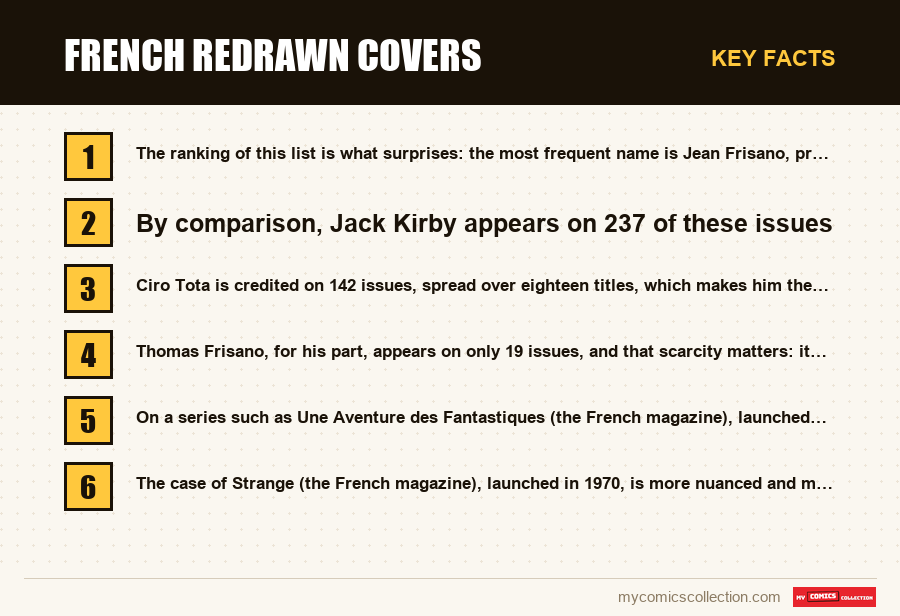
Going through the contents records we have for French magazines, we obtain a little over six hundred distinct artist names. The ranking of this list is what surprises: the most frequent name is Jean Frisano, present on 611 issues in the record, and the second is Jean-Yves Mitton, present on 492. In other words, the two most-cited artists in French comics publishing history are not American.
By comparison, Jack Kirby appears on 237 of these issues. This is not because Kirby counted for less; it is because his work arrives in waves of reprints, whereas the house illustrator intervened issue after issue, across the whole run of the title. That difference in regime is exactly what makes a French collection something other than a shrunken American one.
Two other names complete this core. Ciro Tota is credited on 142 issues, spread over eighteen titles, which makes him the most mobile of the four. Thomas Frisano, for his part, appears on only 19 issues, and that scarcity matters: it marks a short window that you can use as a landmark when dating an issue with no legible date.
Series where the French hand is present on almost every issue
The breakdown by title is more telling still than the total. On a series such as Une Aventure des Fantastiques (the French magazine), launched in 1973, the records show at least one of these four names on all 43 issues. A collector who assembles this series is therefore not merely assembling translations: they are assembling a complete French graphic run, without a gap.
The case of Strange (the French magazine), launched in 1970, is more nuanced and more useful. At least one of these names appears on 187 of the 228 issues, a little over eight in ten. The remaining forty issues are precisely the ones you should examine on the copy before concluding anything, because nothing in the credits signals French involvement there.
Other titles confirm the pattern, though there is no need to list them all. Keep the principle in mind: the older the magazine, and the more sources it mixed within a single issue, the higher the probability that a French illustrator took part.
A measurable break at the end of the 1980s
The series relaunched in 1989 tell a different story. On titles of that generation, the share of issues carrying one of these four names falls to around one in five, compared with nine in ten for their predecessors of the 1970s. The editorial model had changed: the contents narrowed to a single American series, and the original image became directly reusable.
This shift has a direct consequence for what you buy. A French magazine from the 1970s has a strong chance of containing local graphic creation; its counterpart from the early 1990s much less so. This is not a judgment of quality, it is a difference in the nature of the object, and it should inform how you decide what to keep when choosing between two piles.
What the credit field does not allow us to claim
We need to be clear about the limit, because it lies at the heart of the subject. The records we have carry a field of artists per issue, and that field does not separate the cover from the interior pages. A name listed there took part in the issue; nothing indicates in what capacity.
So no, we cannot claim, on this data alone, that a given illustrator signed the cover of a specific issue. We can establish that he is credited, on which series, and between which date boundaries. To move from the credit to the cover, you need the copy in hand, a legible signature inside the image, or a specialist fanzine survey. Any sale listing that assigns a precise cover to a precise name without showing the signature claims more than the public data allows, and you have every right to ask for a photograph of the detail.
This caution does not weaken the heritage argument; it shifts it. What can be demonstrated is the massive and lasting presence of French illustrators in the making of these magazines. What remains to be established, issue by issue, is the exact division of tasks.
Do you collect this series?
Track what you own, what you are missing and what your collection is worth. 7-day trial.
Start my trial →
French and American names in the same field
One detail of the record deserves emphasis, because it explains why the confusion is so common. Of the 954 issues where one of these four names appears, 940 do so alongside at least one American artist, in the same field, separated by a simple comma. Nothing in the layout distinguishes the person who supplied the pages from the person who supplied the cover image.
The phenomenon is even more visible in the co-occurrences. Jean Frisano and Jean-Yves Mitton appear together on 285 issues, which shows the size of the French studio behind these titles, and at the same time rules out attributing a given image to one rather than the other without verification.
There are a handful of cases where the field contains no American name at all: a few issues of Spidey (the French magazine) between November 1980 and April 1981 carry only the name of Jean-Yves Mitton, with no story title recorded. These entries are interesting because they show that the catalogue sometimes records the French hand alone, but they are no more sufficient for identifying the cover.
An image that exists nowhere else
Let us turn to what this means for a collection. A redrawn French cover is, strictly speaking, the only medium for this image. It has no original edition behind it, no American reprint, no deluxe version to fall back on if yours is damaged. For interior pages, a reader frustrated by a tired copy can turn to a reprint; for the cover, there is no recourse.
That is what justifies treating these magazines differently from luxury duplicates. In a market where a French issue is readily compared with its supposed American equivalent, the cover is where the comparison stops making sense, because the French object is unique there. It is also the strongest argument to put forward when presenting a lot, far more than age alone.
By extension, this gives a reason to keep copies whose interior is mediocre. An issue with yellowed pages but a clean cover keeps what cannot be found anywhere else. The reverse is not true.
The most exposed part of the magazine
This uniqueness falls on a bad spot, because the cover is also the surface that suffers most. These magazines were stapled, printed on soft paper, laid flat on piles and handled by children. The first and last leaves take all the punishment: rubbing from the top of the pile, spine creases, halos, staples that rust and stain the central fold, edges that fray.
When examining a copy, look at the cover in this order: the legibility of the image before the whiteness of the paper, the spine fold before the corners, and the integrity of the logo before minor soiling. A tear across a character's face devalues the object more surely than a slightly browned edge, because it damages the one thing the copy holds exclusively. For deciding your purchases, this ranking is more useful than any general grid applied to magazines.
A word on restorations. A cover that was consolidated or detached and then re-glued remains a usable copy, provided the intervention is declared.
Using the active periods as a dating reference
One last, very practical use. Because these illustrators worked in identifiable periods, their names in the credits form a timeline. Jean Frisano appears in these records from the late 1960s, and his frequency peaks in the early 1980s before tailing off at the end of the decade. Ciro Tota follows the opposite curve: almost absent before the mid-1980s, he reaches his maximum around 1989 and 1990.
For an issue whose cover is torn off or whose spine is illegible, this chronology gives a range. An issue whose credits mix Frisano and Mitton sits in the great period of composite contents; an issue where Tota dominates belongs to the next generation of titles. You will not date to the exact month, but you can place the magazine in the right half-decade, which is often enough to choose between two hypotheses about the title.
The same logic applies when detecting an inconsistency in a listing. If a seller dates an issue to the mid-1970s while citing an illustrator whose recorded activity begins ten years later, one of the two pieces of information is wrong, and that is the moment to ask for a photograph of the title page.
What a collector should keep in mind
Three ideas hold the whole together. The redrawn French cover is a local creation, and its massive presence is demonstrated by the place French illustrators occupy in the credits of these magazines. It is unique, and therefore irreplaceable, which makes it the point to protect first, both in conservation and in purchasing decisions. And it cannot be isolated from the rest of the credits, which means speaking of documented participation rather than certain signature.
If you go back through your piles with this grid, you will quickly see two groups emerge: the issues of the 1970s, where the French graphic contribution is almost systematic, and those of the turn of the 1990s, where it becomes the exception. That sorting is useful, because it depends neither on the character nor on supposed rarity, but on a feature of the object that you can check yourself. The hubs for Daredevil and Hulk will help you connect these magazines to the characters they introduced in France, and the blog brings together the guides devoted to the magazines themselves.
Frequently asked questions
Because a French issue often contained three or four episodes from different publications. An original cover would have announced only one of them, and would not have carried the logo of the French title. Having a new image composed, gathering the characters of the contents, was the only solution consistent with this editorial format.
Not from the credits alone. The artist field recorded for each issue does not separate the cover from the interior pages, and nine times out of ten it mixes French and American names. A signature visible in the image, the copy in hand, or a specialist survey is needed to attribute a cover with certainty.
Four names carry most of the recorded corpus: Jean Frisano, by far the most present, Jean-Yves Mitton right behind him, then Ciro Tota over a later period and Thomas Frisano over a short window. The first two are credited on more French issues than any American artist.
It depends where the damage is. A browned edge or soft corners leave the image readable and the object remains relevant. A tear across the drawing, a split in the logo or a missing cover remove what the issue held exclusively, since this image was printed nowhere else.
Much less often. On that generation of titles, the share of issues crediting a French illustrator falls to around one in five, compared with nine in ten for the series of the 1970s. The contents narrowed to a single American series, which makes the original image directly reusable.