The most expensive Flash comic at auction is Showcase #4 (September-October 1956), the first appearance of Barry Allen as the Flash: a CGC NM+ 9.6 copy realised $900,000 at Heritage Auctions in January 2024: the highest price ever paid for a Silver Age DC comic. Its Golden Age counterpart, Flash Comics #1 (January 1940), reached $450,000 for its CGC 9.6 Mile High pedigree copy, also sold at Heritage, in 2010.
The Flash is one of the very few characters to have anchored three distinct eras of American comics: Jay Garrick (Golden Age, 1940), Barry Allen (Silver Age, 1956) and Wally West (modern era, 1987). This multigenerational continuity means that genuinely important key issues exist across three different decades. For the two crown jewels:Flash Comics #1 and Showcase #4: eBay listings are essentially non-existent; Heritage Auctions results are the only reliable benchmark.
This guide sticks to the verifiable: records documented by Heritage Auctions and reported by specialist press (Bleeding Cool, Overstreet). For Silver Age issues from the Flash vol.1 ongoing series (1959-1985), our eBay tool returns zero or one listing: those figures will not be cited as reference prices. Only sourced records appear in the data below.
Flash key issue ranking (documented records)
For Golden Age and Silver Age grails, auction records are the only meaningful measure: these comics appear far too rarely on eBay to produce a reliable median. The figures below are drawn exclusively from documented public sales.
| Issue | Significance | eBay (estimator) | Documented record |
|---|---|---|---|
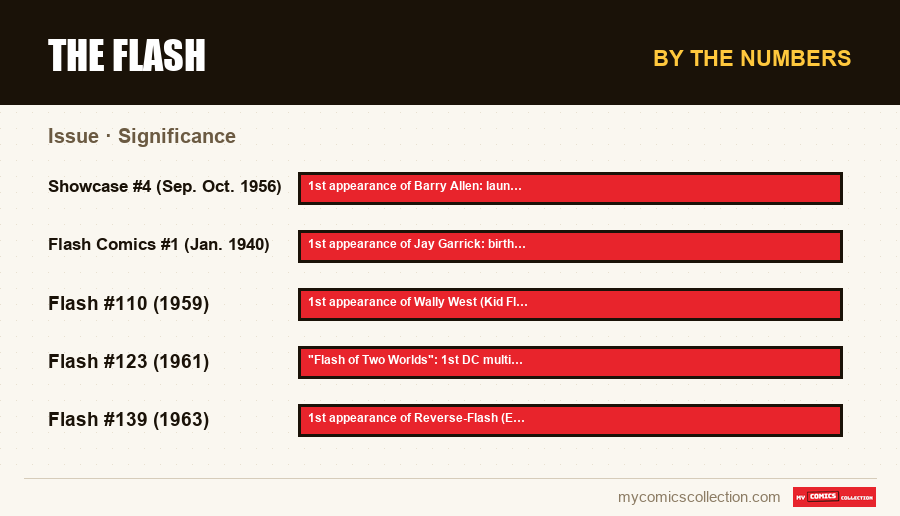
| Showcase #4 (Sep. Oct. 1956) | 1st appearance of Barry Allen: launch of the Silver Age | Outside tool (different series) | $900,000 (CGC 9.6, Heritage Jan. 2024) |
| Flash Comics #1 (Jan. 1940) | 1st appearance of Jay Garrick: birth of the Flash | Outside tool (different series) | $450,000 (CGC 9.6, Heritage 2010) · $396,000 (CGC 8.5, Heritage 2025) |
| Flash #110 (1959) | 1st appearance of Wally West (Kid Flash) + 1st Weather Wizard | 0 eBay listings: no signal | Not publicly documented |
| Flash #123 (1961) | "Flash of Two Worlds": 1st DC multiverse / Jay Garrick returns | 0 eBay listings: no signal | Not publicly documented |
| Flash #139 (1963) | 1st appearance of Reverse-Flash (Eobard Thawne) | 0 eBay listings: no signal | Not publicly documented |
Record sources: Heritage Auctions (Bleeding Cool, January 2024; Bleeding Cool, March 2010).
Showcase #4: the comic that launched the Silver Age
Published in September-October 1956 by DC Comics, Showcase #4 introduces Barry Allen: a Central City police forensic scientist who is struck by lightning in his lab, gaining superhuman speed. Written by Robert Kanigher, pencilled by Carmine Infantino and inked by Joe Kubert under editor Julius Schwartz, this issue is now universally regarded as the official starting point of the Silver Age of Comics. The creative team deliberately reimagined the Flash as a new character in a new setting, a decision that would later give birth to the concept of the DC multiverse when Barry Allen encountered Jay Garrick in Flash #123 (1961).
In January 2024, a CGC NM+ 9.6 copy (white pages) realised $900,000 at Heritage Auctions: the highest price ever paid for a Silver Age DC comic at the time of sale. The same copy had sold for $179,250 at Heritage in 2009, a fivefold increase over fifteen years. According to Bleeding Cool, the lot came close to breaching the one-million-dollar mark on the pre-sale estimates before settling just below that threshold.
Flash Comics #1: Jay Garrick and the birth of the Flash
Published in January 1940 by All-American Publications (which later became part of DC Comics), Flash Comics #1 introduces Jay Garrick, a college physics student who accidentally inhales hard water vapour and acquires phenomenal speed. Created by writer Gardner Fox and artist Harry Lampert, the issue also features the first appearances of Hawkman (by Fox and Sheldon Moldoff) and Johnny Thunder: making it one of the most character-dense Golden Age debut issues on record. With only 48 unrestored copies registered in the CGC Census, the scarcity is extreme.
The most celebrated copy comes from the Edgar Church collection, known as the "Mile High" pedigree: the best-preserved collection in American comic book history. That CGC NM+ 9.6 copy sold for $450,000 at Heritage Auctions in 2010 (up from $273,125 at a prior Heritage sale in 2006). More recently, a CGC 8.5 copy, one of only four examples graded that high or above, realised $396,000 at Heritage in 2025, demonstrating that even mid-grade copies of this title command remarkable prices.
Other Silver Age keys: volumes too thin to quote
The ongoing Flash series (vol.1), launched in 1959 with issue #105 (continuing the original Flash Comics numbering), concentrates several of the most studied Silver Age keys. Issue #110 (1959, John Broome / Carmine Infantino) introduces Wally West as Kid Flash and the Weather Wizard. Issue #123 (1961, "Flash of Two Worlds") establishes the DC multiverse by having Barry Allen cross over to meet Jay Garrick on Earth-Two. Issue #139 (1963) unveils the Reverse-Flash, Eobard Thawne. Our eBay estimator returns zero active listings for all three: volumes are too thin to produce a usable median. CGC-certified copies trade privately or through specialist auctions; quoting precise figures without a documented source would be fabrication, not information.
The Flash on screen
The character's cultural reach is also measured by its adaptations. The CW television series starring Grant Gustin as Barry Allen ran for nine seasons (2014-2023), becoming the longest-running Arrowverse show. The feature film The Flash (2023), with Ezra Miller in the title role, grossed approximately $271 million worldwide against a reported production budget of $200 million: a commercially disappointing result by major-studio standards. These adaptations sustain broad awareness of the character and, at least indirectly, maintain collector demand for the key original issues.
Own a Flash comic? Get a free valuation with our tool based on real eBay sales to find its low, median, and high value.
Frequently asked questions
Showcase #4 (September-October 1956), the first appearance of Barry Allen. A NM+ 9.6 copy set the all-time record for a Silver Age DC comic in January 2024.
Flash Comics #1 (January 1940), which introduces Jay Garrick, created by Gardner Fox and Harry Lampert. It also introduces Hawkman and Johnny Thunder, making it one of the Golden Age comics densest in first appearances.
These issues come up for sale too rarely to produce a reliable valuation, and their prices are not publicly documented. The article sticks to sourced records.
Flash #110 (1959) introduces Wally West as Kid Flash and the Weather Wizard. Flash #123 (1961, "Flash of Two Worlds") lays the groundwork for the DC multiverse, and Flash #139 (1963) reveals the Reverse-Flash, Eobard Thawne.
Yes: Jay Garrick in the Golden Age (1940), Barry Allen in the Silver Age (1956) and Wally West in the modern era (1987). This continuity explains valuable key issues in three different decades.