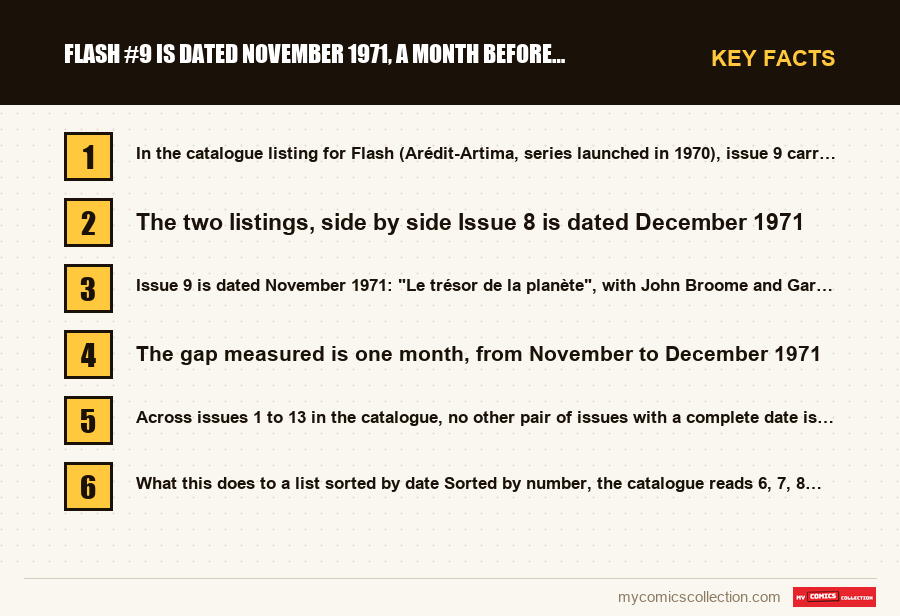
In the catalogue listing for Flash (Arédit-Artima, series launched in 1970), issue 9 carries the date November 1971 and issue 8 the date December 1971. The higher-numbered issue is therefore dated one month before its predecessor. This is an inversion, not a tie. The catalogue does not say whether the error lies in the date or in the order of release: only the copy itself can settle that.
A collector completing a series instinctively sorts by issue number, then checks by date. For Flash, the two orders contradict each other at one specific point, between the eighth and the ninth issues, and this page explains what that changes in a list of gaps.
As always on this guide, only verified information (creators, issue numbers, dates) is stated as fact; the analysis is our own, with no reproduction of artwork or protected dialogue.
The two listings, side by side
Issue 8 is dated December 1971. Its story is titled "Flash prend des risques", the credited writer is John Broome, and the artists are Carmine Infantino and Jacques Van Butsele. Issue 9 is dated November 1971: "Le trésor de la planète", with John Broome and Gardner Fox on script and Carmine Infantino and Gil Kane on art.
These credits are those of the issue, not of a specific episode, and each listing gives only one story title. The catalogue does not give the contents. What is established fits in three lines: a number, a title, a date. The rest of the contents can only be read on the object.
A date inverted between two issues
Two cases look alike but do not mean the same thing. A tie means two issues carry the same date: sorting by date cannot separate them, but it does not put them in the wrong order. An inversion means a higher-numbered issue has an earlier date than a lower-numbered one. Here, 9 is higher than 8 and its date is earlier: this is the second case.
The gap measured is one month, from November to December 1971. Across issues 1 to 13 in the catalogue, no other pair of issues with a complete date is out of order, and none shares the same date: the anomaly is isolated in this stretch.
What this does to a list sorted by date
Sorted by number, the catalogue reads 6, 7, 8, 9, 10: August, October, December, November 1971, then May 1972. Sorted by ascending date, it reads 6, 7, 9, 8, 10. Issue 9 moves ahead of issue 8, and only those two swap places.
If you keep a physical stack, nothing obliges you to follow that sort: the number printed on the issue remains your key. But a spreadsheet, an app or a catalogue label sorted by date will bring 9 ahead of 8, and a check of the form "am I up to date through 8?" can then give a false positive or a false gap, depending on which column drives the sort.
Sorting on the text of the date is worse: "December 1971" would rank before "November 1971" alphabetically, and "August" before "May", with no relation to the calendar. Convert the date into a real date before sorting, or sort by number.
The rhythm around these two issues
Context helps in judging the anomaly. From issue 6 (August 1971) to issue 7 (October), then to issue 8 (December), the issues follow each other at two-month intervals. Issue 9, dated November, breaks that step, whichever side of 8 it is placed on: a two-month step from December would lead to February 1972.
After it, issue 10 is dated May 1972, five months after 8 and six after 9. The catalogue therefore shows a rhythm that spreads out, rather than a steady monthly or bimonthly cadence. Before 6, the intervals were three, three, then four months between issues 1 to 4, and issue 5 has no date in the catalogue.
Do you collect this series?
Track what you own, what you are missing and what your collection is worth. 7-day trial.
Start my trial →
What the data cannot settle
Two explanations remain possible, and the data does not choose between them.
The first is a misrecorded date: a month misread or mistyped on one of the two issues. If 8 were in fact November and 9 December, everything would fall back into order, at the cost of three consecutive issues dated October, November and December, which would make a monthly step that neighbouring issues do not show.
The second is that the dates are accurate and the release order was indeed inverted, or that both issues circulated at the same time, the cover date not reflecting the actual order of release. The catalogue gives one date per listing and does not say whether it is a cover date, a filing date or a sale date. Both hypotheses therefore remain open, and neither can be asserted from the catalogue alone.
What to check on the copy
Take both issues if you have them. First look for the printed issue number: it is that which fixes the identity of the object, not the date. Then look for any date mention on the cover, in the printing line or in the legal block, noting its exact wording (month alone, month and year, year alone).
Finally, compare the story title shown with the one in the catalogue: "Flash prend des risques" for 8, "Le trésor de la planète" for 9. If the two titles are swapped relative to your issues, the anomaly is a data-entry confusion, not a physical inversion. If your copies match, the question remains that of the date.
Placing these two issues in a list of gaps
Keep a "number" column as the key and a "cover date" column as information. In a third "note" column, record that 9 is dated before 8, with the month as read on the object: when you come back to it, you will know this is not a typo of your own.
The catalogue also contains other incomplete dates in the same stretch, for example issue 11, dated 1972 with no month, and issue 5, with no date: they complicate a date sort as much as the inversion of 9, and for the same reason. A solid list of gaps therefore rests on the number and treats the date as a clue.
To place these issues within the rest of the series, the Flash character guide brings together the neighbouring listings.
Immediate neighbours
Issue 7, dated October 1971, is titled "Voleurs par télépathie" and adds Gardner Fox and Carlos d'Aguila to the credited writers. Issue 10, dated May 1972, carries "Vols magiques" and changes writing team, with Gardner Fox, Sid Gerson and Jean-Berard Guiot. In between, 8 and 9 share the same central figure on art, Carmine Infantino, credited on both.
The credits settle nothing: they are at the level of the issue and do not indicate the order of release.
Frequently asked questions
The catalogue dates it November 1971, against December 1971 for issue 8. But a cover date is not a sale date: the data alone does not allow us to state that 9 came out first.
No, file by printed number: that is the key that identifies the issue. The date serves as supplementary information, and you can note it separately if your sorting tool allows it.
The catalogue does not say so, and nothing in the data links this anomaly to scarcity. It matters mainly to the person sorting: on its own, it does not change the value of a copy.
No, among the issues with a complete date. Issues 5 and 11 are separate cases: the first has no date in the catalogue, the second only the year 1972.
Record the printed issue number, then any date mention on the cover or in the legal block, with its exact wording. Then compare the story title shown with the one in the catalogue to rule out a simple listing confusion.