Elektra was born in 1981 and only obtained a monthly series bearing her name in 1996: a fifteen-year gap between the creation of an immediately identifiable figure and the moment when a publisher entrusted her with twelve issues per year. This delay is not an accident of the calendar, it is information on the character itself: on its conception, on its method of writing, and on what a monthly magazine requires. This article treats this delay as an object of analysis: why it lasted, what it cost the series when it finally arrived, and what it allows us to understand more generally about the characters who wait a long time for their first regular title.
There are two ways to tell a character's editorial story. The first is to list its appearances in order, note the significant arcs, and consider that the chronology is sufficient in itself. The second is to focus on the gaps: the periods where nothing happens, the titles that don't exist, the decisions that haven't been made. For Elektra, the second approach is by far the more instructive, because the most striking fact of its trajectory is not what has been published: it is the length of time that nothing regular has been published.
Fifteen years. Between a creation dated 1981 and a monthly series in his name launched in 1996, there is an interval which far exceeds the lifespan of most regular titles. All this time, the character exists, he is recognized, he returns, he is identifiable at first glance by readers who have never read a single one of his appearances, and he does not have a monthly. Understanding why is understanding something quite fundamental about the way comics publishing produces its headliners, and especially about the difference between being memorable and being publishable twelve times a year.
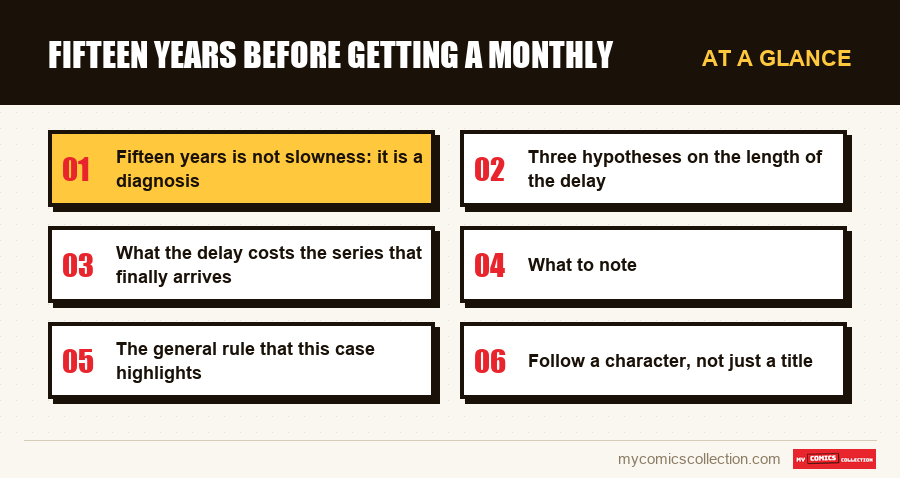
Fifteen years is not slowness: it is a diagnosis
There is a temptation to treat this delay as negligence, as if an editor had simply been slow to notice what he had at hand. It's almost always wrong. A character who returns for fifteen years without obtaining a regular title is not a forgotten character: it is a character that we continue to use, but in a specific format, and that we hesitate to leave this format. Delay measures resistance, not distraction. It indicates that between the character as it functions and the character as it would have to function to carry a monthly, there is a gap that no one has managed or wanted to fill for a very long time.
This reading completely changes the way we approach the 1996 series. It ceases to be a natural outcome (“finally, after all this time”) to become an attempt to resolve a structural problem that had already resisted fifteen years of implicit attempts. All the hypotheses that follow are formulated as hypotheses: it is not a question of reconstructing editorial meetings of which no one has the minutes, but of identifying the logical tensions which make this deadline intelligible.
Three hypotheses on the length of the delay
A figure designed to gravitate
Some characters are written from the outset as satellites: their interest arises from what they do to someone else, from the disruption they introduce into a series that existed before them. Remove the center around which they rotate and you have to invent an entire orbit for them, which amounts to rewriting them. Such a character is extraordinarily effective as a guest and structurally fragile as a headliner. The delay can be read as the time it took to agree to pay this rewriting cost.
Silence does not fill twelve numbers
Elektra's most recognizable characteristic is withdrawal: she speaks little, she explains even less, her interiority is suggested rather than stated. This is a formidable asset on a few pages and a considerable problem on an annual volume. A monthly magazine needs renewable narrative material: dialogues, relationships that evolve, conflicts that are verbalized. A character whose dominant trait is not to tell his story obliges the author to find, every month, a substitute for what others obtain for free through conversation.
A publisher sells what he can sell each month
A monthly is not an artistic reward, it is a recurring commercial commitment. It assumes a readership that returns without needing to be convinced again with each publication. Figures with a strong identity but low talkativeness occupy an uncomfortable position: they are excellent for attracting attention occasionally, less obvious for establishing a habit. The hypothesis is simple: for fifteen years, the calculation has leaned towards the appearance, which capitalizes on the effect, rather than towards the regular title, which requires constancy.
The short format maintains the problem
These three reasons reinforce each other. The more the character is used in short format, the more it is written according to the codes of the short format; the more it is written like this, the less it accumulates the material that a monthly would require. The deadline is therefore not a simple wait: it is a loop which closes on itself and which makes each additional year a little more difficult to overcome than the previous one.
None of these hypotheses is exclusive of the others, and none claims the status of unique cause. Taken together, however, they create a coherence: these are not three independent obstacles, they are the same obstacle seen from three angles. The character is effective precisely because of what makes it difficult to stretch. Its strength and its inability to be monthly have the same origin, which explains why no simple decision could resolve the problem for fifteen years.
An important nuance: a long delay is not proof of disinterest. Elektra remained present throughout the period, at irregular intervals, in varied formats. The question posed here is not “why did it disappear”, it did not disappear, but “why was the presence not converted into regularity”. These are two very different questions, and confusing the two leads to false conclusions.
Corollary for the reader who reconstructs a journey: over these fifteen years, the chronology does not read like a series of steps towards an objective. It reads like a succession of occasional uses, none of which was designed to prepare for the next one.
What the delay costs the series that finally arrives
Two incompatible audiences in the same issue
A series launched fifteen years after the creation of the character must simultaneously present him to readers who discover him and avoid repeating fifteen years of appearances to those who have read them. These two requirements contradict each other page by page: each paragraph of exposition is a service rendered to some and a repetition for others. Series launched shortly after a creation do not have this problem, because their audience is homogeneous.
Fifteen years of conflicting expectations
A character used for a long time without a proper title accumulates divergent readings. Each appearance sets up a slightly different version, and each reader remembers the one that left its mark. When the series arrives, it inherits all of these versions at once and must choose one, which mechanically disappoints those who were expecting the others. The delay not only made the readership wait: it fragmented them.
An unwinnable comparison
The 1996 title is not judged against other series of its era, which would be a fair comparison. It is judged against the few notable stories that preceded it: that is to say, against a selection, against the best that fifteen years have retained. No regular publication can support this comparison, because a monthly necessarily produces connecting numbers, functional episodes, breaths that collective memory never grants to short sets.
The obligation to justify its existence
A series that arrives after such a long wait cannot just be good: it must prove that it was necessary. This pressure brings considerations into the title that have nothing to do with the story: the demonstration that the character stands alone, that he deserved this format, that the bet was justified. It’s a burden that series launched on time don’t have to carry.
An overdetermined first number
The opening number of such a series must fulfill too many functions at once: mark the event, set the tone, reintroduce, distinguish. In the announcements observed, this issue is also presented by its status, “first solo series”, that is to say by its position in a chronology, rather than by its content. The delay ends up becoming the main argument, which says a lot about the weight it has taken on.
Rhythm versus character
The writing problem identified above does not disappear because a monthly has been granted: it becomes a weekly production constraint disguised as monthly. The character who functioned through withdrawal must now maintain a pace, and the solutions to achieve this (more dialogue, more context, more secondary elements) bring him closer to a norm from which his singularity took him away. The delay made the series possible; it didn't make the character any easier to write.
Collecting this series?
Track what you own, what you are missing and what your collection is worth. 7 day trial.
Start my trial →What to note
The deadline is the main information, not a calendar anecdote. Between 1981 and 1996, the character existed without ever having a regular title to his name. This duration exceeds the life of most monthly series, and it can be explained neither by forgetting nor by lack of notoriety. It measures a basic resistance between what the character knows how to do and what a monthly meeting requires. Any reading of his editorial career that neglects this point misses the most structuring fact.
The three hypotheses put forward here are not competing, they are interdependent. A satellite design, writing based on withdrawal, and an editorial logic which only grants a monthly publication to what it knows how to sell each month: these are three formulations of the same obstacle. What makes the character immediately effective as a short appearance is exactly what makes him expensive to stretch over twelve issues per year. No simple decision could resolve this, which explains the length of the wait.
The late series inherits impossible specifications. It must present the character to those who discover him without repeating fifteen years of appearances to those who know them; it must decide between divergent versions accumulated for lack of a reference title; and it is evaluated not against the series of its time, but against the selection of the best that these fifteen years have retained. No regular publication survives this last comparison, because a monthly necessarily produces link numbers that no collective memory preserves.
The reading of August 29, 2026 is an illustration, never a measurement. Of the 1996 series, eleven unauthenticated proposals were visible that day, with requested amounts ranging from $2.99 to $29.00 and a median value of $9.99; no proposal passed through an authentication process appeared. Three titles presented the first issue as "first solo series", at $2.99, $5.00 and $5.95. These are amounts claimed by sellers, not recorded transactions: an asking price is only an intention.
Eleven proposals do not allow any meaningful calculation, and the reservation is severe. A workforce of this size deforms if two announcements disappear and deforms further if only one is added; the median cited above therefore describes nothing other than this reading. What is documented here is the narrowness of the offer visible at a given moment, how many proposals existed, never the level at which they were located. The only really meaningful element is not numerical: the first issue is described by its rank in a chronology rather than by its content, which is consistent, on the announcement side, with the preceding editorial analysis.
No source allows us to state a certain cause, and this article does not claim to provide one. Three coherent hypotheses emerge: a character designed to gravitate around another is poorly suited to the leading role; a character defined by withdrawal and silence is difficult to write over twelve issues a year; and a publisher only grants a regular title to what he thinks he can sell each month. All three point to the same observation: what makes the character strong is exactly what makes him difficult to stretch.
No, and this is the most common confusion. Delay does not measure notoriety, it measures suitability for a format. A character can be immediately recognizable, regularly used, and yet unsuitable for the cadence of a monthly magazine. Presence and regularity are two distinct properties, and one does not entail the other.
It requires reading it for what it is rather than for what it was supposed to be. A series launched after such a long wait inherits impossible specifications: present and not repeat, satisfy divergent expectations, and bear comparison with a selection of the best previous moments. Judging it by this yardstick amounts to condemning it in advance.
Only one thing: the offer visible that day was very narrow. Eleven proposals do not allow any meaningful calculation, and the median of $9.99 mentioned above has only descriptive value of the statement itself. These are amounts requested, not sales, and no conclusion on a level or development can be drawn from them.
By giving up reading it as a progression. Fifteen years of appearances without a regular title produce independent blocks, written for different contexts and without intention of continuity. Treating them as successive stages creates expectations of coherence that the material was never intended to satisfy.
The general rule that this case highlights
We must dare to formulate it frankly, because it goes well beyond this character: a character who takes fifteen years to obtain a monthly magazine almost always has his best material behind him. This is not a judgment on the quality of the late series, it is a mechanical consequence of the way in which these trajectories are constructed. During the years without a regular title, the character is only used when he contributes something decisive: because there is no obligation to summon him otherwise. Each appearance is therefore, by construction, a chosen appearance. This is the most favorable regime available: maximum effect, no obligation to refill.
Monthly exactly reverses this regime. It imposes presence regardless of necessity. It is necessary to publish even when nothing decisive is required, and this constraint inevitably produces issues whose only justification is publication. The character goes from selective use to obligatory use, and the average drops: not through failure of the authors, but because the selection has disappeared. What preceded the monthly was an unintentional anthology; what the monthly produces is a complete series, with everything that a complete series necessarily contains that is necessarily average.
From this follows a useful reversal. The regular title obtained after a long wait should not be seen as the pinnacle of a career, but as the moment when the character ceases to be protected by the rarity of his appearances. It's often at this precise moment that long-time readers begin to feel that "it's not like it used to be", and they are right, without this implying any decline in the quality of the writing. It's no longer like before because the instructions have changed.
For anyone organizing a collection, this grid has a concrete use. It separates two groups which do not follow the same logic: on the one hand fifteen years of selected, scattered interventions, difficult to find because they do not have a common title; on the other a series identified by a name and numbering, easy to locate and complete. The second set is that which we find by searching; the first is that which is found by knowing where to look. Confusing the two leads to believing that we have the journey of a character when we only have the latest and most tabulated part.
There remains a methodological consequence, and it applies to all characters whose editorial history presents a long gap before the first proper title. Documenting such a journey requires tracking down scattered appearances in publications that do not bear the character's name, which no search by title allows. This is precisely where tracking becomes a work of arranging rather than reading, and where the gap widens between a collection that follows a name and a collection that follows a trajectory.
Follow a character, not just a title
Fifteen years of scattered appearances before a first monthly: this is exactly the kind of journey that a list of titles does not reproduce. My Comics Collection allows you to keep an inventory of what you actually own, issue by issue, series by series, and see at a glance what is missing from a set that you thought was complete.