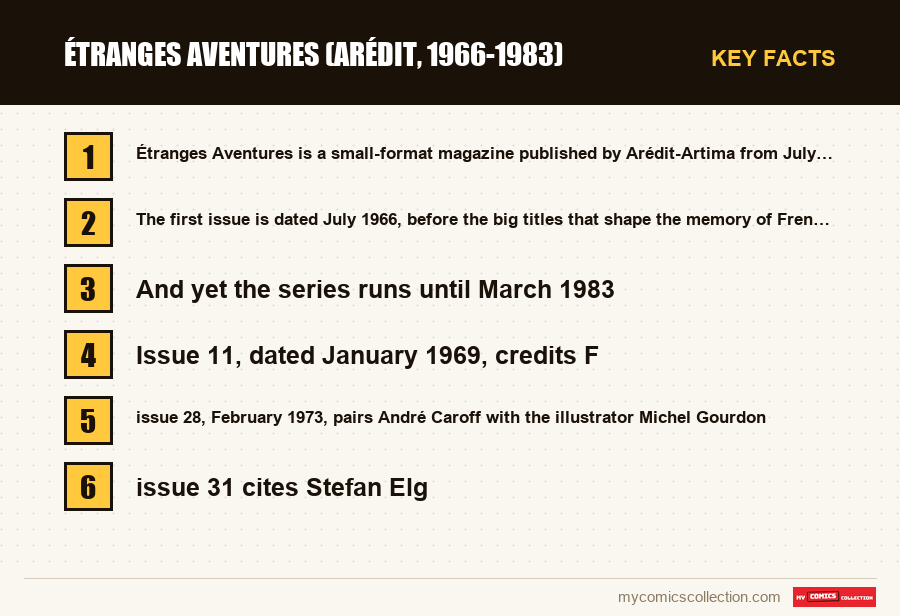
Étranges Aventures is a small-format magazine published by Arédit-Artima from July 1966 to March 1983, that is 78 issues spread over almost seventeen years, mostly on a quarterly schedule. The magazine mixes stories of American origin, British series and adaptations drawn from French popular fiction. Its longevity and its age make it a collection that is hard to complete, where identifying the later issues poses as many problems as the condition of the early ones.
If you have inherited a stack of small formats and find an Étranges Aventures cover among them, you are holding an object older than nearly all the superhero magazines circulating at flea markets. The first issue is dated July 1966, before the big titles that shape the memory of French collectors. And yet the series runs until March 1983. This double trait, old and long, governs everything that follows.
As always on this guide, only verified information (creators, issue numbers, dates) is stated as fact; the analysis is our own, with no reproduction of any panel or protected dialogue.
A magazine with three sources, not a superhero magazine
The first mistake is to file Étranges Aventures among the costumed-hero magazines. The catalogue of issues tells a different story. In the early years, the names that recur on writing are Dave Wood, Bob Haney, Ed Herron and Gardner Fox, and on art Bernard Baily, Mort Meskin, Bob Brown, Gil Kane, Ramona Fradon or Carmine Infantino. This is a stock of adventure and science-fiction stories of American origin. The French titles confirm it: "Le retour du mort" opens issue 1, and what follows lines up "Les Criminels du passé" or "Les gangsters de l'espace".
A second source appears very quickly: British comics. Peter O'Donnell on writing, John Allard and Steve Dowling on art, but also Ted Cowan with Reg Bunn, or Frank S. Pepper, Brian Lewis, Eric Bradbury. Their presence is steady from issue 7 until the mid-1970s. The information is practical: if you look for a well-known American signature and come across pages in a very different line style, you do not have a fake, you have the British part of the contents.
The third source gives the magazine its local character. Issue 11, dated January 1969, credits F. Richard-Bessière on writing; issue 28, February 1973, pairs André Caroff with the illustrator Michel Gourdon; issue 31 cites Stefan Elg. And two titles clearly step outside the comics register: "OSS. 117" in issue 33 and "Coplan" in issue 44. Arédit-Artima tied its magazine to the French popular novel it also published, which explains why a single book can contain universes with nothing to do with one another.
A quarterly rhythm, and the moment it falls out of step
The dates first sketch a regular mechanism: July 1966, October 1966, then releases in January, April, July and October year after year. Four issues a year, which is why it took seventeen years to reach issue 78. For someone completing the series, this slowness is good news: there are not hundreds of issues to hunt down. It is also bad news, because each issue was printed only once, and the survivors are scattered.
Then the rhythm breaks. In 1974, five issues follow one another at one-month intervals: June, July, August, September, November for issues 34 to 38. A quarterly that comes out five times in six months is a magazine whose publisher is reorganizing its range. In a lot bought in bulk, that 1974 cluster often arrives grouped, for the simple reason that it was bought grouped at the time. Conversely, three quarters separate issue 53 from issue 54, between 1976 and 1977: a seller who advertises a "complete and continuous" run for those years describes a series that was not continuous itself.
Why the later dates are less precise
From issue 39 onward, dating stops giving a month and settles for a quarter, and this continues up to issue 57. It is not a cataloguing oversight: it is most likely what the issues themselves carried, small formats having often dropped the monthly date in favor of a quarterly notice.
The consequence is direct for anyone sorting a stack. Issues 39, 40 and 41 share the same first-quarter 1975 notice; issues 63 and 64 share the fourth quarter of 1979. In these cases, the date no longer orders anything: only the issue number does. Finally, three issues are documented by a bare year alone: number 3 in 1967, number 15 in 1970 and number 19 in 1971. If you hold one of those three, there is no point hunting for a finer date: a seller who offers one has deduced it, not read it.
When the indexed title is not a story
Here is the most counterintuitive point about this series. For about twenty issues, the first title recorded in the contents is not a story but an in-house advertising page. "Arédit pense à vous !" recurs in issues 34 to 38, then in 41; "Artima pense à vous !" in 42; "Artima présente la gamme..." occupies a long run, from 47 to 55 and then 57. Issues 21, 22 and 25 carry "Les publications ci dessous...", and issue 75 a presentation notice for the renewed Comics Pocket line. Issue 14 is even indexed as "4ème de couverture" (back cover).
These pages are part of the issue, and as such they are indexed like the others, but they tell you nothing about the narrative content. Two rules follow. Never conclude from a listing written from a title of this kind that you know what the issue contains. And treat these pages as valuable publishing information: the switch from the "Arédit" signature to the "Artima" one around issues 41 and 42 is an internal dating marker, readable on the copy itself.
Recognizing an edition and placing the issue
Arédit and Artima designate the same house at different moments in its history, and the line to which the magazine belongs is named in its own pages under the label Comics Pocket. This is your first foothold when the cover is rubbed so badly that the date has vanished: the collection label, the publisher's signature and the issue number almost always suffice to place a copy without a legible date.
The second foothold is the content itself, which changes hands over the years. From issue 21, dated July 1971, the contents list Stan Lee, Larry Lieber and Jack Kirby, then Steve Ditko in issues 23 to 25; the following decade brings in Steve Englehart, Jim Starlin, Herb Trimpe or George Pérez. Around the turn of the 1980s the signatures shift once more: Jack C. Harris, Bob Rozakis, Sheldon Mayer, Jim Aparo, Luis Dominguez, Leo Durañona. A contents list therefore tells you roughly which stretch of the series you are in, even without a cover.
The third foothold, and it must be said plainly: the catalogue keeps only one story title per issue, whereas a small format contained several. The full contents must still be checked on the copy, page by page. That is why no serious guide can assert that a particular Étranges Aventures contains the first French appearance of a given character, or that it reprints a particular American issue.
The issues that matter, and why
In a series this long, not everything carries the same weight. Issue 1, from July 1966, matters by position: it is the starting point, and also the oldest issue of the whole run, and therefore statistically the most worn. Issue 78, dated March 1983, matters by symmetry: "Bêtes de Somme" closes the series, and the last issues of a small format were often printed in smaller numbers than the first.
Next come the issues whose title signals a multi-part story. Issues 63, 64 and 65 all carry the same title, "Hulk contre l'exosquelette", right after an issue 62 titled "L'incroyable Hulk". Buying 64 without 63 or 65 means buying a third of a story. Issue 61 also presents itself as a second part. These issues sell better together, and an attentive seller knows it.
Finally, a few titles draw attention for what they suggest without proving it: "Le Chevalier de la Nuit" in issue 26, "Captain Comète et Superman" in issue 70. A French title in a small format was often an invention of the editorial team, not a translation: it points to a lead, not an identification.
Do you collect this series?
Track what you own, what you are missing and what your collection is worth. 7-day trial.
Start my trial →
The condition of the copies, from 1966 to 1983
What sets this series apart is the internal gap in age: nearly seventeen years separate the first issue from the last. A 1966 copy and a 1982 copy have not lived the same length of time, and it shows. Look first at the state of the spine, then at ink offset from the cover onto the first page, two defects that worsen with storage time rather than with handling.
The second effect of this gap is economic. For the same visible defect, an issue from 1966 to 1969 remains more defensible than one from 1981, simply because the supply of fresh copies of the early ones is nearly nil. Reason by date band rather than across the whole series, or you will overpay for the late issues and let the early ones slip by.
Buying traps
The most common trap is the lot described as "complete" on the strength of a continuous numbering. With 78 issues and such irregular date notices, it is the absence of duplicates and the consistency of the quarters that need checking. Ask for a photo of the spines lined up rather than a copied list.
The second trap concerns the advertising titles mentioned above. A listing that uses "Artima présente la gamme..." as the content title was not written by someone who opened the issue. It mainly tells you that the seller will not describe the defects he has not looked at.
The third trap concerns credits. Contents pages associate, within a single issue, authors who never worked together, for example Stan Lee and Peter O'Donnell in issue 33. That is normal: several stories of different origins shared the issue. A listing that presents a single name as the author of the issue is wrong, and you will pay for that confusion if you do not catch it.
Completing the series and tracking the collection
Completing 78 issues spread over seventeen years calls for a different method from the one used for a monthly. Older lots circulate in blocks, often assembled at the time of the original purchase: the 1974 cluster on one side, the 1975 and 1976 quarters on the other. Target these blocks, and keep isolated purchases for the gaps you cannot fill any other way, in particular 1, 3, 15 and 19, whose incomplete dating discourages sellers from putting them forward.
For tracking, keep a list of only three columns: the issue number, the date as printed on the copy, and the condition observed. The second column matters as much as the others in this series, since some issues show only a quarter or a year. It is the only way to know, three years later, whether the number 15 being offered to you is really the one you are missing.
Value today
We give no dollar figure, because it would be wrong within a month and would differ from one country to another. Three ratios, however, hold up. Issue 1 trades at a multiple of the common issues, and the gap widens with condition. Issues in a continuity, such as the run 62 to 65, are worth noticeably more together than the sum of their individual values. Finally, a lot of several dozen issues sells per issue for less than a single issue does, which makes it the best entry point if you are starting out.
To estimate a copy, compare it with concluded sales of the same issue described in comparable condition, not with listings still on offer. For an old quarterly, concluded sales are few: it sometimes takes looking back a long way to find an honest point of comparison.
What to remember
Étranges Aventures is a 78-issue small format that ran from July 1966 to March 1983, mixing three traditions: American, British and French. Its interest lies less in one key issue than in the real difficulty of rebuilding the whole run.
Three habits are enough. Read the date as it is printed, and accept that it is sometimes reduced to a year. Be wary of titles that are in fact publisher's advertisements. Check the contents on the copy itself. To go further, the hubs devoted to Hulk and Superman place in their original chronology the characters whose later titles in the magazine bear their names.
Frequently asked questions
The series has 78 issues. The first is dated July 1966 and the last, titled "Bêtes de Somme", March 1983. The rhythm is mostly quarterly, which explains a lifespan of nearly seventeen years for a modest number of issues compared with the monthly magazines of the same period.
Three issues, number 3, 15 and 19, are documented by a year alone: 1967, 1970 and 1971 respectively. From issue 39 onward, dating becomes quarterly instead of monthly. This imprecision comes from what the issues themselves carried: it cannot be filled in, and a finer date announced by a seller is a deduction.
That the first indexed item in the issue is a publisher's advertising page, not a story. This occurs in about twenty issues, with variants signed Arédit or Artima. The information is useful for dating an edition, but it says nothing about the narrative content, which must be read on the copy.
That is preferable. Issues 63, 64 and 65 carry the same title, "Hulk contre l'exosquelette", following an issue 62 titled "L'incroyable Hulk". It is a continuity split across several issues, running from the fourth quarter of 1979 to the first quarter of 1980. Bought separately, these issues leave the story incomplete.
Nothing allows that to be asserted. The magazine assembled stories of different origins within the same issue, American, British and sometimes French, and the catalogue keeps only one title per issue. Any claimed equivalence between a French issue and an American one must therefore be checked page by page on the copy.