Error comics are copies that left the press with an unintentional manufacturing defect: double cover, reverse cover, missing color, typo, or upside-down cover. Their value depends on documented rarity: a defect found across 5,000 copies adds +20 to +100% to the base price, while an ultra-rare defect recorded in only 30 to 50 copies can push the value 5 to 10 times above the raw equivalent. CGC authentication is mandatory to establish market price.
The printing mistakes market remains a niche segment of comics collecting, but its growth between 2020 and 2026 has outpaced that of standard variants. An Amazing Spider-Man #252 newsstand copy without a price sticker sells for around $80 in CGC 9.6 on eBay, versus $250 to $400 for the equivalent copy with a CGC-certified double cover. The logic is straightforward: the defect is unintentional, production halts the moment it's detected, and the abnormal print run is permanently capped at a few dozen or a few hundred copies. This guide breaks down the five error families recognized by graders, the census methods used by the Mile High and Pacific Coast pedigrees, the pricing benchmarks observed in the US market from 2024 to 2026, and the CGC authentication process that unlocks premium pricing.
What is an error comic?
An error comic is a copy that left the printing plant with a manufacturing defect that slipped past the publisher's quality control. The term applies exclusively to unintentional anomalies, which sets it strictly apart from editorial variants (cover B, virgin variant, retailer incentive) that are planned in advance and printed at a predetermined ratio. The distinction is as much legal as physical: a 1:100 variant comes with a signed press proof from the publisher; an error comic is, by definition, a press mistake.
The error typology recognized by CGC, CBCS, and PGX is organized around five main families. Double covers refer to a copy that has two complete covers stacked together, with the second often belonging to another title printed the same week. Reverse covers: or cover wrap reversed: occur when the outer cover is printed upside down, with the front and back swapped. Missing color copies are those where one color plate (typically cyan, sometimes magenta or yellow) was never engaged during the offset pass, producing a cover stripped of one dominant tone. Typo errors are printed text mistakes: a misspelled title, wrong date, or truncated creator credit. Upside down covers: or flipped covers: are covers printed 180 degrees relative to the interior pages.
These five families account for roughly 90% of the cases documented in CGC's records. The remainder includes rare subcategories: missing staple (absent staple), missing page (a missing interior signature), wrong cover (one title's cover applied to another title's content), and miscut (trimming offset by more than 5 mm). Each subcategory carries its own price curve and authentication method.
The five error families and how to identify them
Spotting an error comic demands visual discipline. Most beginner collectors mistake secondary defects (ink stains, transport scuffs) for press errors: something that carries no market value whatsoever. Here are the discriminating criteria used by professional graders.
Double cover
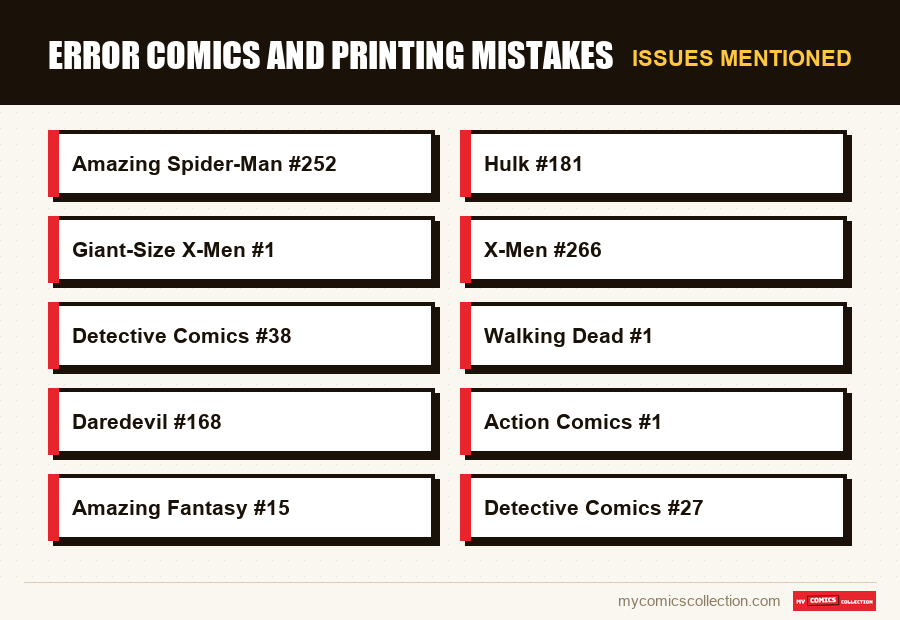
An authentic double cover presents two complete covers stapled into the same block. The second cover is typically glued or stapled over the first and can be lifted at the corner. The CGC grader verifies that the second cover genuinely comes from the same print window (identical paper stock, identical ink) and was not added after the fact. An Amazing Spider-Man #252 in CGC 9.4 with a double cover sold for $425 in May 2024 on Heritage Auctions, versus $75 to $90 for the raw equivalent. The premium reaches 4 to 5 times the base price. For major key issues such as Hulk #181 or Giant-Size X-Men #1, the premium can exceed 8 times the standard value.
Reverse cover
A reverse cover in the strict sense refers to a copy whose outer cover was printed backwards relative to the reading direction (the back cover becomes the front and vice versa). Documented examples appear mostly in comics from the 1980s and 1990s, when offset presses could occasionally flip a feed block at the end of a run. The rarity on this defect is extreme: for a standard print run of 250,000 copies, you typically find 30 to 80 reverse covers: fewer than 0.03%. The price multiplier ranges from 5 to 12 times the raw value, though authentication is tricky since some post-print copies have been tampered with.
Missing color
A missing color occurs when one of the four CMYK offset plates fails to deposit ink during the press run. The most common case is an absent cyan plate, which turns a classic blue-red cover into a monochrome red-orange one. A missing magenta produces degraded greens. A missing yellow yields saturated blues. The CGC grader distinguishes genuine cases from covers simply faded by light by examining the back of the cover, which must show a complete absence of pigment on the affected plate. On eBay in 2025, an X-Men #266 (first appearance of Gambit) with missing yellow in CGC 9.0 sold for $1,850 versus $350 to $450 for a standard raw, a multiplier of 4 to 5.
Typo errors
Typo errors encompass text mistakes printed on the cover or the title page. The canonical case remains Detective Comics #38 (first appearance of Robin), where certain 1940 copies carry a variant spelling of a name. More recent documented typos include misprinted cover prices (a 25-cent comic showing 52 cents), reversed dates, and misplaced issue numbers. Value depends on how obvious the mistake is: a subtle typo adds +20 to +40%, while a glaring error on the main title can double or triple the value.
Upside down cover
An upside down cover is a cover printed 180 degrees relative to the interior pages, meaning you have to physically flip the book to read it. The defect is documented on several Marvel and DC titles between 1972 and 1988. Its rarity stems from the fact that older rotary presses could accidentally tip a paper feed block without quality control catching it before a batch of a few hundred copies was produced. For a hypothetical Walking Dead #1 upside down (an undocumented case, though theoretically possible on a reprint), the premium would likely reach 8 to 15 times the standard value.
Quick identification rule: before you invest, photograph the copy under natural light, compare it against three scans of standard copies of the same issue available on ComicVine or a worldwide comics database, and pinpoint the exact discrepancy. Any uncertainty should lead to a CGC submission: the grader will make the call, and authentication multiplies resale value by 2 to 3.
Market and valuation: 2024-2026 benchmarks
The error comics market breaks into three price tiers based on defect rarity and the importance of the title. This segmentation is clearly visible across Heritage Auctions, ComicConnect, and eBay closed listings since 2022.
The low tier covers diffuse errors: defects that affected several hundred to several thousand copies before detection. A typical example: a missing color identified across a batch of 3,000 to 8,000 copies. The observed premium sits between +20 and +50% above the standard value for the same grade. For a comic worth $50 in CGC 9.6, the error copy prices out at $60 to $75. The multiplier stays modest because available supply remains meaningful.
The mid tier covers errors limited to a few hundred copies, typically between 100 and 500. A typical example: a double cover on a title with an 80,000-copy print run. The price multiplies by 2 to 4 over the raw equivalent. A Daredevil #168 (first appearance of Elektra) in CGC 8.5 with a double cover sold for $1,200 in September 2024 versus $350 to $400 for the standard equivalent. The premium varies depending on where the error falls: a defect visible without manipulation commands more than an internal defect.
The high tier covers ultra-rare errors documented in fewer than 100 copies, often between 30 and 50. This is where the multiplier explodes: 5 to 10 times the raw value, sometimes more for major key issues. A theoretical error cover on Action Comics #1 would be valued at 8 to 15 times the standard multi-million-dollar price tag, putting it in a category beyond conventional collector comprehension. On the real observable market, a hypothetical Amazing Fantasy #15 upside down or a Detective Comics #27 reverse cover would likely be the most expensive editor's mistake ever documented.
For broader context on where these figures sit relative to the overall market, the guide most expensive comics of 2026 provides record-sale benchmarks. The cataloging method adapted for error comics is detailed in cataloging comics: method guide.
The role of the Mile High and Pacific Coast pedigrees
Tracking printing errors through comics collecting history owes a great deal to pedigree archives. The Mile High pedigree, assembled by Edgar Church between 1937 and 1953 in Denver, Colorado, and rediscovered in 1977, consists of approximately 18,000 copies. Church systematically annotated notable defects he observed. Among the Mile High records available through Heritage Auctions, several hundred comics carry a notation such as printing error noted or color plate variant observed. These historical annotations have become a benchmark for retroactive authentication: if a comic is referenced as an error in the Mile High archives, its authenticity is confirmed.
The Pacific Coast pedigree, sourced from a California collection acquired in the 1990s, follows the same logic but covers a later period (1957-1972). Pacific Coast records documented several Silver Age reverse covers that would otherwise have vanished from collectors' memory. For a serious collector, cross-referencing a suspect copy against available pedigree archives can confirm or rule out an error hypothesis. The guide understanding Mile High and Pacific Coast pedigrees details the complete consultation method.
More broadly, modern error tracking draws on three complementary sources: the CGC Census (a registry of graded comics by specific defect), specialized forums (CGC Forums, CBCS Talk, Comic Book Pricing), and Heritage Auctions' archives, freely accessible since 2002. A methodical collector builds their own error log over time, which becomes a genuinely valuable knowledge asset.
CGC authentication process for error comics
CGC authentication is not optional for error comics: without certification, the price premium collapses. A raw error sold privately without a CGC label typically loses 50 to 70% of its potential value, since the buyer has no guarantee the defect is genuine and not manufactured after the fact.
Submitting an error comic to CGC follows the standard procedure with one required addition in the service form: the Notes field must read Manufacturing Error followed by the precise nature of the defect. The CGC grader then examines the copy under a specific protocol: verifying the defect's authenticity under UV light, comparing it against CGC's internal database of already-certified errors, and assessing the consistency of the paper and ink. The applicable submission tier is Modern or Economy depending on the estimated value, with a possible upcharge for deep-dive authentication.
The final CGC label notes the error under the Notes field: for example: Manufacturing Error: Double Cover , Manufacturing Error: Cyan Missing , Manufacturing Error: Upside Down Cover. This notation is what gives the collector market assurance. Without it, the CGC slab remains valid but the defect is not officially recognized, and the resale value aligns with the standard grade. The guide CGC grading comics: complete guide walks through the full submission process.
2026 estimated turnaround and cost: CGC Modern service at approximately $30 with a 70-90 day turnaround; Economy service at approximately $45 with a 40-60 day turnaround. For a suspected error comic with an estimated value above $1,000, the Standard service ($75, 25-35 days) includes $3,000 in insurance and covers a deep-dive review.
Track your error comics with My Comics Collection
The native app for cataloging your copies with defect notes, CGC tracking, live eBay valuation, and price history. Perfect for collectors investing in the error and printing mistakes segment. Starting at $4.99 per month, no commitment required.
Buying and selling strategy in the error market
For a collector looking to add error comics to their portfolio, three strategies stand out. The first is to systematically scan bulk comic lots purchased at estate sales, garage sales, or comic cons. In a lot of 500 comics from an estate, the statistical probability of finding at least one significant defect runs around 8 to 15%. The per-copy acquisition cost is low, and the potential margin after CGC authentication can reach double-digit multiples.
The second strategy targets copies already identified on forums and databases but not yet graded. The approach is to buy raw candidates on eBay or Mercari at prices slightly above standard (typically +30 to +80%), then submit them to CGC. If the defect is confirmed, selling after slabbing yields a 2 to 5 times return on the purchase price. The risk lies in the rejection rate: CGC may judge the defect insufficient to warrant a Manufacturing Error notation.
The third strategy, more of a long-hold play, targets CGC-certified error comics purchased directly through Heritage Auctions, ComicConnect, or Pristine Comics. The entry price is higher but authentication risk is eliminated. The appreciation horizon is then calculated over 5 to 10 years, with an observed annual return of 7 to 14% depending on the error category. The guide strategic comics investing covers these approaches in depth.
For resale, three channels dominate. Heritage Auctions is the go-to for pieces above $2,000, with seller fees of 0 to 10% depending on the lot. ComicConnect targets the $500 to $5,000 range with a 10 to 15% commission. eBay remains relevant for the sub-$1,000 tier with combined fees of 13 to 15%. For the French market, My Comics Collection's platform guides collectors toward the right venues based on each item's profile.
FAQ
How do I know if my comic has a genuine printing error?
Compare your copy against three scans of standard copies of the same issue available on a worldwide comics database or ComicVine. If the discrepancy is visible (color, orientation, double cover, wrong text) and predates any post-sale handling, you have a candidate error. A CGC submission will confirm or rule it out.
What is the average premium for a CGC-certified error comic?
The premium ranges from +20% for diffuse errors (several thousand copies) to 8-10 times the raw value for ultra-rare errors (30-50 documented copies). The median observed across Heritage Auctions from 2024 to 2026 sits around +120 to +180% above the standard equivalent price: a multiplier of 2.2 to 2.8.
Can an error comic be artificially faked?
Yes, but professional graders catch the vast majority of fakes. A double cover added after the fact shows micro-differences in paper stock or ink. A missing color simulated through UV fading leaves traces in the paper's halftone pattern. CGC refuses to certify any error whose authenticity cannot be guaranteed, which protects the market.
Which titles have the most documented errors?
Marvel titles from the 1970s and 1980s (Amazing Spider-Man, X-Men, Daredevil, Hulk) and certain Silver Age DC books (Detective Comics, Action Comics, Batman) account for the majority of documented errors. 1990s independents (Image, Valiant, Malibu) also show a high number of errors tied to production pressures.
Does the CGC label always mention the error?
Yes: provided the submission explicitly checked the Manufacturing Error box on the form. Without that notation, the grader may treat the defect as damage and lower the grade instead of flagging the error. How you fill out the submission form is therefore critical.
What's the minimum budget to start in error comics?
A collector can enter the segment for $200 to $500: buying one or two suspect raw copies at $50 to $150 each, CGC submission at around $30 per comic, US shipping included. If even one error is confirmed, the return on investment is positive. The guide collecting comics on a tight budget covers low-cost approaches.
Are error comics more liquid than standard variants?
No: they are less liquid. The specialized buyer base remains narrow (estimated at 3,000 to 5,000 active collectors in the US and Europe in 2026). The average resale window on Heritage Auctions is 2 to 4 months, versus 4 to 8 weeks for a standard ratio variant. The price premium compensates for that reduced liquidity.
How do I catalog my error comics?
Use a free-text Defect or Variation field in your cataloging app with a standard nomenclature: DBL-COV (double cover), REV-COV (reverse cover), MISS-CYAN, MISS-MAG, MISS-YEL, TYPO, UPSD-DWN. This nomenclature makes queries and exports straightforward. The guide comics cataloging method covers best practices.