
Doctor Doom #1 (2019), written by Christopher Cantwell and drawn by Salvador Larroca, launches a modern solo series where Doctor Doom, wrongly accused, almost becomes an anti-hero in search of redemption. This recent key offers one of the most nuanced explorations of the character. We decipher this run and its interest for collectors.
In 2019, Marvel finally gave Doom an ongoing series centered on him. The result, by Christopher Cantwell, reveals a Latverian monarch more complex and human than ever. Decryption.
As always in this guide, only verified information (creators, numbers, dates) is stated; the analysis is ours, without reproduction of plates or protected dialogue.
A modern solo series for Fatalis
Doctor Doom #1, published in 2019, launches an ongoing series entirely devoted to Doctor Doom, written by Christopher Cantwell and drawn by Salvador Larroca. This series marks an important moment: it offers the character a modern series centered on him, exploring his psychology and his dilemmas with contemporary depth. The plot places Doom in an unusual situation: wrongly accused of a crime he did not commit, the monarch of Latveria finds himself hunted down and forced to clear his name. This starting point, which makes Fatalis almost an anti-hero, allows us to explore the character in a new light, far from his usual role as antagonist.
This series is part of a tradition which, periodically, gives Fatalis the leading role again, confirming its ability to carry its own stories. Christopher Cantwell, recognized screenwriter, provides nuanced writing that explores the character's contradictions: his pride, his dignity, his doubts, his quest for meaning. The series questions the nature of Doom: is he a tyrant, a savior, a man seeking redemption? without providing a simple answer. For the collector and the reader, Doctor Doom #1 marks the beginning of a significant modern run, one of the most successful devoted to the character. This recent key offers an ideal entry point to a contemporary and in-depth exploration of the Latverian monarch.
Fatalis as a tragic anti-hero
Christopher Cantwell's run stands out for its portrayal of Doom as a tragic anti-hero. Wrongly accused, the monarch of Latveria is forced to flee and fight to prove his innocence, a situation which places him in the unusual position of victim of injustice. This configuration allows us to explore the psychology of the character with finesse: his anger in the face of injustice, his dignity despite adversity, his doubts about his own nature. The run reveals a more human Fatalis, confronted with existential questions about his identity and his role. This approach, which humanizes the character without ever absolving him of his tyranny, offers one of the most nuanced portraits of the monarch of Latveria.
This exploration of Fatalis as an anti-hero illustrates the richness of the character and his ability to evolve in various registers. Far from the one-dimensional villain, Cantwell's Fatalis is a complex being, torn between his pride and his doubts, between his tyranny and a possible aspiration to good. This moral ambiguity is at the heart of what makes the character fascinating. The run questions Doom's deep motivations, his conviction to act for a greater good, and the fine line between tyrant and savior. For the reader, this series offers a deep reflection on the character, essential to appreciate his complexity. It confirms that Doom is much more than a simple villain: a tragic figure of rare richness, capable of telling stories of remarkable depth.
A recent key for collectors
For the collector, Doctor Doom #1 (2019) has the interest of being a recent key marking the launch of an acclaimed solo run. As the first issue of a significant modern series devoted to Doom, it is sought after by enthusiasts wishing to complete their collection with important contemporary issues. With recent comics generally remaining accessible, Doctor Doom #1 offers an affordable target, while providing major narrative content. This accessibility makes it a relevant acquisition for a Fatalis collection, complementing the old keys with a modern reference run. Early issues of acclaimed series often increase in value over time, which adds to the interest of this issue.
This modern dimension makes Doctor Doom #1 an ideal addition to a collection spanning the character's entire publishing career. From its first appearance in 1962 to modern runs, Doom has been the subject of varied stories, of which Doctor Doom (2019) is one of the most recent and most successful. For the collector, bringing together these issues allows us to document the evolution of the character through the decades. Doctor Doom #1, as a recent key, offers appreciable accessibility while marking an important milestone. As with any comic, condition determines value, but recent issues offer greater availability. The Fatalis hub brings together our guides to identify these modern keys and build a balanced collection of the Latverian monarch.
The Cantwell run in line with the great stories of Fatalis
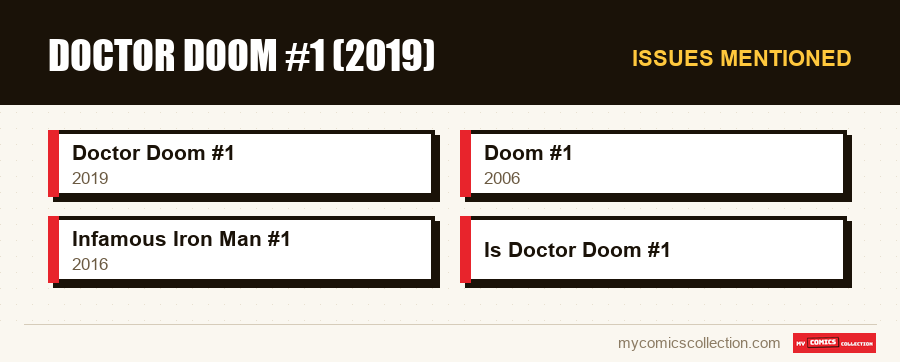
Christopher Cantwell's run is part of a line of great stories that have explored Doctor Doom in depth. Alongside Brubaker's Books of Doom (2006), or Bendis' Infamous Iron Man (2016), Doctor Doom (2019) demonstrates the authors' lasting interest in this complex character. Each of these stories offers a different facet of Doom: its nuanced origin, its quest for redemption, its existential dilemmas. The Cantwell run deepens this exploration, presenting a Doom confronted with injustice and his own contradictions. This series is thus part of a set of modern stories which have enriched the understanding of the character.
This place in the lineage of the great Doom stories makes Doctor Doom (2019) recommended reading for those wishing to explore the character through contemporary perspectives. The run illustrates the way in which modern authors have seized Doom to reveal its psychological richness, going beyond its villainous image. Heading into Avengers: Doomsday, where the character is treated as a central threat, these modern narratives illuminate the depth the film could explore. For the reader, the Cantwell run offers a nuanced and contemporary exploration of the Latverian monarch, essential to appreciating his complexity. The Fatalis hub brings together our guides to discover these great modern stories and understand the character at the dawn of his cinematic consecration.
Collecting this series?
Track what you own, what you are missing and what your collection is worth. 7 day trial.
Start my trial →An exploration of the dilemmas of power
Beyond the intrigue of the unjust accusation, Cantwell's run explores the dilemmas of power and identity that inhabit Doom. Deprived of his throne and his position, the monarch of Latveria is confronted with existential questions: who is he without his power? Is his value due to his status or his person? These questions, finely handled, reveal a vulnerable Fatalis, forced to redefine himself in the face of adversity. The run also questions his conception of power and responsibility, in particular his relationship to Latveria and its people. This psychological and political dimension considerably enriches the portrait of the character, offering a deep reflection on what defines him.
This exploration of the dilemmas of power distinguishes the Cantwell run from more classic stories. By placing Fatalis in a situation of loss and questioning, the series reveals facets of the character that are rarely highlighted: his vulnerability, his doubts, his ability to question himself. These elements humanize Doom without absolving him, offering a complex and nuanced portrait. For the reader, this depth makes the run a stimulating read, one that goes beyond a simple action story to touch on universal questions about identity and power. It confirms the richness of the character and his ability to tell stories of great finesse. The Fatalis hub brings together our guides to explore these dimensions and the stories that deepen them.
Salvador Larroca and the aesthetics of running
The success of Doctor Doom (2019) also owes to its designer, Salvador Larroca, whose detailed and realistic style perfectly serves the tone of the story. Larroca, an artist recognized for his work on numerous Marvel series, brings to the series a careful aesthetic that highlights the dignity and presence of the monarch of Latveria. His rendering of Doom's armor, Latveria and action scenes contributes to the atmosphere of the run, both modern and respectful of the character's iconography. This visual quality reinforces the impact of the story, making Doctor Doom a successful series both narratively and graphically.
This collaboration between a nuanced screenwriter and a talented designer illustrates the care taken in this series. Larroca's graphic quality serves the depth of Cantwell's story, creating a coherent and striking work. For both the collector and the reader, this artistic success adds to the interest of Doctor Doom (2019), which is among the best modern stories dedicated to the character. The polished aesthetic of the run contributes to its status and appeal, both for reading and collecting. This visual dimension, combined with the narrative richness, makes Doctor Doom #1 a particularly recommendable modern key. The Fatalis hub brings together our guides to discover this run and the other great stories of the monarch of Latveria.
Where to read and locate the Cantwell run
To discover Christopher Cantwell's run, the Doctor Doom series (2019) is available in collections, an ideal format for following the plot from start to finish. This run, of relatively short duration, is easy to read and offers a complete exploration of the character in his situation as a wrongly accused anti-hero. For the collector, Doctor Doom #1 is the most sought-after key to the series, marking its launch. The following issues complete the run and allow you to own the story in its entirety. The accessibility of recent comics makes this series an affordable acquisition, whether you prefer collections for reading or issues for collecting.
In a collection dedicated to Doom, the Cantwell run naturally finds its place alongside the other great modern stories of the character. Bringing together Doctor Doom (2019), Books of Doom (2006) and Infamous Iron Man (2016) covers the most accomplished contemporary explorations of the Latverian monarch, each offering a different angle. For the collector, this thematic approach gives coherence to a collection, by documenting the modern richness of the character. The Cantwell run, through its narrative and graphic quality, deserves a special place in this selection. As Avengers: Doomsday approaches, these modern stories provide ideal preparation for understanding the character. The Fatalis hub brings together our guides to identify these reads and build a collection worthy of Marvel's greatest villain.
Frequently asked questions
The first issue of a modern solo series dedicated to Doctor Doom, written by Christopher Cantwell and drawn by Salvador Larroca. The plot places Doom, wrongly accused, in the position of an anti-hero forced to clear his name, exploring the character in a new light.
Because it presents Fatalis as a tragic anti-hero, wrongly accused and confronted with his own contradictions. This nuanced approach, which humanizes the character without absolving him of his tyranny, offers one of the most profound portraits of the monarch of Latveria.
It’s a recent key marking the launch of an acclaimed run. As recent comics remain accessible, it offers an affordable target while providing major content. Early issues of acclaimed series often increase in value over time.
It is part of a line of great modern stories, alongside Books of Doom (2006) and Infamous Iron Man (2016). Each explores a facet of the character; the Cantwell run delves deeper into his existential dilemmas and his confrontation with injustice.
It's recommended reading: by exploring Doom with nuance, the run illustrates the depth of character the film could explore. It is one of the modern stories that shed light on the monarch of Latveria as he approaches his cinematic consecration.
Do you own Doctor Doom #1 (2019) or aim for this key? Estimate its value for free with our tool based on current eBay listings.