Two great comics cultures coexist on opposite sides of the Atlantic, sometimes ignore each other, and attract collectors of very different profiles. On one side, the American comic book: a 32-page monthly, gigantic shared universes, and iconic characters owned by massive publishers.
Two great comics cultures coexist on opposite sides of the Atlantic, sometimes ignore each other, and attract collectors of very different profiles. On one side, the American comic book: a 32-page monthly, gigantic shared universes, and iconic characters owned by massive publishers. On the other, the Franco-Belgian BD (bande dessinée): a 48- or 64-page hardbound album, annual publication, works carried by authors whose names often matter as much as the characters.
For the collector, these two worlds don't play by the same rules. How you acquire, preserve, value, and catalog them differs fundamentally. This article tours the practical differences: no side-taking, but with precision.
Format and cadence: two very different publishing rhythms
The traditional American comic is a roughly 32-page pamphlet (22 pages of story + ads), published monthly. A 100-issue run represents more than 8 years of regular publication. That cadence creates a culture of the ritual, but also significant accumulation: a collector following 10 active series receives about 100 comics per month.
The Franco-Belgian album, by contrast, is a denser object: 48 to 64 pages, annual release (usually in autumn), hardcover or softcover depending on publisher and series. A series like Astérix or Tintin puts out an album only every 2-3 years (or less since their original authors passed). The pace is slow, but every release is an event.
American publishers adapted their format with TPBs (Trade Paperbacks): collections bundling 5-6 issues into a single volume, plus deluxe hardcovers. These formats approach the Franco-Belgian album in handling. Many English-speaking readers discover Franco-Belgian comics through translated albums from Cinebook, Humanoids, or Fantagraphics: more accessible than jumping into a 200-issue run.
In numbers: Amazing Spider-Man has surpassed 900 issues since 1963. The Astérix series has 40 albums since 1961. Two very different ways to build a collection over decades.
Shared universes vs. standalone works
This is one of the most fundamental differences, and often the most disorienting for anyone crossing between the two worlds.
At Marvel and DC, characters belong to the publisher, not their creators. Spider-Man has been drawn and written by dozens of different authors since 1962. Stories interlock in a shared universe where an X-Men event can ripple into Thor. That creates tremendous narrative richness, but also complexity for the collector trying to understand who created what, which is the "real" series, and how runs connect.
In Franco-Belgian BD, the situation is nearly inverted. Tintin belongs to Hergé's estate, Astérix to the Goscinny and Uderzo estates. Characters are tightly tied to their creators, which is why the death of an author is often a major turning point for the series and its collection value. A Franco-Belgian album is generally a standalone work, readable without prior knowledge of the other albums in the series.
The secondary market: two logics of value
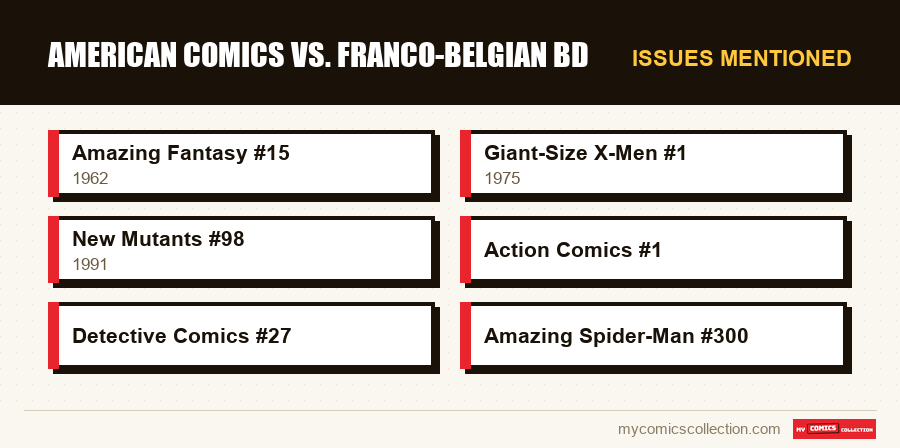
For American comics, collecting value is largely driven by key issues: issues containing a first appearance, a major death, or a rare variant cover. Amazing Fantasy #15 (first Spider-Man, 1962), Giant-Size X-Men #1 (1975), or New Mutants #98 (first Deadpool, 1991) trade for thousands of dollars in good condition. Prices are structured, referenced by guides like the Overstreet Comic Book Price Guide, and heavily influenced by film and TV adaptations.
For Franco-Belgian BD, the most sought-after pieces are first editions of classic titles, especially those predating the series' global fame. A black-and-white Tintin from the 1930s, a Dupuis first edition of Lucky Luke from the 1940s-50s, or an early Spirou: that's what sends auction prices soaring. Condition and edition authenticity matter as much as they do for comics, but the reference framework is less standardized.
| American comics | Franco-Belgian BD | |
|---|---|---|
| Primary value driver | Key issues, first appearances, rare variants | First editions, age, author |
| Reference tools | Overstreet Guide, CGC Census, eBay sold listings | BDGest, Sotheby's sales, Label Expert BD |
| Certification | CGC, CBCS (encapsulated grading) | No CGC-equivalent standard |
| High end of market | Millions of dollars (Action Comics #1, Detective Comics #27) | Hundreds of thousands (signed original Tintin) |
Preservation: bags/boards vs. album sleeves
Preservation practices differ between the two worlds, though the enemies are identical: humidity, UV, heat, paper acidity, and repeated handling.
For American comics, the standard is well-established: each issue goes in a bag (polyethylene or Mylar sleeve) with a board (acid-free cardboard) for rigidity. Comics are then stored vertically in longboxes (specialized cardboard boxes) or shortboxes. This system stores hundreds of issues efficiently in minimal space.
For Franco-Belgian albums, plastic sleeves do exist (brands like Kangourou or Cristal), but usage is less systematic. Many collectors keep albums upright on shelves, shielded from direct light. Hardbound albums are naturally sturdier than stapled pamphlets. For high-value pieces, custom sleeves or plexiglass display cases are used.
Shared enemies to fight
- Humidity > 50%: encourages mold and warping
- Direct UV: yellows paper and fades colors within years
- Heat > 77°F (25°C): accelerates chemical paper aging
- Paper acidity: old newsprint comics slowly self-destruct
- Careless handling: crushed corners, creases, fingerprints
Collecting this series?
Track what you own, what you are missing and what your collection is worth. 7 day trial.
Start my trial →Cataloging your collection: the right tools for each world
The two worlds don't have the same resources available, which is where My Comics Collection enters the picture for American comics fans.
For American comics, My Comics Collection is powered by its built-in worldwide catalog of about 2.6 million issues. Automatic series import, issue-by-issue tracking, missing-issue detection, and daily-updated valuation make it the ideal tool for an American collection.
For Franco-Belgian BD , BDGest is the French-language reference: a very deep album catalog with detailed entries, prices, and an active community. The two tools aren't substitutes: they map to two distinct editorial worlds.
Hybrid readers: managing a mixed collection
Plenty of bilingual collectors grew up with Tintin and Spirou before discovering Spider-Man and the X-Men as teens. Mixed collections are common, and demand slightly more rigorous organization.
The key is to physically separate the two worlds: distinct shelves for BD albums, longboxes for comics. And to use the right tool for each world rather than forcing a single solution that does both poorly. My Comics Collection for American comics, BDGest for Franco-Belgian BD: each in its domain of excellence.
Original vs. translated: the language question for collectors
American comics are published in France by Panini Comics (Marvel in French) and Urban Comics (DC in French). These French editions are fine for reading, but have almost no collecting value compared to the English originals.
An Amazing Spider-Man #300 in English (1988, first full Venom) can run several hundred dollars. The French-language Panini equivalent trades for a few euros used. The rule is simple and universal in the comics world: the original language edition is always more collectible than the translation.
This rule works in reverse for exported Franco-Belgian BD: a French or Belgian first edition of Tintin is worth far more than the English translation published by Methuen or Little, Brown.
The bilingual collector's rule of thumb: For American comics, buy in English for collecting, in translation for pleasure reading. For Franco-Belgian BD, the original-language first edition remains the absolute reference.
FAQ: Comics vs. Franco-Belgian BD
My Comics Collection: specialized for American comics
Automatic import from the built-in worldwide catalog, issue-by-issue tracking, daily-updated valuation. The right tool for American comics collectors.
🚀 Free 7-day trial, no commitment