
One thousand dollars is the sweet spot for building a real comic book investment portfolio. Split it 40/30/20/10 across blue-chip keys, growth picks, speculation bets, and one CGC grading. Below: a concrete sample portfolio, management tips, and the mistakes that burn most first-time comic investors.
One thousand dollars is not a fortune, but in the comic book market it is the threshold where you stop buying comics and start building a portfolio. At $100 you are testing the waters. At $500 you can pick up a few key issues. At $1,000 you have enough capital to diversify across risk tiers, get a book professionally graded, and still keep dry powder for opportunities. This guide lays out a complete comic book investment portfolio strategy for 2026, with real price points and a sample portfolio you can replicate this weekend.
The 40/30/20/10 portfolio allocation strategy
Every serious investor, whether in stocks, real estate, or comics, needs an allocation framework. Dumping the full $1,000 into a single slab is not investing; it is gambling. The split below balances stability, growth, and upside while reserving budget for the single highest-ROI move most beginners skip: professional grading.
Recommended $1,000 comic investment allocation
- 40% ($400): Blue chips: Established key issues with proven demand and stable appreciation
- 30% ($300): Growth picks: Modern keys tied to upcoming MCU/DCU projects or rising cultural relevance
- 20% ($200): Speculation: Recent first appearances and pre-announcement bets with high upside
- 10% ($100): Grading budget: CGC or CBCS grading for your single highest-value raw book
Why this split works
Blue chips anchor the portfolio. These are books that have appreciated steadily for a decade or more and are unlikely to collapse: think first appearances of major characters in mid-grade condition. They will not double overnight, but they protect your downside. Growth picks carry more risk but target a specific catalyst, usually a film or series announcement, that could push values up 50-200% over 12 to 24 months. Speculation is your lottery ticket section: small dollar amounts on books that could spike hard if a rumor becomes official. And grading converts a raw book into a certified, more liquid asset, often adding 30-60% in market value for the cost of a $50-80 submission.
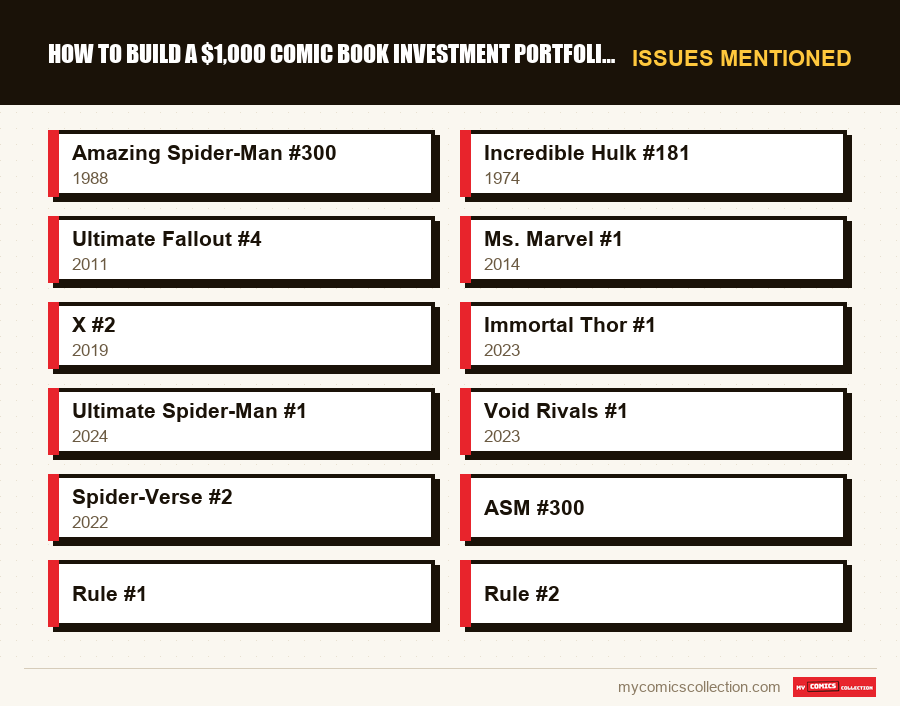
Sample $1,000 comic book portfolio for 2026
Here is a concrete portfolio built from 2026 market prices. Every book listed below can be found on eBay, MyComicShop, or at major conventions at the stated prices.
Blue chips: $400 (40%)
- Amazing Spider-Man #300 (1988, raw VF): ~$200. First full appearance of Venom. One of the most liquid Bronze/Copper Age keys on the market. Hold period: 3-5 years.
- Incredible Hulk #181 (1974, raw GD/VG): ~$200. First full Wolverine appearance. Even in lower grades this book has appreciated relentlessly for 20 years. Hold period: 5+ years.
Growth picks: $300 (30%)
- Ultimate Fallout #4 (2011, raw VF/NM): ~$120. First Miles Morales appearance. Miles is now a global franchise after the Spider-Verse films and the upcoming live-action debut is the next catalyst. Hold: 1-3 years.
- Ms. Marvel #1 (2014, raw NM): ~$80. First Kamala Khan solo series. The character is embedded in the MCU and demand keeps climbing. Hold: 2-4 years.
- House of X #2 (2019, raw NM): ~$100. The Moira reveal that redefined X-Men mythology. With X-Men entering the MCU, this book is positioned for a significant run. Hold: 1-3 years.
Speculation: $200 (20%)
- Immortal Thor #1 (2023, raw NM): ~$30. Al Ewing's run is being praised as a modern classic. If a future Thor project adapts this material, expect a quick double. Hold: 6-18 months.
- Ultimate Spider-Man #1 (2024, raw NM): ~$50. The Jonathan Hickman relaunch is generating enormous collector buzz. Scarcity of NM copies will increase with time. Hold: 1-2 years.
- Void Rivals #1 (2023, raw NM): ~$40. First appearance of the new Energon Universe by Robert Kirkman. If the franchise takes off, this is the gateway book. Hold: 1-2 years.
- Edge of Spider-Verse #2 (2022, raw NM): ~$80. First appearance of Spider-Punk (Hobie Brown redesign). Spider-Verse property keeps expanding. Hold: 1-2 years.
Grading budget: $100 (10%)
- CGC standard submission: ~$50-80 per book (including shipping). Grade your best raw candidate, likely the Ultimate Fallout #4 or the House of X #2 if they present well. A 9.8 slab on either book commands a significant premium over raw copies.
- Remaining $20-50: Mylar bags, acid-free boards, and a proper storage box for the rest of your raw books.
Total investment: $1,000. Nine comics spanning four decades, three publishers (Marvel, Image, Skybound), and four risk tiers. This is what a diversified comic investment strategy looks like.
Portfolio management: track, review, act
Buying the books is only half the job. A portfolio without tracking is just a stack of comics in a box. Here is how to manage it like an actual investment.
Log every acquisition immediately
The moment a book enters your collection, record it in My Comics Collection: title, issue number, grade, purchase price, date, and source. This creates the cost basis you need to calculate real returns later.
Set price targets before you buy
For each book, define a sell target and a stop-loss. Example: "I will sell ASM #300 if it hits $350, and I will cut losses if it drops below $140." Having these numbers written down prevents emotional decisions when the market moves.
Review quarterly
Every three months, check eBay sold listings and GPA Analytics for each book in your portfolio. Compare current market value to your cost basis. Identify which tier is outperforming and which is lagging. Rebalance if needed: if a speculation pick doubled, consider taking profits and rolling them into your blue chip tier.
Know when to sell
The best time to sell is when a catalyst peaks, not when it is announced. MCU announcements spike prices, but the peak usually hits 1-2 weeks before the film or series premiere, then corrects. If your growth pick doubles on an announcement, selling half and holding half is a proven strategy.
Track your comic portfolio value
Log each comic with its purchase price, grade, and date. My Comics Collection calculates your portfolio's total value and shows performance over time, so you always know where you stand.
Start tracking your portfolioFree
Risk management: five rules to protect your capital
Comics are an illiquid, unregulated market. That makes risk management more important here than in stocks or ETFs. Follow these five rules:
Rule #1: Never invest money you cannot afford to lose. If you need the $1,000 for rent, food, or an emergency fund, do not put it in comics. This is discretionary capital only.
Rule #2: Diversify across publishers. A portfolio of nothing but Marvel keys is exposed to a single risk factor: Disney's MCU roadmap. Add DC, Image, or indie books to spread that risk. Our sample portfolio includes Marvel, Image, and Skybound for exactly this reason.
Rule #3: Avoid hype cycles. When a book spikes 300% in a week because of a casting rumor, you are already too late. The money was made by whoever bought it six months ago. Chasing spikes is the fastest way to overpay for books that will correct.
Rule #4: Buy the book, not the slab. A CGC 9.8 label does not make a bad book a good investment. A common issue with no first appearance, no key status, and no cultural significance will not appreciate just because it has a 9.8 grade. Grade matters, but only after content and significance are established.
Rule #5: Store properly or lose money. A raw VF book left unbagged in a humid room will degrade to FN or lower in 1-2 years, wiping out 20-40% of its value. Mylar bags, acid-free boards, and climate-controlled storage are not optional for a portfolio. Budget $20-30 for supplies and treat it as part of your investment cost.
Frequently asked questions
Your portfolio, valued in real time
Never lose track of your investment. My Comics Collection tracks each issue, calculates total portfolio value, and shows performance over time so you know exactly when to hold and when to sell.
Start tracking your portfolioFree trial, Sign up in 30 seconds