Some comics have delivered returns that dwarf traditional investments. Amazing Fantasy #15 turned a $0.12 cover price into $3.6 million (a 3,000,000,000% gain). Even modern books like Ultimate Fallout #4 ($3.99 to $2,500+) have generated 60,000%+ returns in barely a decade. The common triggers: media adaptations, first appearances of breakout characters, and cultural shifts that turned niche books into mainstream grails.
Stocks, real estate, gold: these are the investments most people consider. But over the past two decades, a different asset class has quietly delivered some of the most dramatic returns in any market: comic books. While the S&P 500 has averaged roughly 10% annual returns since 1962, a handful of comics have appreciated by thousands, even millions, of percent over the same period.
This is not speculation. These are verified auction results from Heritage Auctions, ComicLink, and eBay, tracking real comic book value increases from cover price to final hammer price. Below are 10 case studies that show how comics gained value at rates no index fund could match, and, more importantly, what triggered each spike.
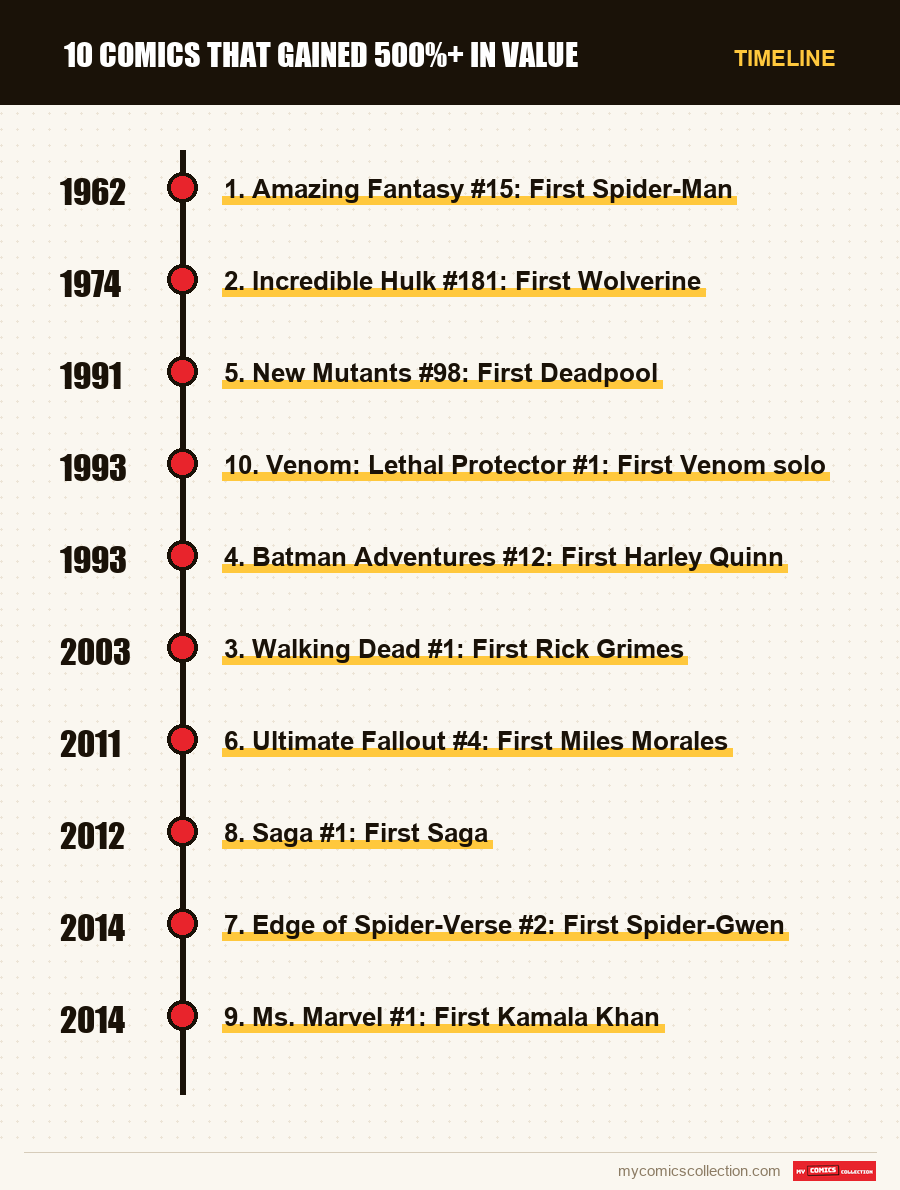
10 comics with extraordinary ROI: the data
1. Amazing Fantasy #15 (1962): First Spider-Man
Cover price: $0.12
Record sale: $3,600,000 (CGC 9.6, Heritage Auctions, 2022)
ROI: ~3,000,000,000%
What triggered the spike: Spider-Man's six decades of cultural dominance, amplified by the MCU film franchise and the animated Spider-Verse films. High-grade copies are among the rarest Golden/Silver Age comics in existence, and every new Spider-Man media event pushes demand higher. This is the single most profitable comic book investment in history.
2. Incredible Hulk #181 (1974): First Wolverine
Cover price: $0.25
Record sale: $30,000+ (CGC 9.8)
ROI: ~12,000,000%
What triggered the spike: Wolverine became the most popular X-Men character in history, fueled by the Hugh Jackman film franchise (2000-2024) and his MCU debut in Deadpool & Wolverine (2024). CGC 9.8 copies are scarce due to the book's notoriously fragile black cover, creating a supply ceiling that keeps prices elevated.
3. Walking Dead #1 (2003): First Rick Grimes
Cover price: $2.95
Current value: $10,000+ (CGC 9.8)
ROI: ~339,000%
What triggered the spike: AMC's The Walking Dead TV series (2010-2022) transformed this indie Image Comics title into a mainstream phenomenon. The show's massive ratings, combined with the book's small initial print run, created extreme scarcity in high grade. A textbook case of a media adaptation multiplying a comic's value.
4. Batman Adventures #12 (1993): First Harley Quinn
Cover price: $1.25
Current value: $4,000+ (CGC 9.8)
ROI: ~320,000%
What triggered the spike: Harley Quinn's leap from animated series character to A-list DC property drove this book from bargain-bin status to grail territory. Her starring roles in Suicide Squad , Birds of Prey, and a solo animated series created sustained demand. This is the most profitable comics investment from the 1990s.
5. New Mutants #98 (1991): First Deadpool
Cover price: $1.00
Current value: $3,000+ (CGC 9.8)
ROI: ~300,000%
What triggered the spike: Ryan Reynolds' Deadpool films (2016, 2018, 2024) turned a cult anti-hero into a billion-dollar franchise. Each film announcement triggered a price surge. The 2024 Deadpool & Wolverine crossover reignited demand yet again, proving that sustained film presence compounds comic book ROI.
6. Ultimate Fallout #4 (2011): First Miles Morales
Cover price: $3.99
Current value: $2,500+ (CGC 9.8)
ROI: ~62,600%
What triggered the spike: Sony's Spider-Man: Into the Spider-Verse (2018) and its sequel Across the Spider-Verse (2023) made Miles Morales a global icon. His presence in Marvel video games and the mainline comics solidified him as a permanent part of Spider-Man canon. This is the most profitable modern-era comic book.
7. Edge of Spider-Verse #2 (2014): First Spider-Gwen
Cover price: $3.99
Current value: $1,500+ (CGC 9.8)
ROI: ~37,500%
What triggered the spike: Spider-Gwen (Ghost-Spider) became an instant fan favorite, earning her own ongoing series and a co-starring role in the Spider-Verse animated films. Her iconic white-and-pink suit became one of the most popular cosplay designs in comics culture, driving consistent demand across multiple collector demographics.
8. Saga #1 (2012): First Saga
Cover price: $2.99
Current value: $800+ (CGC 9.8)
ROI: ~26,700%
What triggered the spike: Brian K. Vaughan and Fiona Staples' Saga became the most acclaimed creator-owned comic of its decade, winning multiple Eisner Awards. Persistent film/TV adaptation rumors and the series' return from hiatus in 2022 reignited collector interest. An example of critical reputation and scarcity driving value without a confirmed adaptation.
9. Ms. Marvel #1 (2014): First Kamala Khan
Cover price: $3.99
Current value: $500+ (CGC 9.8)
ROI: ~12,400%
What triggered the spike: Kamala Khan's Disney+ series Ms. Marvel (2022) and her role in The Marvels (2023) confirmed her as a core MCU character. As the first Muslim superhero to headline a Marvel comic, the book also benefits from cultural significance: a factor that creates long-term, non-speculative demand.
10. Venom: Lethal Protector #1 (1993): First Venom solo
Cover price: $1.75
Current value: $500+ (CGC 9.8)
ROI: ~28,500%
What triggered the spike: Sony's Venom film trilogy (2018, 2021, 2024) starring Tom Hardy established Venom as a standalone box-office draw. As Venom's first solo title, this book captures collector interest from both the Spider-Man and Venom fan bases. The high print run keeps mid-grade copies affordable, but CGC 9.8 copies command premiums.
Important note: All values cited above are approximate and based on publicly recorded sales from Heritage Auctions, eBay, and GoCollect as of early 2026. Comic book values fluctuate with market conditions. ROI percentages are calculated from original cover price to highest recorded sale at the grade indicated. Past performance does not guarantee future results.
What these 10 case studies teach us
Across all 10 comics, three patterns emerge that explain why certain books experience massive comic book value increases while others remain stagnant.
Pattern 1: Media adaptation is the strongest catalyst
Eight of the 10 comics above experienced their biggest price jumps within 12 months of a film or TV announcement. Walking Dead #1 was a $50 book before AMC's series was confirmed; Batman Adventures #12 sat at $20 before Suicide Squad casting news. Media adaptations don't just increase demand: they create entirely new buyer pools of non-collectors entering the market for the first time. If you want to identify the most profitable comics to invest in for 2026, tracking studio announcements is essential.
Pattern 2: Cultural significance creates durable value
Some comics hold value not because of a single event, but because of what they represent. Ms. Marvel #1 carries cultural weight as a milestone for Muslim representation. Ultimate Fallout #4 matters as the origin of Miles Morales, now a generational icon. These books resist the typical "buy the rumor, sell the news" cycle because their significance transcends any single adaptation.
Pattern 3: Scarcity in high grade amplifies everything
Every comic on this list is priced at CGC 9.8 for a reason. A Walking Dead #1 in CGC 6.0 sells for roughly $300: a fraction of the $10,000+ that a 9.8 commands. The CGC census reveals that only a small percentage of submissions achieve 9.8 or above, creating a scarcity premium that multiplies the effect of any demand catalyst. This is especially relevant for books with fragile covers like Incredible Hulk #181 (dark cover that shows every imperfection). For collectors looking at undervalued comics in 2026, finding raw copies in potential 9.8 condition remains the highest-leverage strategy.
How to track your own portfolio's ROI
Knowing that comics can gain extraordinary value is one thing. Tracking whether your collection is appreciating is another. Here is a practical approach:
- Record your purchase price and date for every book you buy. This is your cost basis.
- Track current market value using eBay sold listings, GoCollect, or the free valuation tool on My Comics Collection.
- Calculate ROI with the formula:
((Current Value: Purchase Price) / Purchase Price) x 100. - Use a dedicated collection management app like My Comics Collection to centralize your catalog with built-in valuation tracking. It saves hours of manual lookup and gives you a real-time snapshot of your collection's total worth.
For a complete methodology on building and tracking a comic book portfolio, see our full investment guide.
Frequently asked questions
Can modern comics still gain 500%+ in value?
Yes. Ultimate Fallout #4 (2011) and Edge of Spider-Verse #2 (2014) both achieved five-figure valuations within a decade of publication. The key is identifying first appearances of characters with strong multimedia potential before adaptations are announced. Modern books with small print runs and confirmed film/TV deals are the highest-probability candidates.
Do I need CGC grading to maximize my comic's ROI?
For most profitable comics, yes. CGC certification removes condition ambiguity, increases buyer confidence, and grants access to higher-value auction channels. A raw copy of New Mutants #98 in Near Mint condition might sell for $600-$800; the same book in a CGC 9.8 slab sells for $3,000+. The grading cost (~$50-$150 depending on tier) is usually recovered many times over on key issues.
What is the biggest risk when investing in comics for value?
Overpaying at the peak of hype. Many comics spike 200-400% on a film announcement, then retrace 30-50% once the initial excitement fades. The safest strategy is to buy before mainstream media coverage and hold through at least one full hype cycle. Diversification across different publishers, eras, and characters also reduces portfolio risk.
How do I find comics that might gain significant value in the future?
Focus on three factors: (1) first appearances of characters appearing in upcoming films, TV shows, or video games; (2) low CGC census counts at 9.8, indicating genuine scarcity; and (3) cultural relevance: characters that represent underserved demographics or have strong fan communities. Tracking studio announcements, patent filings, and casting news gives you an information edge over casual buyers.