
The best time to buy a comic is before everyone else realizes it matters. These 15 key issues -- all under $100 raw -- are sitting in dollar bins and convention boxes right now. First appearances of Gambit, Beta Ray Bill, Elektra, Taskmaster, and John Constantine at prices that won't last once their next screen adaptation drops. This is your 2026 shopping list for affordable key issues with real upside.
| Rank | Comic | Key Feature | Raw Price | CGC 9.8 Price |
|---|---|---|---|---|
| 01 | Wolverine #1 (1988) | First appearance of Patch | $15-30 | $180-250 |
| 02 | Batman #497 (1993) | Bane breaks Batman's back | $10-25 | $120-180 |
| 03 | Uncanny X-Men #266 (1990) | First appearance of Gambit | $30-60 | $350-500 |
| 04 | Thor #337 (1983) | First appearance of Beta Ray Bill | $25-50 | $400-600 |
| 05 | Marvel Super Heroes Secret Wars #8 (1984) | Black suit Spider-Man origin | $30-60 | $500-750 |
| 06 | Avengers #196 (1980) | First appearance of Taskmaster | $20-40 | $300-450 |
| 07 | Daredevil #168 (1981) | First appearance of Elektra | $25-50 | $600-900 |
| 08 | Iron Man #128 (1979) | "Demon in a Bottle" climax | $20-40 | $350-500 |
| 09 | Swamp Thing #37 (1985) | First appearance of John Constantine | $30-70 | $700-1,000 |
| 10 | Moon Knight #1 (1980) | First solo series | $25-50 | $400-600 |
| 11 | New Teen Titans #2 (1980) | First appearance of Deathstroke | $40-80 | $800-1,200 |
| 12 | Incredible Hulk #340 (1988) | Wolverine vs. Hulk (McFarlane cover) | $20-40 | $250-400 |
| 13 | What If...? #105 (1998) | First appearance of Spider-Girl | $15-30 | $200-350 |
| 14 | Punisher #1 (1987) | First solo ongoing series | $10-25 | $150-250 |
| 15 | Nova #1 (1976) | First appearance of Richard Rider | $25-50 | $500-800 |
Why "undervalued" is relative -- and why timing is everything
Every collector has a story about the one that got away. New Mutants #98 was a $3 book before the Deadpool movie was announced. Batman Adventures #12 was a forgotten animated tie-in before Harley Quinn became a cultural icon. The pattern is always the same: a key issue sits quietly for years, then a catalyst -- a movie, a show, a viral moment -- sends it vertical overnight.
In 2026, the landscape is packed with potential catalysts. The MCU Phase 6 slate is expanding into characters that were B-list five years ago. The DCU reboot under James Gunn is pulling deep from the source material. And the speculator herd is still chasing the same handful of overpriced books while genuinely important keys fly under the radar.
That is where this list comes in. These are not lottery tickets. These are cheap comics worth money -- established key issues with proven historical significance, currently priced well below where they should be relative to comparable books. The goal: identify the undervalued comics 2026 before the market corrects.
Disclaimer: Comic speculation carries risk. Prices listed are approximate based on recent eBay sold listings and marketplace data. Nothing here is financial advice. Always collect what you love first, speculate second.
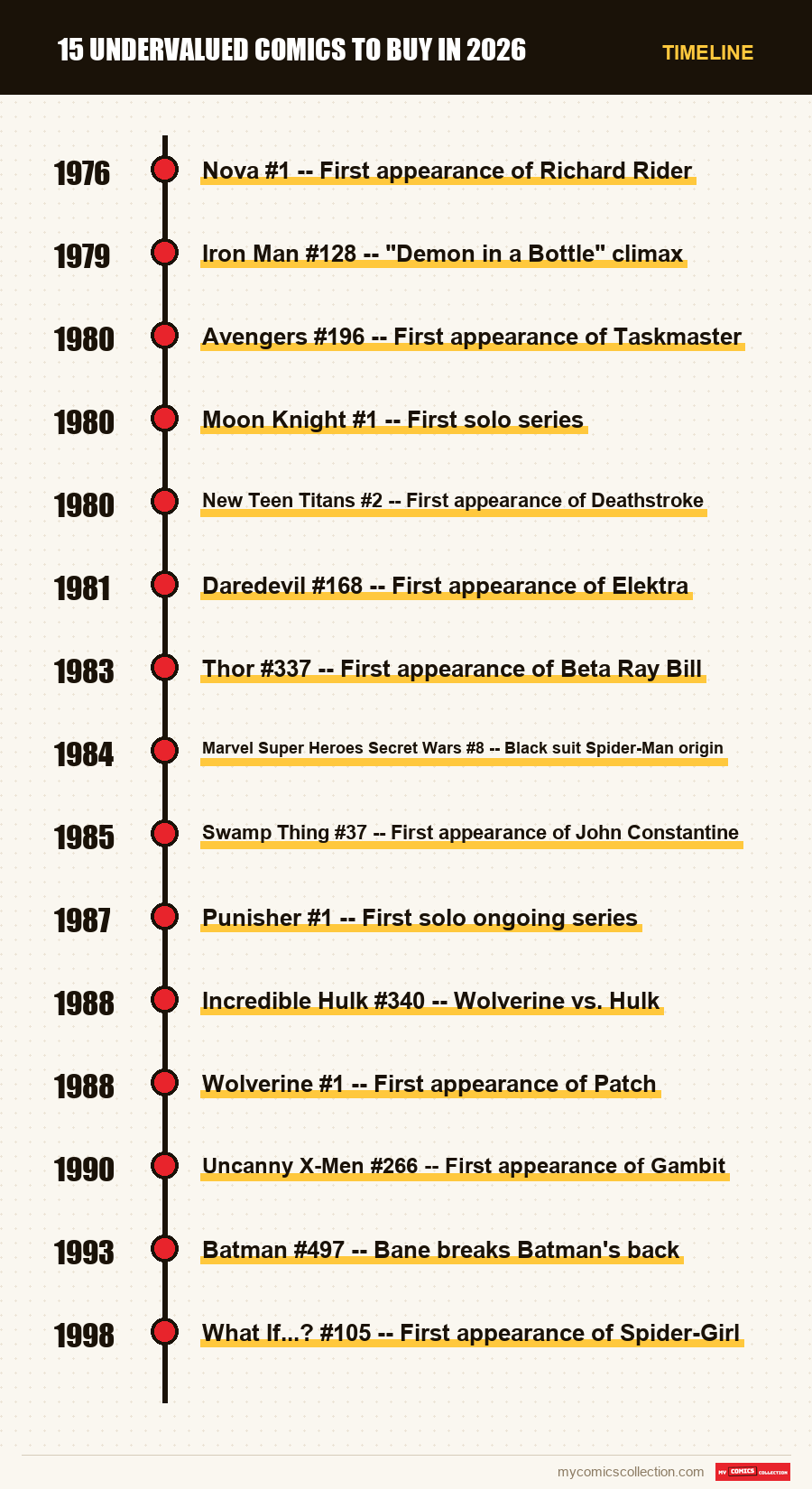
15 undervalued comics under $100 to buy now
Each pick below includes the current approximate price in raw (ungraded) condition, the CGC 9.8 price where applicable, and the upside catalyst that could send it higher. These are all comics under $50 worth buying in raw -- most are well under that threshold.
Wolverine #1 (1988) -- First appearance of Patch
Raw: $15-30 | CGC 9.8: $180-250The launch of Wolverine's first ongoing series, featuring his undercover "Patch" identity in Madripoor. Chris Claremont and John Buscema delivered a noir-flavored take on Logan that remains one of the character's defining eras. Raw copies in VF/NM are absurdly cheap for a #1 issue of one of Marvel's most popular characters.
Upside catalyst: Madripoor has already appeared in the MCU (Falcon and the Winter Soldier). With the X-Men franchise ramping up, a Wolverine solo project set in Madripoor would make this book a must-own overnight.
Batman #497 (1993) -- Bane breaks Batman's back
Raw: $10-25 | CGC 9.8: $120-180The iconic Knightfall moment -- Bane lifting Batman over his head and snapping his spine across his knee. This is one of the most recognizable single panels in comics history, yet the issue remains remarkably affordable. The 1990s print run was large, but demand for high-grade copies is steadily climbing.
Upside catalyst: Bane is a near-certainty for the Gunn DCU. Any casting announcement will send Knightfall-era books surging. This is the definitive Bane moment.
Uncanny X-Men #266 (1990) -- First appearance of Gambit
Raw: $30-60 | CGC 9.8: $350-500Remy LeBeau's debut remains one of the most sought-after Modern Age first appearances, yet it is still far cheaper than comparable keys like New Mutants #87 (Cable) or #98 (Deadpool) were at their peak. In raw VF condition, this book can still be found under $40.
Upside catalyst: Gambit's profile got a massive boost from Channing Tatum's long-delayed interest and his appearance in Deadpool & Wolverine. A confirmed solo project or X-Men team roster spot would push this well past $100 raw.
Thor #337 (1983) -- First appearance of Beta Ray Bill
Raw: $25-50 | CGC 9.8: $400-600Walter Simonson's legendary Thor run begins here with the introduction of Beta Ray Bill -- the first non-Asgardian worthy of lifting Mjolnir. This issue marks a turning point in Thor's mythology and remains one of the most important Bronze Age Marvel keys. The cover alone is iconic.
Upside catalyst: Beta Ray Bill has been teased in the MCU for years. His eventual live-action debut -- whether in a Thor sequel or an Avengers film -- would make this the hottest Bronze Age key on the market.
Marvel Super Heroes Secret Wars #8 (1984) -- Black suit Spider-Man origin
Raw: $30-60 | CGC 9.8: $500-750The issue where Spider-Man first bonds with the alien symbiote that would eventually become Venom. This is the origin story for one of Marvel's biggest franchises. Despite its significance, raw copies in good condition remain accessible. Compare this to Amazing Spider-Man #300 (first Venom), which commands several hundred dollars more.
Upside catalyst: The symbiote saga is far from over in both comics and film. Any new Venom or Spider-Man project that references the original bonding will spotlight this issue.
Avengers #196 (1980) -- First appearance of Taskmaster
Raw: $20-40 | CGC 9.8: $300-450Taskmaster -- the villain who can replicate any fighting style he observes -- debuted here and has become a fan-favorite character across comics, animation, and video games. His MCU appearance in Black Widow was underwhelming by most accounts, which actually depressed prices on this key. That is the opportunity.
Upside catalyst: A proper MCU Taskmaster portrayal -- unmasked, talking, menacing -- would rehabilitate the character and send this book soaring. The potential for a Thunderbolts appearance keeps this relevant.
Daredevil #168 (1981) -- First appearance of Elektra
Raw: $25-50 | CGC 9.8: $600-900Frank Miller's masterwork begins its ascent here with the introduction of Elektra Natchios. This issue is the gateway to one of the most important creator runs in comics history. Elektra has become a Marvel A-lister, and her MCU trajectory -- from Netflix to Daredevil: Born Again -- keeps building momentum.
Upside catalyst: Daredevil's MCU resurgence is driving demand for his entire supporting cast. Elektra's continued presence in the Disney+ series makes this a strong mid-term hold. See also our comics investment guide for more on how key issues appreciate.
Iron Man #128 (1979) -- "Demon in a Bottle" climax
Raw: $20-40 | CGC 9.8: $350-500The definitive Tony Stark story -- the issue where he confronts his alcoholism. This is not a first appearance; it is something rarer -- a defining character moment that transcends the hobby. "Demon in a Bottle" is referenced in virtually every modern Iron Man adaptation and remains one of the most acclaimed single-issue stories ever published.
Upside catalyst: Any future Iron Man project (reboot, animated series, legacy character) will inevitably draw from this story. Its cultural weight makes it undervalued at current prices.
Swamp Thing #37 (1985) -- First appearance of John Constantine
Raw: $30-70 | CGC 9.8: $700-1,000John Constantine -- the trench-coated, chain-smoking occult detective -- first appeared here in Alan Moore's legendary Swamp Thing run. Constantine has proven to be one of DC's most adaptable characters, with multiple TV and film versions. Yet his first appearance remains more affordable than you would expect for a character of his stature.
Upside catalyst: Constantine is a confirmed character in the Gunn DCU. A proper big-screen portrayal faithful to the comics would send this book into the stratosphere. The raw price has room to double.
Moon Knight #1 (1980) -- First solo series
Raw: $25-50 | CGC 9.8: $400-600Marc Spector's first ongoing series launched the character into the Marvel spotlight. While Werewolf by Night #32 (his true first appearance) commands premium prices, this #1 issue is the one that defined Moon Knight as a solo hero. The Disney+ series elevated the character's profile significantly.
Upside catalyst: A second season of Moon Knight or an MCU crossover appearance would push demand for all Moon Knight keys. This #1 is the most affordable entry point into the character.
New Teen Titans #2 (1980) -- First appearance of Deathstroke
Raw: $40-80 | CGC 9.8: $800-1,200Slade Wilson's debut is one of the most important DC villain first appearances of the Bronze Age. Deathstroke has become a multimedia powerhouse -- appearing in animated series, the Arrowverse, video games, and more. Despite all this, the issue remains accessible in raw condition compared to villain first appearances of similar stature.
Upside catalyst: Deathstroke is almost certainly in the pipeline for the Gunn DCU. A proper live-action portrayal by a major actor would make this the next Batman Adventures #12.
Incredible Hulk #340 (1988) -- Wolverine vs. Hulk (McFarlane)
Raw: $20-40 | CGC 9.8: $250-400Todd McFarlane's iconic cover of Wolverine reflected in Hulk's eye makes this one of the most visually striking issues of the 1980s. The Wolverine vs. Hulk rivalry is one of Marvel's greatest, and this issue captures it at its artistic peak. McFarlane keys from this era continue to gain collector attention.
Upside catalyst: A Wolverine vs. Hulk storyline in the MCU is something fans have demanded for years. If it happens, this cover will be everywhere -- and the price will reflect it.
What If...? #105 (1998) -- First appearance of Spider-Girl
Raw: $15-30 | CGC 9.8: $200-350May "Mayday" Parker -- the daughter of Peter Parker -- debuted in this What If...? issue and went on to anchor one of Marvel's longest-running female-led series. Spider-Girl represents a legacy character with enormous untapped potential, and her first appearance is still shockingly cheap.
Upside catalyst: Legacy characters are the future of the MCU. A Spider-Girl announcement -- even as part of an animated project -- would send this from a $20 book to a $100+ book instantly.
Punisher #1 (1987) -- First solo ongoing series
Raw: $10-25 | CGC 9.8: $150-250Frank Castle's first ongoing series launched after the success of his limited series and cemented him as a Marvel A-lister. The issue is widely available, which keeps prices low -- but availability does not equal lack of importance. This is the book that proved the Punisher could carry his own title.
Upside catalyst: The Punisher's MCU future remains uncertain but inevitable. Any confirmed project would lift all Punisher keys, and this #1 is the cheapest entry point. For more bargain hunting, see our guide to comics under $20 with real potential.
Nova #1 (1976) -- First appearance of Richard Rider
Raw: $25-50 | CGC 9.8: $500-800Richard Rider -- the original Nova -- debuted here in a series created by Marv Wolfman. Nova has been a cornerstone of Marvel's cosmic line for decades, and the Nova Corps have already appeared in the MCU's Guardians of the Galaxy films. Yet Richard Rider himself has never had his moment on screen.
Upside catalyst: A Nova project has been rumored at Marvel Studios for years. Richard Rider's debut would be the cosmic equivalent of Kamala Khan's -- and this book would respond accordingly.
Why these comics are undervalued
If these books are so important, why are they so cheap? The answer lies in market psychology and the way collectors -- especially newer ones -- allocate their budgets.
Herd mentality concentrates money on the same books
The speculator market tends to pile into a small number of consensus picks. When a YouTube personality or social media influencer highlights a book, the entire community chases it. This creates overvaluation on popular picks and undervaluation on everything else. The books on this list are overlooked not because they lack importance, but because they lack hype.
Print run bias
Many collectors assume that high print runs equal low value. Books from the late 1980s and early 1990s -- the so-called "speculation era" -- were printed in massive quantities, which depresses raw prices. But here is what the market often misses: high-grade copies are still scarce. A book with a million-copy print run might have only a few hundred copies graded 9.8 by CGC. The raw price reflects the total supply; the CGC price reflects the quality supply.
Screen-adaptation lag
The market reacts to announcements, not to potential. A book that could be relevant to a future film sits flat until the official announcement. The entire point of buying undervalued comics is to position yourself before that announcement. If you wait for confirmation, you are already too late.
Cross-publisher blind spots
Marvel keys get more attention than DC keys, and both get more attention than independent publisher keys. This creates systematic undervaluation for DC and indie books. Swamp Thing #37 (Constantine) and New Teen Titans #2 (Deathstroke) are prime examples -- both would be significantly more expensive if they were Marvel books. For a broader view of how to evaluate these opportunities, check our top 10 comics to invest in for 2026.
How to spot undervalued comics yourself: 4 strategies
This list is a snapshot. The real skill is learning to identify undervalued comics on your own. Here are four strategies that work consistently.
1. Track studio development pipelines
Follow entertainment industry news from sources like Deadline, The Hollywood Reporter, and Variety. When a character enters "development" -- before casting, before a release date -- that is your buying window. The market does not react to development news the way it reacts to trailers.
2. Compare relative pricing across similar keys
If the first appearance of Character A sells for $500 and the first appearance of Character B -- with comparable significance and print run -- sells for $50, that is a pricing anomaly worth investigating. Use tools like the My Comics Collection free estimator to quickly compare market values and track price movements across your collection.
3. Watch CGC census data
The CGC census tells you exactly how many copies of a book have been graded at each level. A book with a high raw supply but a low 9.8 census count is a candidate for grade scarcity -- meaning the CGC price could spike even while raw prices stay flat. This is where tools like the My Comics Collection app become essential for tracking your inventory against market data.
Pro tip: Sort your want list by the ratio of total print run to CGC 9.8 census count. Books with a ratio above 10,000:1 have genuine grade scarcity regardless of total print run.
4. Buy the "second-best" key in a character's history
Collectors fixate on true first appearances, which drives those prices up. But the second most important issue in a character's history -- often the first solo series, a defining storyline, or a major costume change -- tends to be dramatically cheaper. Iron Man #128, Incredible Hulk #340, and Batman #497 are all examples of "second-best" keys that punch well above their price point in terms of historical significance.
FAQ
Frequently asked questions
A cheap comic has no particular significance -- it is priced low because demand is low and there is no reason for it to increase. An undervalued comic is one where the current market price does not reflect its historical importance, character significance, or potential catalysts. First appearances of major characters, defining storylines, and keys by legendary creators that sell below comparable books are genuinely undervalued -- the market just has not caught up yet.
For books under $50 raw, buying raw and submitting to CGC yourself is usually the better strategy if you can identify high-grade copies. The grading fee plus the raw purchase price is often less than the CGC market price, giving you instant equity. However, if you are not confident in your grading skills, buying pre-graded at 9.6 or 9.8 locks in the grade and removes uncertainty.
The ideal hold period depends on the catalyst. If you are buying based on a rumored film adaptation, you may need to hold for 2-5 years until the project materializes. The best strategy is to buy and forget -- set a price alert using a collection management tool and revisit when the market moves. Trying to time the market precisely is how most speculators lose money.
Absolutely -- but selectively. The 1990s had massive print runs, which depressed most books' values. However, genuine key issues from the era -- first appearances, landmark storylines, and books by creators who became legends (McFarlane, Lee, Liefeld) -- still carry value, especially in high grade. The key is focusing on significance rather than speculation-era hype. Batman #497, Wolverine #1 (1988), and Punisher #1 (1987) are all examples of 1980s/1990s books with lasting importance.
Convention dollar bins remain the single best hunting ground -- dealers price books based on average demand, not individual significance, so key issues regularly end up in cheap boxes. Local comic shops with unsorted back-issue inventory are another goldmine. Online, eBay auction-format listings (not Buy It Now) often close below market value during off-peak hours. Estate sales and garage sales occasionally surface collections where the seller does not know what they have.