Long-term holds in comics historically outperform short-term speculation, but both strategies have a place in a collector-investor's toolkit. Key issues held for 10+ years have delivered 8-15% annualized returns, while movie-driven flips can yield 200-400% in months: with far greater risk of loss.
Comic book investing has matured dramatically over the past decade. What was once a niche hobby driven by nostalgia is now a legitimate alternative asset class, with auction records regularly making headlines and institutional interest growing. But the fundamental question facing every collector-investor remains: should you buy and hold for the long haul, or flip comics for quick profits? The answer depends on your capital, risk tolerance, and how deeply you understand the market.
Long-term holding: the case for patience
The long-term hold strategy treats comics like blue-chip stocks. You identify key issues with enduring significance: first appearances, iconic covers, landmark storylines: buy the best grade you can afford, and hold for years or decades. The historical data strongly supports this approach.
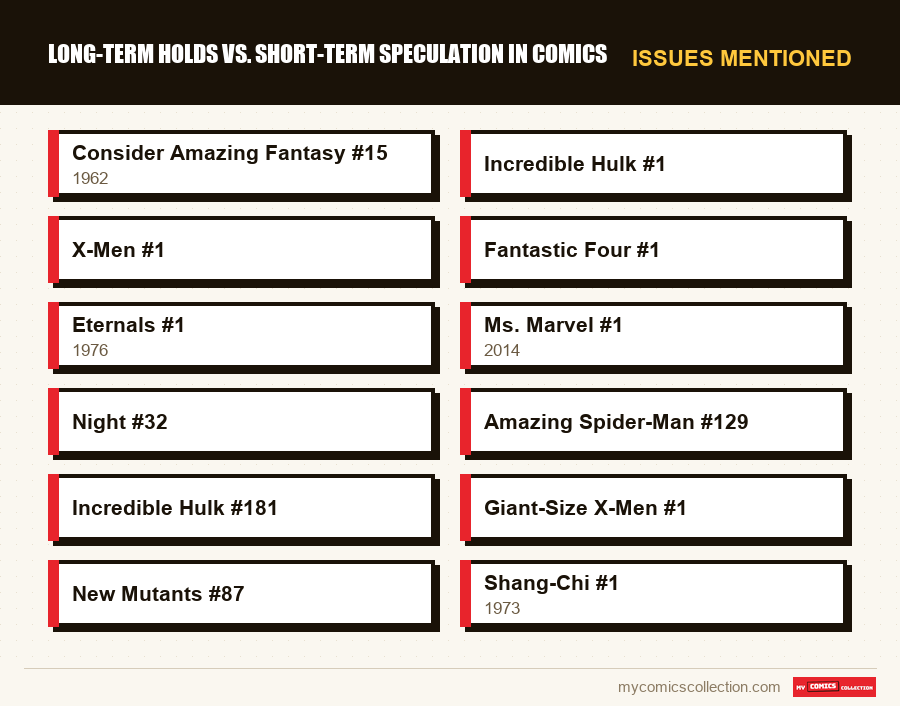
Consider Amazing Fantasy #15 (first Spider-Man, 1962). A CGC 6.0 copy sold for around $12,000 in 2005. By 2025, the same grade commands $80,000-$120,000. That represents roughly 12-15% annualized returns over two decades: outperforming the S&P 500 over the same period. Similar patterns hold across the major Silver Age keys: Incredible Hulk #1, X-Men #1, Fantastic Four #1.
- Compounding appreciation: Truly scarce, historically significant comics have appreciated consistently across every market cycle since the 1970s.
- Reduced transaction costs: Fewer buys and sells means fewer auction commissions (typically 15-20% buyer's premium plus seller's fees).
- Tax advantages: In many jurisdictions, long-term capital gains are taxed at lower rates than short-term profits.
- Lower stress: You are not chasing rumors or refreshing eBay listings every morning.
Short-term speculation: high risk, high reward
Short-term speculation, often called "spec buying" or "flipping", means buying comics based on upcoming catalysts (movie announcements, casting news, TV show rumors) and selling into the resulting hype spike. When it works, the returns are extraordinary.
How speculation cycles typically play out
The pattern is remarkably consistent. A rumor surfaces that a character will appear in an upcoming MCU or DCU project. Within days, the character's first appearance jumps in price. When the casting is confirmed, another spike. When the trailer drops, a third spike. Then, in most cases, the comic retraces significantly after the movie's release: sometimes dropping below pre-rumor levels.
- Eternals #1 (1976): Jumped from $50 to $400+ on movie announcement, then fell back to $100-150 after the film's tepid reception.
- Ms. Marvel #1 (2014): Rose from $20 to $300+ during Disney+ series hype, settled around $80-120 post-release.
- Werewolf by Night #32 (Moon Knight): Climbed from $800 to $4,000+ on Disney+ series news, now stabilized around $2,000-2,500.
The winners and losers of speculation
Short-term speculation rewards those who get in early and get out before the peak. The problem is that both timing points are nearly impossible to predict reliably. Most speculators buy after the initial spike (when the news is already public) and sell too late (after the hype has faded).
Research suggests that fewer than 20% of spec buys result in profitable exits after accounting for transaction costs (eBay fees, shipping, CGC grading costs). The winners tend to be people deeply embedded in industry networks who hear news before it becomes public: a significant informational disadvantage for casual investors.
Comparing ROI: real-world examples
Let us compare the two strategies using concrete examples over a 10-year window (2015-2025):
Long-term hold examples
- Amazing Spider-Man #129 (CGC 8.0): Purchased in 2015 for $1,200. Value in 2025: $3,500-$4,500. Annualized return: ~12-14%.
- Incredible Hulk #181 (CGC 7.0): Purchased in 2015 for $3,000. Value in 2025: $8,000-$10,000. Annualized return: ~10-13%.
- Giant-Size X-Men #1 (CGC 8.0): Purchased in 2015 for $1,500. Value in 2025: $3,000-$3,500. Annualized return: ~7-9%.
Short-term speculation examples
- Successful flip: New Mutants #87 (Cable): Bought at $30 in 2018 pre-Deadpool 2, sold at $120 during hype. Profit: $90 (200% return in 6 months).
- Failed flip: Shang-Chi #1 (1973): Bought at $400 during movie hype in 2021, now worth $150-200. Loss: 50-60%.
- Break-even: Ironheart (Invincible Iron Man #7): Bought at $80, sold at $90 after fees. Net result: essentially zero return.
The hybrid strategy: best of both worlds
The most successful comic book investors typically employ a hybrid approach that combines the stability of long-term holds with the upside potential of selective speculation.
The 70/20/10 allocation
- 70% in blue-chip keys: First appearances of major characters (Spider-Man, Wolverine, Batman villains) in the best grade you can afford. These are your core holdings that appreciate steadily.
- 20% in mid-tier opportunities: Comics with strong fundamentals (low print runs, significant first appearances) that have not yet been fully recognized by the market.
- 10% in speculative plays: Calculated bets on upcoming media adaptations, undervalued characters, or emerging trends. Only risk what you can afford to lose entirely.
Rules for the speculative portion
If you choose to speculate, follow these risk management principles:
- Set a sell target before you buy. If you want a 100% return, sell when you hit it: do not get greedy waiting for more.
- Never chase a comic that has already spiked. If news is public and prices have already doubled, the easy money is gone.
- Limit individual spec bets to 2-3% of your portfolio. No single speculation should threaten your overall collection value.
- Track your wins and losses honestly. Most people remember their winning flips and forget their losses, creating a distorted picture of their actual returns.
What makes a comic a strong long-term hold?
Not all comics are equal as long-term investments. The best candidates share specific characteristics:
- First appearance of an enduring character: Characters who have remained popular across multiple decades (not just one movie cycle) are the safest bets.
- Genuine scarcity: Low print runs, high attrition rates, and a limited number of high-grade copies in the census.
- Cultural significance: Comics that represent a turning point in the medium's history (Action Comics #1, Amazing Fantasy #15, Giant-Size X-Men #1).
- Cross-generational appeal: Characters that resonate with new generations of fans, not just nostalgic collectors.
- Strong CGC census fundamentals: A comic where high-grade copies are genuinely rare: not simply unsubmitted.
Common mistakes in both strategies
Long-term hold mistakes
- Overpaying at market peaks: Even great comics can be bad investments if you buy at the top of a hype cycle.
- Ignoring condition: A low-grade copy of a key issue rarely appreciates as fast as a mid-to-high grade copy.
- Emotional attachment: Refusing to sell a comic that has peaked because you "love the character" is an investing mistake.
Speculation mistakes
- Buying on rumor, holding through disappointment: When a movie flops or a show is canceled, spec comics can lose 70-80% of their peak value.
- Overconcentration: Putting too much capital into a single speculative bet.
- Ignoring transaction costs: eBay takes roughly 13%, PayPal another 3%, shipping costs $5-15. A comic needs to gain at least 20% before you break even.
Building a watchlist: comics to hold for the next decade
If you are committed to the long-term hold strategy, these are the categories of comics that historical data suggests will perform best over the next 10 years:
Tier 1: Proven blue-chip keys
- Silver Age Marvel first appearances: Amazing Fantasy #15, Incredible Hulk #1, X-Men #1, Fantastic Four #1, Avengers #1. These books have never experienced a sustained decline over any 10-year period.
- Golden Age DC pillars: Action Comics #1, Detective Comics #27, All Star Comics #8. Historical significance that transcends market cycles.
- Bronze Age breakout keys: Incredible Hulk #181, Giant-Size X-Men #1, Amazing Spider-Man #129. The backbone of modern collecting.
Tier 2: Undervalued holds with growth potential
- DC Silver Age keys relative to Marvel equivalents: Brave and the Bold #28 (first Justice League), Showcase #4 (first Barry Allen Flash), and Green Lantern #76 remain cheaper than comparable Marvel keys.
- Independent publisher cornerstones: Teenage Mutant Ninja Turtles #1 (first print), Bone #1 (Cartoon Books), Walking Dead #1. These have independent demand outside Marvel/DC cycles.
Tier 3: Modern keys with decade-long runway
- First appearances tied to MCU Phase 7+: Characters confirmed or strongly rumored for future phases whose comics have not yet fully priced in the media catalyst.
- Critically acclaimed runs: Saga #1, Immortal Hulk #1, House of X #1. Books from runs universally regarded as modern classics but whose prices remain accessible.
The role of CGC grading in long-term strategy
For long-term holds, CGC grading is not just about authentication: it is about physical preservation. A CGC slab creates a controlled environment that prevents the chemical degradation, physical damage, and environmental exposure that slowly erode a raw comic's condition over decades.
- Grade lock: Once slabbed, your comic's grade is fixed. A raw comic stored improperly can drop from VF to FN in 10 years, losing 30-40% of its value.
- Liquidity premium: CGC-graded comics sell 2-3x faster than raw equivalents. When it is time to exit, you want maximum liquidity.
- Insurance documentation: A CGC label provides objective proof of condition and value for insurance claims.
Frequently Asked Questions
Comics and stocks serve different roles. Top-tier key issues have historically delivered returns comparable to equities (8-15% annually), but comics are illiquid, require storage, and carry no dividends. They work best as a small allocation within a broader investment portfolio rather than a replacement for traditional investments.
For blue-chip key issues, a minimum of 5-10 years is ideal to smooth out market cycles and maximize appreciation. For speculative plays, you should have a clear exit target set before purchase: typically selling within 1-6 months of the catalyst event.
Most experienced collector-investors recommend limiting speculation to 10-15% of your total portfolio value. This allows you to participate in potential windfalls without risking your core holdings. Never speculate with money you cannot afford to lose.
Select Modern Age comics, particularly first appearances of characters who achieve lasting cultural relevance, can be excellent investments. However, the vast majority will not appreciate significantly due to high print runs and widespread speculation-driven hoarding. Focus on genuine first appearances with confirmed low print runs.
For comics valued above $100 in raw condition, CGC grading almost always makes economic sense. The authentication, preservation, and market confidence provided by a CGC slab typically adds 20-50% to a comic's value above the grading cost. For long-term holds, grading is especially important for preservation.