
Between 2016 and 2026, the comic book market underwent a historic transformation. Golden Age keys appreciated 150-300%, Silver Age keys gained 100-250%, and Bronze Age keys surged 80-200%. The market was supercharged by the MCU, the COVID-19 pandemic collecting boom, and mainstream acceptance of comics as alternative investments. However, the market also experienced a significant correction in 2022-2023 after pandemic-era speculation cooled.
Disclaimer: This information is provided for informational purposes only. My Comics Collection is not an investment advisor. Values vary based on condition, rarity, and market trends.
Understanding how comic book prices have moved over the past decade is essential for any collector or investor making decisions today. The 2016-2026 period was arguably the most eventful decade in comic collecting history -- marked by explosive growth, a speculative frenzy, a painful correction, and an ongoing recovery that has reshaped which books hold value and which were merely riding hype.
This analysis breaks down the decade year by year, examining price movements across the four major eras (Golden, Silver, Bronze, and Modern Age), identifying the forces that drove each phase, and drawing lessons for the next decade of comic investing.
2016-2019: The MCU Acceleration Phase
The comic market entering 2016 was already riding a multi-year uptrend powered by the Marvel Cinematic Universe. But the pace of appreciation was accelerating as each new MCU film introduced characters to a global audience of millions who had never read a comic.
Key market drivers 2016-2019
- MCU expansion -- Films featuring Black Panther, Captain Marvel, Doctor Strange, and Spider-Man (Homecoming) sent first appearance books soaring.
- Jungle Action #6 / Fantastic Four #52 -- Black Panther's first appearances surged 200-400% following the 2018 film's cultural phenomenon.
- Marvel Spotlight #5 (1st Ghost Rider) -- Rose from $200 to $600+ in CGC 7.0 as the character gained streaming interest.
- Growing institutional attention -- Major auction houses (Heritage, ComicConnect) reported record consignment volumes and hammer prices.
Average annual appreciation (2016-2019):
- Golden Age keys: 8-12% per year
- Silver Age keys: 10-15% per year
- Bronze Age keys: 12-20% per year
- Modern keys: 15-30% per year (highly volatile)
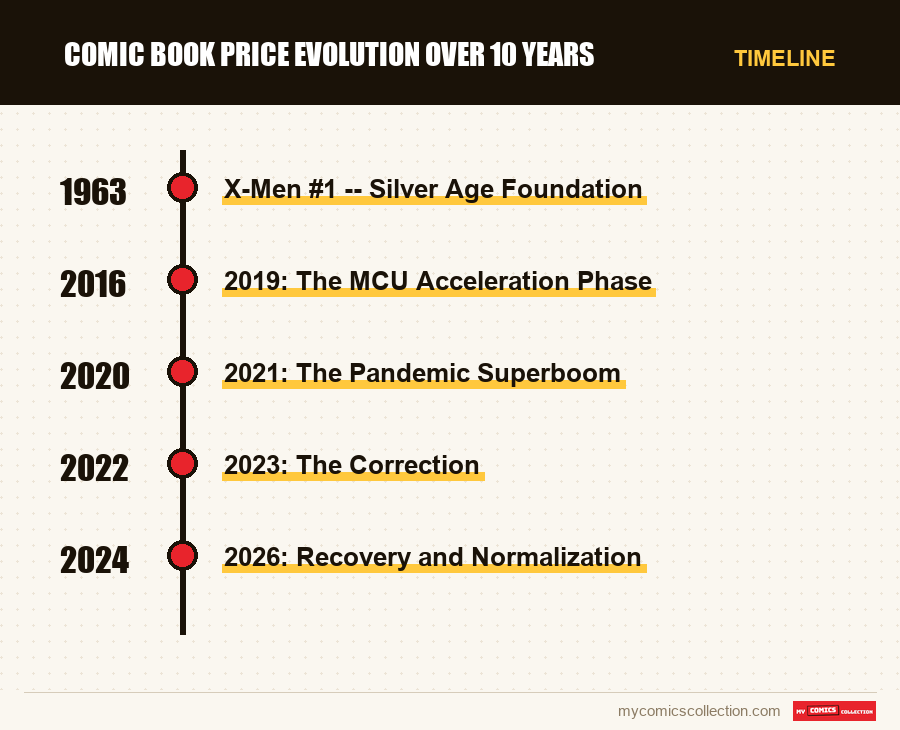
2020-2021: The Pandemic Superboom
The COVID-19 pandemic triggered the most explosive price surge in comic collecting history. A perfect storm of factors converged to create a speculative frenzy that dwarfed anything since the 1990s bubble -- though with one crucial difference: this time, much of the money flowed into genuinely scarce vintage keys rather than overprinted modern junk.
Why prices exploded
- Stimulus checks -- Direct government payments gave millions of Americans discretionary cash at a time when most forms of spending were restricted.
- Lockdown boredom -- People stuck at home rediscovered childhood collections, organized them, and started actively collecting again.
- Crypto wealth effect -- Cryptocurrency gains created a new class of affluent collectors willing to spend lavishly on grails.
- Social media hype -- YouTube channels, TikTok creators, and Instagram accounts dedicated to comic investing exploded in popularity, drawing non-collectors into the market.
- eBay accessibility -- Online marketplaces made buying and selling frictionless, expanding the buyer pool globally.
Notable price movements 2020-2021
- Amazing Fantasy #15 (CGC 9.0) -- Sold for $3.6 million in 2021, shattering previous records.
- Incredible Hulk #181 (CGC 9.8) -- Surged past $150,000.
- Amazing Spider-Man #300 (CGC 9.8) -- Jumped from $2,500 to $6,000+.
- Batman #1 (1940) (CGC 6.0) -- Exceeded $600,000 at auction.
Peak annual appreciation (2020-2021):
- Golden Age keys: 30-60% per year
- Silver Age keys: 40-80% per year
- Bronze Age keys: 50-100% per year
- Modern keys: 100-300%+ per year (extreme volatility)
2022-2023: The Correction
What goes up must come down -- at least partially. By mid-2022, the comic market began a correction that took many pandemic-era buyers by surprise. The forces that drove the boom either reversed or weakened, and prices across most categories pulled back significantly.
What triggered the correction
- Rising interest rates -- The Federal Reserve's aggressive rate hikes made traditional investments more attractive and reduced disposable income for discretionary spending.
- Crypto crash -- The collapse of cryptocurrency prices in 2022 evaporated the wealth effect that had driven many high-end purchases.
- Seller saturation -- Speculators who bought during the boom flooded the market with inventory, increasing supply without corresponding demand growth.
- MCU fatigue -- Critical and commercial underperformance of several Marvel projects reduced the media-driven hype cycle that had powered modern key speculation.
How far did prices fall?
- Modern keys (1990s-2010s) -- Dropped 30-50% from pandemic peaks. Speculative books with no fundamental demand fell 60-80%.
- Bronze Age keys -- Pulled back 20-35% from peaks, stabilizing well above pre-pandemic levels.
- Silver Age keys -- Declined 15-25% from absolute peaks, remaining 50-100%+ above 2019 levels.
- Golden Age keys -- Fell only 10-15% from peaks, demonstrating the strongest resilience across all eras.
Key insight: The correction hit hardest where speculation was most intense -- modern keys and books without deep historical significance. Genuine blue-chip keys from the Golden and Silver Age held their gains far better, confirming that scarcity and historical importance provide downside protection that hype alone cannot.
2024-2026: Recovery and Normalization
By late 2024, the comic market had largely digested the correction and entered a new phase characterized by more rational pricing, selective buying, and a return to fundamentals. Prices stabilized at levels significantly above pre-pandemic norms but well below the speculative peaks of 2021.
Current market characteristics (2025-2026)
- Selective strength -- Blue-chip keys are appreciating again at 5-10% annually. Speculative modern books remain flat or declining.
- Condition premium widening -- The gap between high-grade and low-grade copies of the same book has grown. Collectors are more discriminating about quality.
- X-Men catalyst -- Marvel Studios' X-Men plans are creating renewed interest in X-Men keys, with Giant-Size X-Men #1, X-Men #1 (1963), and Wolverine first appearances leading the recovery.
- International growth -- Non-US collector demand (particularly from Asia and Europe) is expanding the buyer pool for top-tier keys.
Lessons for the Next Decade
What the data tells us
- Blue chips always recover -- Action Comics #1, Detective Comics #27, Amazing Fantasy #15, and their peers have survived every correction since the 1960s and come out higher. Time horizon matters more than entry timing.
- Media speculation has a short shelf life -- MCU-driven price spikes typically peak within 2-4 weeks of an announcement and revert within 6-12 months unless the character achieves lasting cultural impact.
- Condition is becoming more important -- As the market matures, the premium for high-grade copies expands while low-grade copies stagnate. Invest in the best condition you can afford.
- Diversify across eras -- Portfolios concentrated in a single era underperformed diversified portfolios in every correction. Golden Age provides stability; Modern Age provides growth potential.
Tracking your portfolio's performance
A comic collection tracker that records purchase dates, prices paid, and current market values is essential for understanding your real returns after accounting for fees, grading costs, and inflation. Without tracking, most collectors dramatically overestimate their actual returns.
Individual Book Case Studies: 10-Year Price Histories
To illustrate how different types of keys behaved over the full decade, here are detailed price histories for five representative books across different eras and price tiers.
Amazing Spider-Man #300 (CGC 9.6) -- Modern Key
- 2016: $350-$400
- 2018: $500-$600 (Venom film announcement boost)
- 2020: $700-$900 (pre-pandemic appreciation)
- 2021 peak: $1,500-$1,800 (pandemic speculation peak)
- 2023 low: $800-$1,000 (post-correction bottom)
- 2026: $1,000-$1,200 (recovery and stabilization)
- Total 10-year return: approximately 200% (12% annualized)
Incredible Hulk #181 (CGC 7.0) -- Bronze Age Blue Chip
- 2016: $3,000-$3,500
- 2019: $5,000-$6,000 (steady appreciation)
- 2021 peak: $12,000-$15,000 (pandemic mania)
- 2023 low: $7,000-$8,500 (correction)
- 2026: $9,000-$11,000 (recovery, MCU Wolverine catalyst)
- Total 10-year return: approximately 200-215% (11.5-12% annualized)
X-Men #1 (1963, CGC 4.0) -- Silver Age Foundation
- 2016: $3,500-$4,500
- 2019: $5,500-$7,000 (Fox X-Men films)
- 2021 peak: $14,000-$18,000 (pandemic peak + MCU X-Men speculation)
- 2023 low: $9,000-$11,000 (correction)
- 2026: $11,000-$14,000 (MCU X-Men development catalyst)
- Total 10-year return: approximately 210% (12% annualized)
Conclusion: What the Next Decade Holds
The 2016-2026 decade was defined by the MCU's dominance as a price catalyst, the unprecedented pandemic boom, and the painful correction that followed. The next decade (2026-2036) will likely be shaped by different forces: the MCU's X-Men saga, the maturing Millennial collector demographic reaching peak wealth, continued international market expansion, and the growing recognition of comics as a legitimate alternative asset class alongside fine art and wine.
The collectors who will profit most over the next decade are those who learned from this one: buy quality over hype, diversify across eras, hold through corrections, and let time do the work.
Frequently Asked Questions
The pandemic-era bubble already burst in 2022-2023. Current prices reflect a post-correction market with more rational valuations. Blue-chip keys are trading at levels well above pre-pandemic norms but below speculative peaks. The biggest risk is in modern speculative books with no proven long-term demand -- those remain vulnerable to further declines.
Bronze Age keys (1970-1984) delivered the strongest total returns from 2016-2026, driven by relatively low starting prices, MCU character introductions, and strong collector nostalgia. Silver Age keys were a close second with more consistent appreciation and better downside protection during corrections.
Long-term trends strongly favor continued appreciation for genuinely scarce key issues. The supply of Golden and Silver Age keys is fixed and shrinking (through damage, loss, and absorption into permanent collections), while demand continues to grow globally. However, the pace of appreciation will likely normalize to 5-10% annually rather than the 30-100% seen during the pandemic boom.
From 2016-2026, the S&P 500 returned approximately 150% total (including dividends). Top-tier Silver and Golden Age keys matched or exceeded this, with many appreciating 200-300%. However, comics carry higher transaction costs, are less liquid, and require storage costs that stocks do not. The comparison is more nuanced than raw percentage returns suggest.